
“Automate 100% of your quality assurance” is popular advice. In a BPO, it can be dangerous.
A green dashboard doesn't prove that customers received the right outcome. It may only prove that a scoring model processed a large volume of interactions according to rules it already knows. The difficult work is finding the rare compliance failure, the sarcastic exchange, the confusing resolution, or the customer who accepted an answer but left dissatisfied.
Automated quality assurance creates value when it expands observation without pretending to eliminate judgment. The practical target is statistical scale, supported by human calibration, representative sampling, and metrics connected to customer experience. That distinction matters for every BPO operation managing multiple sites, languages, clients, and service-level agreements.
Table of Contents
- The Reality of Automated Quality Assurance
- How Quality Assurance Became an Enterprise Priority
- Designing Statistically Valid QA Frameworks
- Scaling Coverage with Speech Analytics
- Recognizing the Limits of Pure Automation
- Measuring ROI and Automation Maturity
- Building a Hybrid Quality Strategy
The Reality of Automated Quality Assurance
The first operational mistake is treating coverage as a quality outcome. A system can transcribe, classify, and score interactions at scale while still missing the reasons a customer struggled. Automation reviews more evidence, but it doesn't automatically understand every business context represented in that evidence.
Manual QA has an obvious limitation. Reviewers can examine only a fraction of interactions, so supervisors often work from a small and potentially unrepresentative sample. That creates blind spots, especially when serious defects are uncommon or concentrated in a particular queue, agent group, product, language, or escalation path.
Automation addresses the volume problem, not every interpretation problem. Speech analytics can identify silence, interruptions, prohibited phrases, sentiment shifts, and process steps. It can also flag conversations for human review. The value appears when the machine does the broad search and the reviewer investigates the meaning.
Operational rule: Use automation to decide what deserves attention. Don't let it decide that nothing deserves attention simply because the score is green.
The “100% automated coverage” promise also encourages the wrong management behavior. Leaders start optimizing the dashboard rather than the customer journey. Agents learn which phrases satisfy the scorecard, supervisors chase model exceptions, and quality teams confuse consistent scoring with accurate scoring.
A stronger BPO framework separates three questions:
- Did the system observe the interaction?
- Did it apply the rubric reliably?
- Did the result correspond with the customer's actual experience?
The first question is technical. The second is calibration. The third is operational and commercial. A useful program must answer all three, because clients care about compliance, repeat contacts, resolution quality, and customer sentiment, not merely the number of interactions processed.
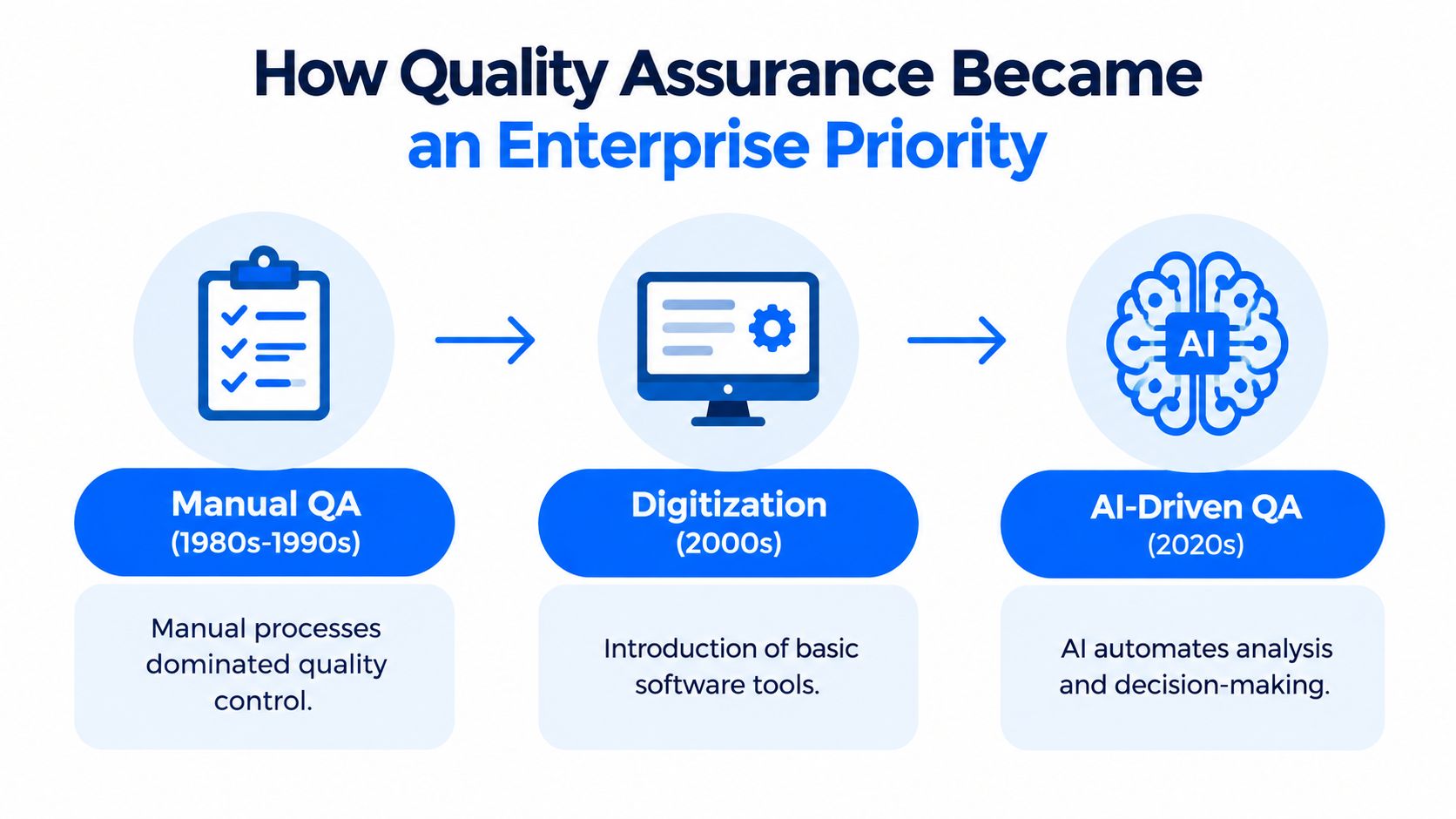
How Quality Assurance Became an Enterprise Priority
Quality assurance moved from a specialist engineering concern into a broader enterprise priority because delivery teams eventually encountered the limits of manual control. Software releases accelerated, customer journeys became more distributed across digital channels, and contact centers generated interaction volumes that traditional review teams couldn't inspect fully.
The 2020 World Quality Report captures the change clearly. 88% of respondents identified AI as the strongest growth area in their testing activities, while 86% considered AI a key criterion when selecting new QA solutions, according to the report summary published by Business Wire. Those figures show that AI had become more than an experimental tool. It had entered the buying criteria used by enterprise QA leaders.
The same source shows why enthusiasm didn't translate into effortless deployment. 68% said they already had the required automation tools, but only 63% said they had enough time to automate tests. The gap is familiar to BPO operations leaders: buying technology is easier than redesigning workflows, maintaining rules, training reviewers, validating data, and aligning several delivery sites around one quality model.
From tool acquisition to lifecycle integration
That combination of confidence and constraint marked an important transition. Organizations were no longer primarily asking whether QA should be automated. They were asking how automation could operate across the full testing lifecycle and fit broader delivery processes.
For software teams, that means connecting test suites with regression workflows and release controls. For BPOs, the equivalent is connecting interaction monitoring with coaching, compliance escalation, root-cause analysis, workforce planning, and client reporting. A score that sits in a QA platform without changing any operational decision is an expensive report, not an improvement system.
The enterprise priority also changed the definition of quality. It became less about isolated inspection and more about continuous evidence. Leaders wanted repeatable controls, shared visibility, and faster detection of risks across products, vendors, queues, and customer journeys.
What the history means for BPO leaders
A mature QA program therefore needs more than an AI feature. It needs an operating model that defines who owns the rubric, who approves model changes, how disagreements are resolved, and which signals trigger human investigation.
The early-2020s shift established the direction. Automation became mainstream, but implementation remained a people, process, and governance challenge. BPOs that treat it as a procurement exercise usually inherit another disconnected dashboard. BPOs that treat it as a quality operating system can use automation to make review broader, faster, and more comparable across sites.
Designing Statistically Valid QA Frameworks
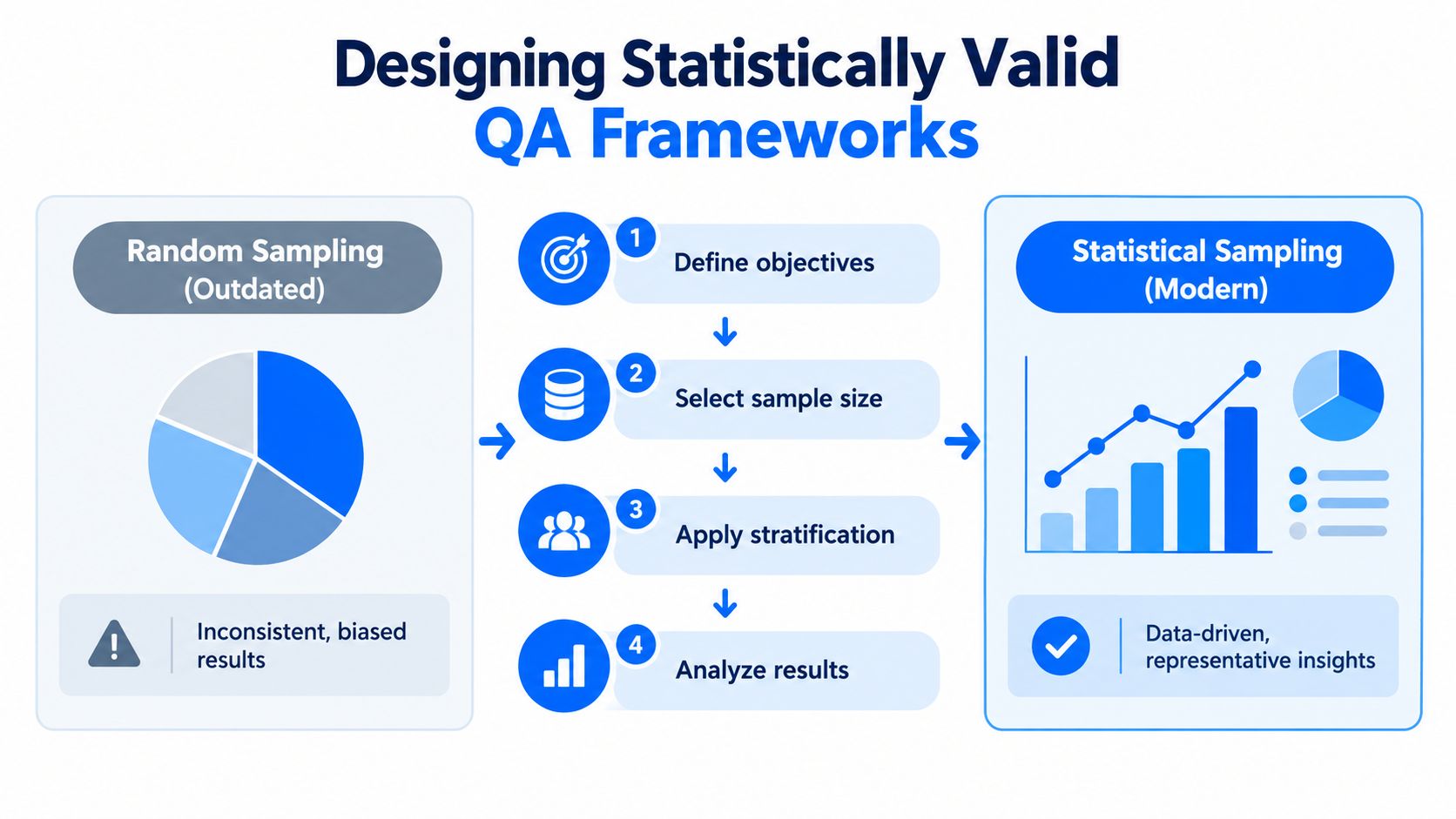
A QA framework starts with a sampling question, not a software question. You need to know which business decision the evidence will support. Is the objective compliance assurance, coaching, customer-experience diagnosis, scorecard calibration, or comparison across delivery sites? Each objective can require a different sample design.
Manual teams often select calls through convenience or simple randomness. That approach may produce a usable snapshot, but it can underrepresent important groups. A statistically valid design makes the population visible and deliberately includes the segments that could change the decision.
Build the sample around the risk
A practical design separates the interaction population into relevant strata, such as:
- Queue and journey: Sales, service, retention, complaints, and escalation calls shouldn't automatically share one sample.
- Agent and tenure: New hires, experienced agents, and agents with recent coaching may require different monitoring priorities.
- Language and site: Translation quality and local operating practices can affect scoring reliability.
- Outcome and risk: Repeat contacts, transfers, complaints, compliance triggers, and low survey responses deserve explicit treatment.
One benchmark approach evaluates 400 recorded calls and 400 post-call surveys, then compares results with more than 500 North American contact centers, using standardized CX, compliance, repeat-call, and transcription-quality measures, as described in the SQM Group auto-QA benchmark. The numbers are useful because they illustrate a structured design, not because every BPO should copy them without adjustment.
The benchmark pairs call review with post-call feedback. That pairing matters. A model may assign a strong process score to an interaction while the customer reports confusion, effort, or dissatisfaction. The divergence is not a nuisance to hide. It's a diagnostic signal that the rubric, the model, the process, or the customer journey needs investigation.
Connect scores to decisions
A sound framework translates observations into operational actions. Compliance findings can trigger immediate review. Repeated transfer patterns can inform process redesign. Sentiment changes can help identify where a script or policy produces friction. QA should therefore report not only average scores, but also distribution, exceptions, recurrence, and relationship to customer outcomes.
The benchmark approach emphasizes identifying error sources, predicting CSAT, and surfacing compliance gaps within a few business days. That makes it relevant to high-volume BPO environments, where manual review alone can't provide timely visibility across every interaction type.
Use the sales call center operating context to define the commercial outcomes your framework must protect. For sales, that may involve accurate qualification and compliant claims. For service, it may involve resolution quality and avoidance of repeat contact. The scorecard should follow the outcome, not dictate it.
A short explainer can help stakeholders understand why sample design changes the reliability of QA conclusions:
The best design is not the largest possible review. It's the smallest defensible sample that answers the operational question, combined with automated monitoring that can surface exceptions outside the formal sample.
Scaling Coverage with Speech Analytics
Speech analytics expands QA by turning conversations into analyzable evidence. The core capabilities are straightforward: transcription converts speech into text, diarization separates speakers, and scoring logic evaluates defined behaviors. The operational benefit comes from combining those capabilities with a workflow that tells people what to do with the result.
Manual review tends to produce depth without breadth. A reviewer can understand a conversation in context, but the team may inspect too few interactions to identify recurring patterns confidently. Automated analysis reverses the balance. It processes much more material, but human reviewers must verify whether the scoring reflects the interaction accurately.
Validate before you scale
The first deployment phase should establish a human gold standard. Select a representative set of interactions, have experienced reviewers score them independently, and compare the human assessments with the automated results. Don't use only easy calls. Include different accents, call types, outcomes, languages, emotional states, and known edge cases.
A speech-analytics deployment described in the RDI case study reports higher efficiency and accuracy, close correlation between manual and automated scores, and more actionable insights after analyzing more calls than manual QA. The practical lesson isn't that correlation removes the need for reviewers. It is that automation becomes credible when operators test it against a human reference and use the broader evidence base to improve calibration.
A workable operating cycle looks like this:
- Define the behavior precisely. “Shows empathy” is too broad unless the rubric identifies observable language or actions.
- Test the rule against representative interactions. Include correct, incorrect, ambiguous, and borderline examples.
- Review disagreement patterns. Repeated disagreement may indicate poor transcription, weak definitions, missing context, or human inconsistency.
- Set escalation thresholds. High-risk compliance events should receive a different response from low-confidence coaching signals.
- Recalibrate continuously. New products, policies, customer language, and fraud patterns can make old rules less reliable.
Measure evidence, not activity
The number of processed calls is a capacity measure. It isn't proof of value. Leaders should track whether broader analysis identifies defects earlier, whether supervisors receive usable coaching signals, whether recurring process failures reach the client, and whether automated scores remain aligned with human judgments.
Automation should also preserve the evidence behind a score. Reviewers need the relevant transcript segment, timestamp, detected behavior, confidence level, and customer context. Without that trail, an agent may receive a score but have no practical way to understand or challenge it.
A strong speech-analytics program therefore does two things at once. It increases monitoring breadth and narrows human attention to calibration, exceptions, and decisions with material customer or compliance consequences. That is how BPOs gain scale without surrendering accountability.
Recognizing the Limits of Pure Automation
Pure automation is strongest where the behavior is explicit, repetitive, and observable. It can check whether a required disclosure appeared, whether a verification step occurred, or whether a conversation contained a defined phrase. It becomes less reliable when meaning depends on context, timing, tone, history, or an unusual customer request.
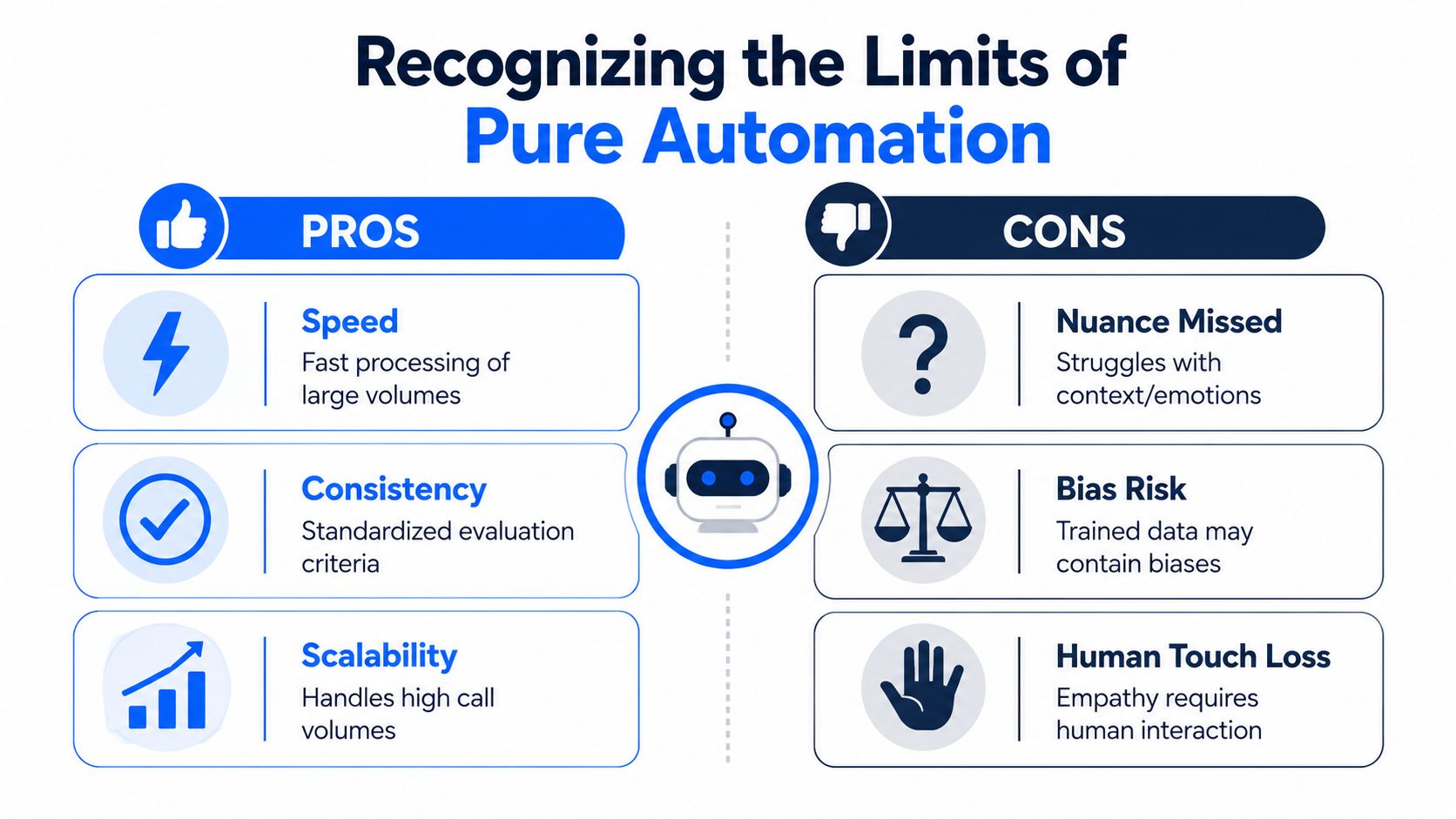
A model trained on historical interactions is naturally better at familiar patterns than novel ones. Historically rare scenarios may receive low priority because the system has limited examples. Sarcasm can look positive at the word level while sounding hostile to a human listener. A customer may say “fine” to end a frustrating conversation, and a literal classifier may interpret that as satisfaction.
Where human judgment remains essential
Human reviewers are particularly valuable in situations where the meaning isn't contained in a single phrase or event:
- Novel defects: New product failures and policy changes may not resemble the data used to design existing rules.
- Context-dependent conversations: A technically correct response can still be inappropriate for the customer's circumstances.
- Emotion and sarcasm: Tone, hesitation, pacing, and contradiction can change the meaning of the words.
- Low-signal interactions: Some of the most important risks appear as weak patterns spread across several steps.
- Model disagreement: Low-confidence or disputed scores deserve investigation rather than automatic acceptance.
The risk isn't limited to missed defects. Automation can create a false sense of security by passing large volumes of checks while overlooking usability problems, edge cases, and nuance that human review catches. A dashboard can look stable because the system is measuring the wrong thing consistently.
Assign people to the hard problems
The answer isn't to send every call back to manual QA. That recreates the capacity constraint that automation was meant to solve. Instead, use automation to route work by risk and uncertainty.
Reviewers can calibrate scorecards, investigate outliers, examine new interaction types, and coach agents on behaviors that require judgment. Quality leaders can study whether a model systematically misses certain accents, customer groups, products, or emotional patterns. Operations managers can use those findings to change processes rather than just penalize agents.
The market's move toward AI-assisted QA, real-time data-driven control, and hybrid workflows reflects this operational reality, as discussed in Quality Magazine's analysis of automation's next frontier. The right question isn't whether automation can replace manual QA. It's where automation is structurally weak and where human attention produces the greatest value.
Measuring ROI and Automation Maturity
ROI becomes difficult to defend when leaders measure only automation activity. Processed interactions, generated scores, and active rules show adoption, but they don't show whether the operation is making better decisions. A BPO needs to connect QA automation to review efficiency, defect detection, coaching quality, compliance protection, and customer outcomes.
The maturity picture is also uneven. The 2025 State of Testing report found that teams reporting no automation impact fell from 26% in 2023 to 14% in 2025, while teams saying automation replaced 75% or more of manual testing rose from 18% to 20%. The same report found that teams automated an average of 40% of testing and aimed for 63% automated testing by the next year.
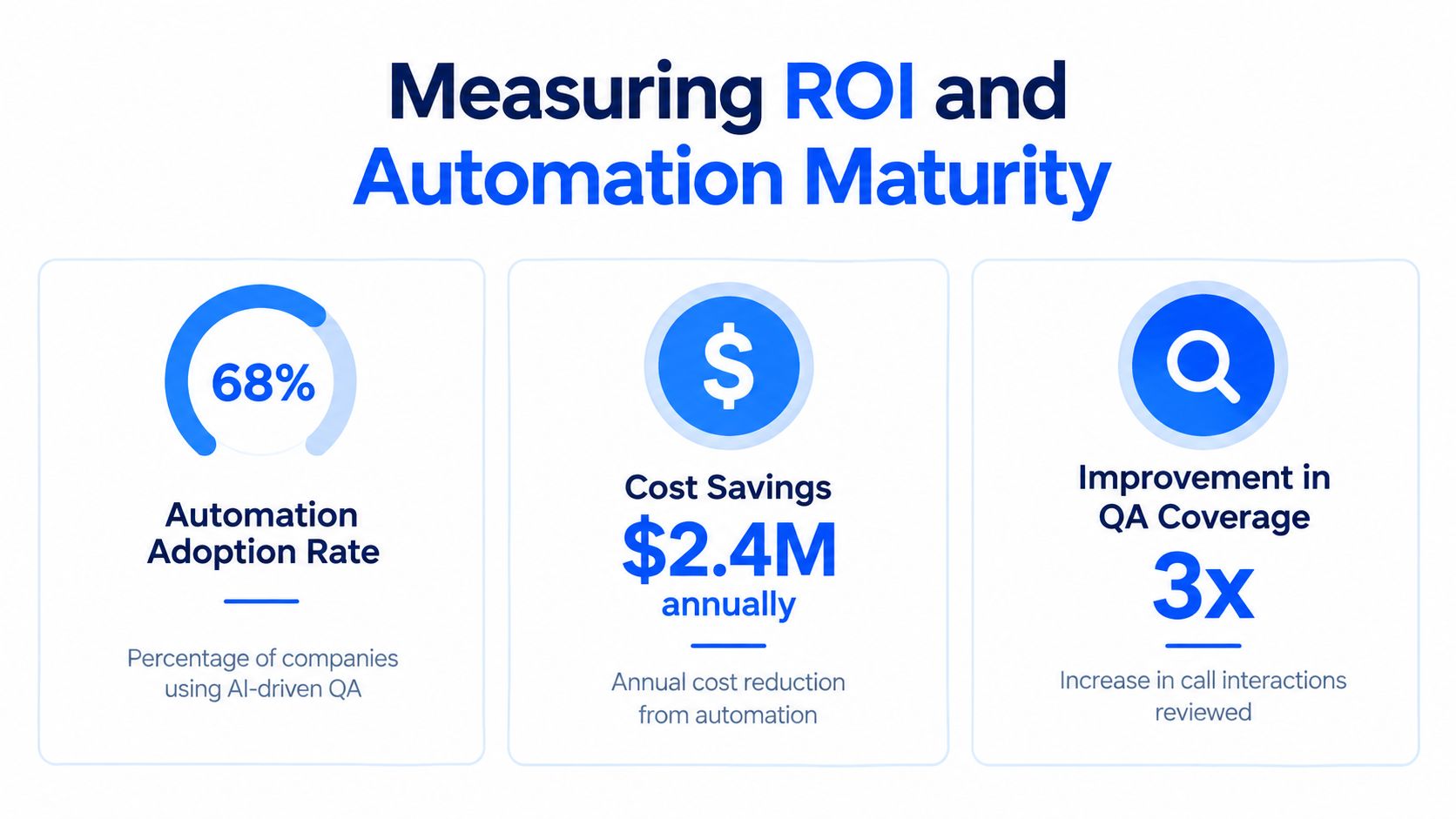
Those figures describe progress without implying full automation. Many teams still operate with a mixed model, and the report identifies breakages, data-quality problems, and skill gaps as constraints. For BPOs, that is a realistic benchmark: automation can shift the balance toward repeatable execution while human expertise remains necessary for exceptions and control.
Use a phased measurement model
Start with baseline measures before changing the workflow. Record how much reviewer time goes into selection, listening, scoring, dispute handling, and reporting. Then measure whether automation changes those activities without lowering score reliability.
A practical dashboard can include:
| Measurement area | What to examine |
|---|---|
| Coverage | Which queues, sites, languages, and interaction types are being analyzed? |
| Reliability | How closely do automated scores align with calibrated human scores? |
| Exception yield | Do flagged interactions contain genuine compliance, process, or CX issues? |
| Reviewer productivity | Are humans spending more time on interpretation and coaching than on search? |
| Business effect | Do findings influence repeat-contact reduction, resolution quality, compliance, or customer sentiment? |
Avoid treating “manual hours removed” as the only return. A program can reduce review effort and still fail if it sends inaccurate coaching signals or misses high-risk interactions. Conversely, a program that preserves human review for sensitive cases can create strong value by improving the quality of decisions rather than eliminating every task.
Plan for maintenance
Automation has a maintenance cost. Policies change, products change, customer vocabulary changes, and model behavior can drift. Assign ownership for rubric updates, sampling reviews, access controls, dispute resolution, and periodic human revalidation.
That governance work is part of ROI, not overhead. It protects the credibility of the scores that supervisors use, the reports clients receive, and the operational actions taken from automated findings.
Building a Hybrid Quality Strategy
A hybrid strategy is not a compromise between modern technology and outdated manual work. It's a deliberate allocation of strengths. Machines provide breadth, speed, consistency, and pattern detection. People provide interpretation, empathy, challenge, and judgment when the evidence is incomplete or unfamiliar.
The operating model should make that division explicit:
- Automation observes broadly. Transcribe and analyze interactions across the population or through a defensible sampling design.
- Rules prioritize attention. Route high-risk, low-confidence, unusual, and outcome-divergent interactions to reviewers.
- Humans calibrate the system. Compare scores with a representative gold standard and investigate recurring disagreement.
- Operations closes the loop. Turn findings into coaching, policy changes, process fixes, client reporting, and product feedback.
- Leaders inspect the outcome. Track customer experience, compliance, repeat contacts, resolution quality, and score reliability rather than dashboard volume alone.
This structure keeps quality visible. A green score remains a useful signal, but it isn't treated as proof that the customer journey worked. Reviewers still listen to the interactions that carry ambiguity, risk, or unusual context. Managers still challenge a model when its results conflict with customer feedback.
Vendor strategy matters too. An enterprise may compare internal delivery, specialist QA platforms, speech-analytics providers, and BPO partners. Decisions about offshoring versus nearshoring should include the QA operating model, language coverage, data governance, calibration capacity, and escalation design, not just labor economics.
AnyBPO can support provider discovery, due diligence, transformation planning, and leadership requirements through services including AnyMatch, AnyConsult, and AnyIntel. That kind of support is relevant when a BPO needs to assess partners for automation capability while preserving the human controls that protect CX.
The strongest program doesn't promise that every interaction will receive a perfect machine score. It builds a reliable evidence system in which automation finds patterns, humans interpret consequences, and leaders act before quality disappears behind attractive dashboards.
If you're evaluating QA automation across BPO sites, AnyBPO can help define requirements, assess suitable partners, and shape a practical transformation roadmap. Bring your current scorecard, sampling model, and operational constraints, then use AnyBPO's advisory and provider network to identify a hybrid approach that scales coverage without giving up human calibration.