
A 1,200-employee SaaS company is losing renewals because customers receive different answers depending on which time zone, channel, or team they reach. The VP of CX has enough budget to fix the problem, but not enough certainty to know whether to build an internal operation, outsource capacity, or combine both.
That decision isn't a software purchase. It determines who owns customer outcomes, who controls product knowledge, how quickly capacity can change, and who carries the risk when service fails. The right customer support center operating model starts with governance and accountability, then selects the people, channels, technology, and partners needed to deliver it.
Table of Contents
- Choosing the Right Operating Model
- Comparing In-House, Outsourced, and Hybrid Models
- Channel Strategy Across Voice, Digital, and Self-Service
- Building the Core Tech Stack
- Metrics That Actually Predict Performance
- Where AI Helps and Where It Hurts
- Governance, SLAs, and Vendor Management
- Designing a Customer Support Center That Holds Up
Choosing the Right Operating Model
Start by defining the support outcomes the business must protect. Renewal retention, technical resolution, regulatory compliance, customer trust, and global availability may all matter, but leadership must decide which outcomes have priority when they conflict. A team optimized for short interactions won't necessarily protect a complex enterprise renewal, and a team built for deep technical work may not handle seasonal demand efficiently.
The three operating paths are straightforward:
- In-house support keeps customer knowledge, management authority, and brand accountability inside the company.
- Outsourced support transfers defined operating capacity to a specialist provider, usually to gain speed, coverage, or variable capacity.
- Hybrid support reserves sensitive or complex work for internal teams while external partners handle repeatable demand, extended coverage, or selected channels.
Treat these as governance choices, not entries in a vendor catalog. Each path changes who writes the knowledge base, who approves policy exceptions, who coaches agents, and who answers when a customer experience damages revenue.
Use three questions before choosing
Where does brand-defining support happen? High-value complaints, churn-risk conversations, complex implementation questions, and sensitive account decisions usually need internal ownership. If the interaction requires judgment about the product roadmap or commercial relationship, keep the decision rights close to the business.
How quickly must capacity scale? Outsourcing can provide faster access to trained teams and broader coverage. In-house hiring gives stronger cultural control but requires forecasting, recruiting, training, and management capacity before demand arrives.
Which knowledge assets are too sensitive to externalize? Customer data, proprietary troubleshooting methods, pricing exceptions, security procedures, and regulated workflows may require tighter access controls or internal handling. The answer isn't always to keep every interaction inside. It may be to separate information by tier and task.
Operating principle: Choose the model that gives one accountable owner authority over the customer outcome, even when several teams deliver the work.
Write the decision into an operating charter. Name the owner, define which journeys remain internal, specify what a provider may decide without approval, and document how knowledge moves between teams. If you can't explain those rules on one page, you're not ready to select a model.
Comparing In-House, Outsourced, and Hybrid Models
The trade-off becomes clearer when the models are compared against the operating realities that create pressure. In-house teams generally build deeper product knowledge and stronger cultural alignment. Outsourced teams often launch faster and make it easier to provide extended coverage. Hybrid teams can place repeatable Tier 1 work with a partner while preserving internal expertise for Tier 2 and Tier 3 cases.
Cost requires particular discipline. Internal operations carry a larger fixed structure, including recruitment, management, training, facilities, and technology. Outsourcing creates a more variable cost structure, but the quoted interaction price rarely captures the full operating burden. Quality assurance, vendor management, knowledge transfer, rework, escalations, security reviews, and internal oversight all affect the cost of resolution.
| Dimension | In-House | Outsourced | Hybrid |
|---|---|---|---|
| Control over brand voice | Strongest direct control | Depends on training, QA, and governance | Strong for escalations, variable for frontline work |
| Cost structure | More fixed capacity and overhead | More variable capacity, plus oversight costs | Shared fixed and variable structure |
| Demand scalability | Slower to expand or contract | Fastest access to additional capacity | Flexible if routing and ownership are clear |
| Operational risk | Internal attrition, forecasting, and coverage risk | Vendor dependency, IP, compliance, and quality risk | Handoff failures and unclear accountability |
| Program launch speed | Usually slower | Usually faster | Moderate, with more design work upfront |
A hybrid model works only when the split follows customer intent, not an arbitrary staffing line. A partner might handle password resets, order updates, and basic troubleshooting, while internal specialists own account recovery, complex defects, regulated requests, and renewal-risk cases. The customer should experience one support operation, not two organizations negotiating responsibility.
Companies evaluating geography and partner location should also distinguish offshoring from nearshoring based on language, time-zone coverage, labor-market access, data controls, and escalation needs, rather than treating location as a simple cost lever. The offshoring versus nearshoring comparison is useful when those factors need to be made explicit.
Know where each model breaks
In-house operations fail when demand forecasting is weak and leaders build capacity for an expected volume that never arrives. They also struggle when the business needs continuous coverage but can't sustain the required hiring and management rhythm.
Outsourced operations fail when product complexity is high, documentation is poor, or the provider has no authority to resolve exceptions. A provider can't compensate for unclear policy ownership.
Hybrid operations fail when the customer moves between tiers and nobody owns the complete case. Use one case record, one escalation policy, and one executive owner. Otherwise, hybrid becomes a convenient label for fragmented service.
Channel Strategy Across Voice, Digital, and Self-Service
Channel strategy is a routing problem. Customers don't care whether voice, email, chat, social messaging, or self-service belongs to a separate department. They care whether the next interaction contains enough context to move the issue forward.
Voice should carry the work that needs empathy, judgment, or urgency. Complaints, billing disputes, churn-risk conversations, security concerns, and emotionally charged failures are poor candidates for rigid automation. Email and ticket queues suit structured follow-up, documentation, and cases that require investigation. Live chat and messaging occupy the fast middle, but agents often have less context and less time to diagnose complex issues.
Social support needs its own playbook. Public replies protect reputation, but the actual resolution usually belongs in a private case flow. The social team needs rules for authentication, escalation, tone, and handoff. A public response that says little more than “please contact support” can make the company appear evasive if the private process then forces the customer to start again.
Design the handoff, not just the channel
Every channel should pass four things forward:
- Identity: Who is the customer, and what authorization has been completed?
- Context: What has already happened, including prior troubleshooting and promises?
- Intent: What outcome does the customer need?
- Case state: What is pending, who owns it, and when is the next action due?
A customer who starts in chat, escalates to voice, and follows up by email should see continuity. The agent should see the transcript, account history, intent classification, commitments, and unresolved tasks. If each channel uses a separate queue or case number, the business has created a transfer problem disguised as omnichannel service.
Self-service can absorb routine demand, but only when customers can find accurate answers in the language and terminology they use. A help center, IVR flow, community forum, or guided chatbot should lead to a human without trapping the customer in a loop. Track whether self-service resolves the issue end to end, not just whether the customer stopped clicking.
Building the Core Tech Stack
A support operation needs five technology layers. The names of the products matter less than the job each layer performs and the way information moves between them.
- ACD or routing engine: Sends each contact to the right queue, skill group, language team, or escalation path. Routing should use intent, customer value, urgency, authentication state, and agent capability where appropriate.
- CRM as the record of truth: Holds customer identity, history, entitlement, prior cases, commitments, and relevant commercial context. The CRM must support the complete case, not just store a contact record.
- Workforce management: Forecasts demand, plans schedules, accounts for shrinkage, and shows where coverage will fail. A schedule that ignores training, meetings, absence, and after-contact work isn't a real capacity plan.
- Knowledge base: Gives agents and customers verified answers. It needs ownership, review dates, article feedback, search analytics, and clear rules for retiring outdated guidance.
- Analytics and QA: Measures service quality, resolution, effort, repeat contacts, and policy adherence, then feeds the findings into coaching and product improvement.
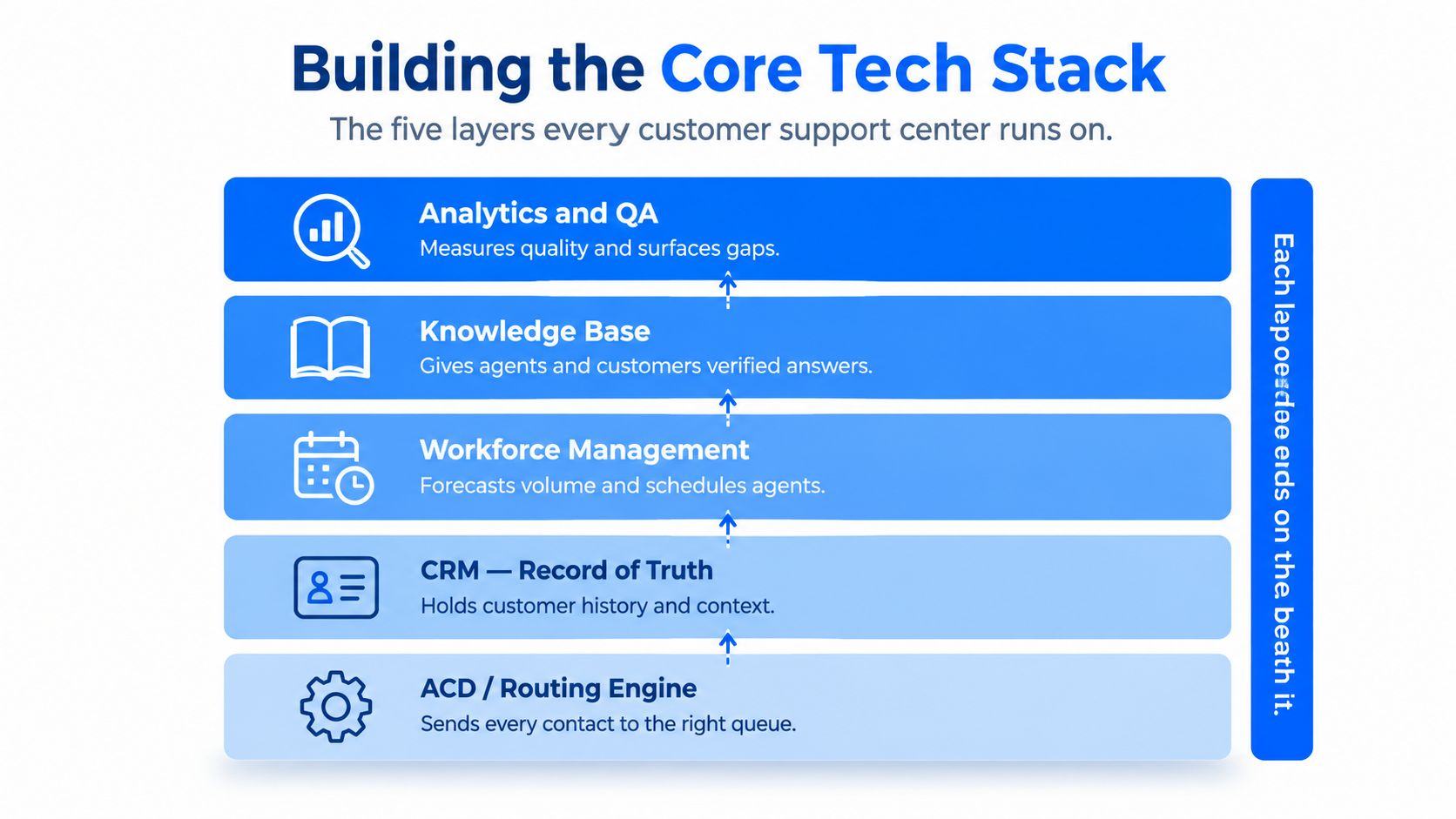
Integration is the dividing line between a stack and a collection of applications. The CRM should trigger an ACD screen-pop. The agent desktop should surface relevant knowledge without forcing a second search. Workforce forecasts should reflect actual arrival patterns and handling work. Analytics should connect QA findings to intents, queues, products, and training plans.
Cloud-native platforms have made it easier to buy these capabilities as connected services, while on-premise systems can remain defensible where data residency, latency, legacy integration, or regulatory controls demand them. Don't choose architecture by fashion. Choose it against the security, continuity, and change requirements of the operation.
Supervisor test: Can a supervisor trace one interaction from channel entry to resolution, including every transfer and system touchpoint, in under five minutes?
If the answer is no, agents are probably doing swivel-chair work and supervisors are investigating performance through incomplete evidence.
Metrics That Actually Predict Performance
A support dashboard should distinguish customer outcomes from agent activity. CSAT captures satisfaction with a specific interaction. First-contact resolution tests whether the issue was solved without unnecessary follow-up. Average handle time, or AHT, combines talk time, hold time, and after-call work, making it one of the most useful operational benchmarks. Escalation rate shows how often frontline work moves to another level, but it doesn't explain whether that movement was appropriate.
Across large benchmark compilations, a common AHT planning range is about 5 to 8 minutes, with some compilations citing 6 minutes and 3 seconds as a broad benchmark, 4 to 7 minutes for simpler queues, and roughly 10 minutes for complex technical support. These ranges should guide segmentation, not become individual agent quotas. See the customer support AHT benchmark guidance for the operational relationship between handle time, knowledge access, routing, and wrap-up work.
| Metric | What It Measures | How It Gets Gamed | Predictive Value |
|---|---|---|---|
| CSAT | Reported satisfaction after an interaction | Low response volume or surveys sent only to easy cases | Useful when segmented by intent, channel, and complexity |
| First-contact resolution | Resolution without a follow-up contact | Closing cases early or discouraging reopening | Strong when paired with repeat-contact tracking |
| AHT | Total handling effort for a contact | Rushed conversations, transfers, or incomplete notes | Useful by intent, not as a universal target |
| Escalation rate | Movement to a higher support tier | Warm transfers or informal help that isn't logged | Valuable when reviewed with severity and outcomes |
An effective scorecard weights FCR against repeat-contact rate within a defined follow-up window. It also ties CSAT to ticket complexity and segments AHT by intent. A short interaction that generates another contact isn't efficient. A longer interaction that prevents recurrence may be the better operating result.
The source of truth sits downstream. Review retention, renewal behavior, and lifetime value monthly to test whether the operational metrics predict commercial outcomes. Review queues, service levels, QA themes, and repeat contacts weekly so managers can intervene before those lagging indicators move.
Sales and support leaders should also agree on the boundary between service recovery, expansion, and revenue ownership. A sales call center operating model can clarify that boundary, but support shouldn't be judged as a sales channel unless its mandate, training, and customer protections are explicit.
Where AI Helps and Where It Hurts
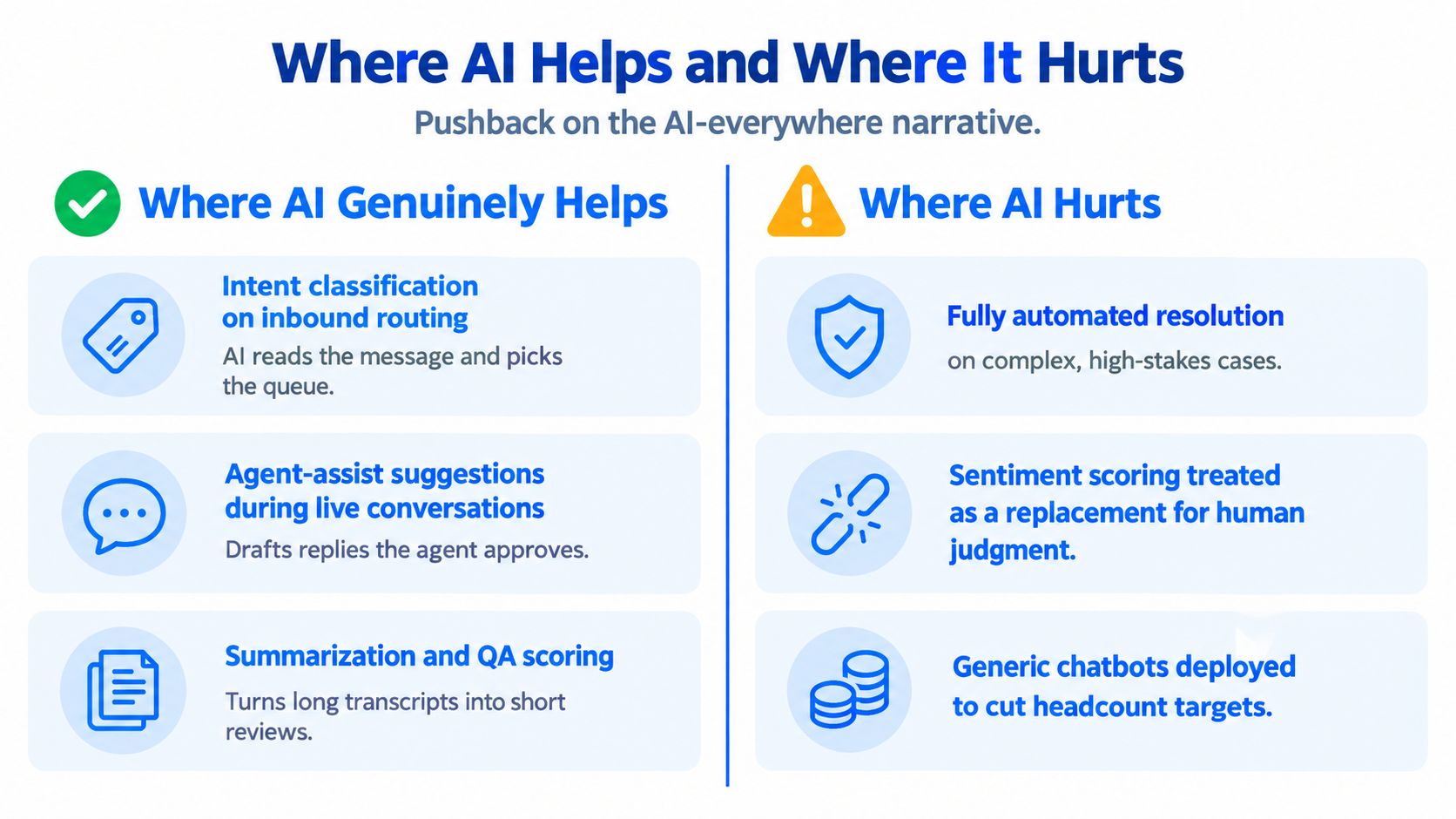
AI is useful in support when it removes low-value work without removing accountability. It can classify inbound intent, suggest responses during a live interaction, summarize a conversation, and surface relevant knowledge. Those applications assist an agent who remains responsible for accuracy and judgment.
The wider market is moving faster than customer confidence. Deloitte's 2026 global contact center survey reports that 35% of contact centers already use agentic AI, while more than half of consumers said service quality stayed the same or worsened in 2025. The same research reports that organizations with mature AI had 85% greater profitability than low-maturity peers. The lesson isn't to reject AI. It's to separate operational productivity from customer outcome.
Put a hard boundary around automation
AI helps when the task has a clear intent, a verified answer, and a safe recovery path. Intent classification can route an account-access request to the right queue. Agent assist can draft a response for approval. Summarization can reduce wrap-up work and give QA teams a consistent review starting point.
AI hurts when it becomes a barrier between the customer and the person who can solve the problem. Deflection bots that loop through irrelevant articles increase effort. Voice biometrics can create access friction for customers whose speech differs from the system's training assumptions. Generated replies can state policy details that no agent has confirmed.
Qualtrics found that 61% of consumers prefer human channels for completing tasks and 74% prefer human channels for technical support, while only 20% of agents were actively using AI to resolve issues. The same research describes a difficult operating environment in which 61% of contact centers face more difficult conversations even as 98% report some AI use. These findings support a practical design rule, not an AI ban.
Every deployment needs a human fallback, a published accuracy floor, and a measure of containment versus resolution. AI is a productivity layer for agents. It isn't a substitute for account ownership on hard cases.
Governance, SLAs, and Vendor Management
Governance becomes real when it appears in operating documents. Start with service-level agreements that define response and resolution expectations by channel, severity, customer tier, and support level. A missed target should trigger an action, such as an escalation, service credit, corrective plan, or executive review. An SLA without a consequence is a forecast, not an agreement.
Escalation paths need named owners. Define the handoff from L1 to L2 and L3, then create separate lanes for engineering, security, legal, and compliance issues. Each handoff should include required evidence, a time-bound acceptance, the next customer update, and the person accountable for closure. Don't make the customer carry information between tiers.
Make the scorecard operational
A vendor scorecard should combine customer outcomes, quality, operational reliability, and control compliance. Avoid letting volume or cost dominate the review. A low interaction price has little value if rework, repeat contacts, poor documentation, or escalations consume the savings.
| Dimension | Weight | Review Cadence |
|---|---|---|
| Quality and policy adherence | Defined by business risk | Weekly operational review, monthly governance review |
| CSAT and customer effort | Defined by journey importance | Weekly trend review, monthly analysis |
| First-contact resolution and repeat contacts | Defined by intent complexity | Weekly monitoring, monthly root-cause review |
| SLA performance and staffing | Defined by channel and severity | Daily monitoring, monthly business review |
| Security, privacy, and compliance | Non-negotiable control threshold | Continuous monitoring, quarterly audit |
| Improvement delivery | Agreed roadmap contribution | Monthly review, quarterly planning |
The exact weight should reflect the journey. A regulated support queue may prioritize compliance and accuracy above speed. A simple transactional queue may place more emphasis on availability and response time. Document the rationale so the scorecard doesn't become a negotiation exercise every month.
Security governance should cover role-based access, payment-card scope, privacy obligations, recording and retention policies, incident notification, subcontractor controls, and audit rights. When selecting a BPO provider for customer support operations, require evidence that the provider can operate inside those controls, not just a promise that it has experience.
Set a review rhythm
Run weekly standups on active defects, queue health, staffing gaps, and customer-impacting incidents. Hold monthly root-cause reviews on repeat contacts and knowledge failures. Use quarterly performance audits to test quality, security, documentation, and resilience. Revisit the platform and operating model annually, or sooner when volume, product complexity, channel mix, or AI usage changes materially.
A hybrid or outsourced program is defensible only when governance connects the external team to the internal outcome owner.
Designing a Customer Support Center That Holds Up
The durable design sequence is simple, but leaders often reverse it. They buy a platform first, add channels second, and only later ask who owns the customer result. Start with the outcome, then choose the operating model, channel strategy, technology, metrics, and governance that support it.
- Define outcome ownership. Name the executive accountable for resolution quality, customer trust, and commercial impact.
- Choose the model. Use in-house capacity where judgment, knowledge sensitivity, or relationship ownership dominates. Use partners where scale, coverage, or speed matters. Blend the two only with explicit boundaries.
- Map customer journeys to channels. Put empathy-heavy and high-risk work where trained humans can own it. Use digital and self-service for appropriate, well-documented intents.
- Integrate the stack. Make routing, CRM context, workforce planning, knowledge, and QA operate as one evidence chain.
- Measure outcomes. Pair CSAT, FCR, AHT, and escalation data with repeat contacts, retention, and lifetime value. Don't reward activity that damages resolution.
- Govern the system. Set owners, SLAs, escalation lanes, security controls, scorecards, and review cadences before launch.
AI belongs inside defined journeys with tested fallbacks, not above the operating model. Leadership should revisit the design whenever customer demand, issue complexity, or channel behavior shifts. A support center holds up when the company owns the outcome, partners are accountable to the same evidence, and customers never have to understand the internal org chart to get help.
AnyBPO helps enterprise teams define support requirements, compare operating models, and identify suitable BPO and human-hybrid partners through independent advisory and AI-powered matching across its audited provider network. Visit AnyBPO to evaluate customer support partners against governance, coverage, technology, and outcome ownership needs.