

The most popular advice about executive hiring is also the least useful: compare retained and contingency fees, then choose the cheaper route. That treats a senior appointment like a sourcing purchase. It isn't. The real purchase is protection against a leadership decision that weakens strategy, destabilizes a team, compromises succession, or becomes embarrassing to reverse.
Executive retained search earns its premium when the role carries consequences beyond the vacancy itself. A board hiring a CEO, a founder appointing a first CFO, or an enterprise selecting a BPO operating leader isn't looking for an impressive résumé. They need a defensible view of the market, a disciplined assessment of judgment, and a partner willing to challenge the brief before approaching candidates.
The market continues to support that distinction. Retained engagements represented 62.88% of executive search market share in 2025, according to Mordor Intelligence's executive search market analysis. Clients still choose exclusivity when the assignment is confidential, strategically important, or too consequential to leave to a volume-led process.
Table of Contents
- What Executive Retained Search Actually Solves
- How a Retained Engagement Runs From Kickoff to Close
- Retained Search Pricing in Real Engagements
- Retained vs Contingency Search for Senior Hires
- When Retained Search Is the Right Tool and When It Is Not
- How to Evaluate a Retained Search Firm Before You Sign
- A Short Decision Framework for Your Next Senior Hire
What Executive Retained Search Actually Solves
Retained search doesn't primarily solve a shortage of résumés. It solves a shortage of certainty.
A senior leader can look credible on paper and still fail because the mandate was unclear, the board wanted one leadership style while the CEO expected another, or the candidate had succeeded in a context that doesn't resemble the new organization. Those failures rarely appear during a conventional screening call. They surface after the appointment, when the executive's decisions affect the senior team, customers, investors, and operating rhythm.
The cost is also cumulative. A misaligned leader may preserve appearances while priorities drift, strong people leave, and the company delays a necessary correction. By the time the board acts, the organization isn't only replacing one person. It's repairing trust and explaining why the original decision failed.
Practical rule: If the buyer is mainly asking how quickly a firm can produce names, the buyer hasn't defined the risk clearly enough.
The four risks a serious search should expose
A retained partner should help the hiring group examine:
- Mandate risk: Does the role have the authority, resources, and executive sponsorship required to deliver its objectives?
- Market risk: Does the desired profile exist in the target geography and compensation environment, or is the brief describing an unrealistic combination of experience?
- Leadership risk: Can the person make difficult trade-offs, influence peers, and operate at the required level of ambiguity?
- Succession risk: Is the organization building a durable leadership bench, or merely reacting to the latest departure?
That work starts before outreach. A good firm calibrates the role against comparable organizations, maps passive leaders who aren't applying, and tests the difference between essential capabilities and inherited preferences. It also forces stakeholders to identify deal-breakers instead of adding them late in the process.
This matters especially in transformation-heavy roles. Current executive-search coverage identifies capabilities such as AI strategy, governance, digital customer experience ownership, and vendor management as increasingly important, while AI-focused leadership roles are being treated as comparable in complexity to traditional executive positions. Christian & Timbers' coverage of executive search trends describes the shift toward specialized, transformation-critical leadership.
Why succession changes the buying decision
Reactive replacement is a weak use of executive search. By the time a departure is announced, the company has already lost time and bargaining power.
A succession-oriented engagement looks at the leadership system around the role. It asks which capabilities the current team lacks, which internal candidates could grow into larger responsibility, and where an external appointment would change the organization's trajectory. That is more valuable than a shortlist because it gives the board a clearer view of future choices.
Leadership transitions are becoming a more visible risk. One industry summary reports that CEO succession reached 12.5% in 2025, compared with 9.8% the previous year, while external hires represented 33% of replacements, up from a historical 18%. Those figures appear in Recruiterflow's recruitment trends summary. The implication is straightforward: companies need to assess transition quality, not just candidate availability.
Use retained search when the appointment can alter the company's direction. Don't use it to disguise an undefined role or outsource basic résumé collection at a premium.
How a Retained Engagement Runs From Kickoff to Close
A retained engagement should feel like a managed decision process, not a sequence of mysterious recruiter updates. The firm earns its fee by producing specific work at each stage, explaining what it has learned, and keeping stakeholders aligned when the market challenges the original brief.
Stage one defines the mandate
The process begins with interviews involving the CEO, board members, relevant direct reports, and other influential stakeholders. The purpose isn't to gather polite opinions. It is to establish the business problem, success outcomes, leadership context, decision rights, compensation parameters, and reasons a candidate would reject the role.
The first deliverables should include a written search brief, a stakeholder alignment record, an assessment scorecard, and a list of critical risks. If stakeholders disagree about the role at kickoff, the firm should surface that disagreement immediately. Outreach cannot repair a mandate that the client itself hasn't resolved.
Stage two maps the market
The search team then builds a market map across direct competitors, adjacent industries, relevant geographies, and organizations with comparable complexity. The map should show where the capability exists, how leaders reached their current positions, and which assumptions in the brief need adjustment.
Retained search separates itself from inbound recruitment. The firm approaches passive executives discreetly and gives them a credible reason to consider the opportunity. The client should receive evidence of the research, not only a list of names. Ask for target organizations, candidate rationale, outreach themes, and obstacles discovered during research.
Stage three tests the shortlist
The shortlist should be curated, not forwarded. Each finalist needs a clear narrative covering relevant achievements, likely concerns, leadership style, motivation, compensation expectations, and alignment with the mandate.
Assessment can include structured interviews, role-specific cases, leadership exercises, and references. The right method depends on the role. A CFO should face questions about capital allocation and control under pressure. A BPO operations leader should be tested on service continuity, client governance, workforce complexity, and commercial accountability.
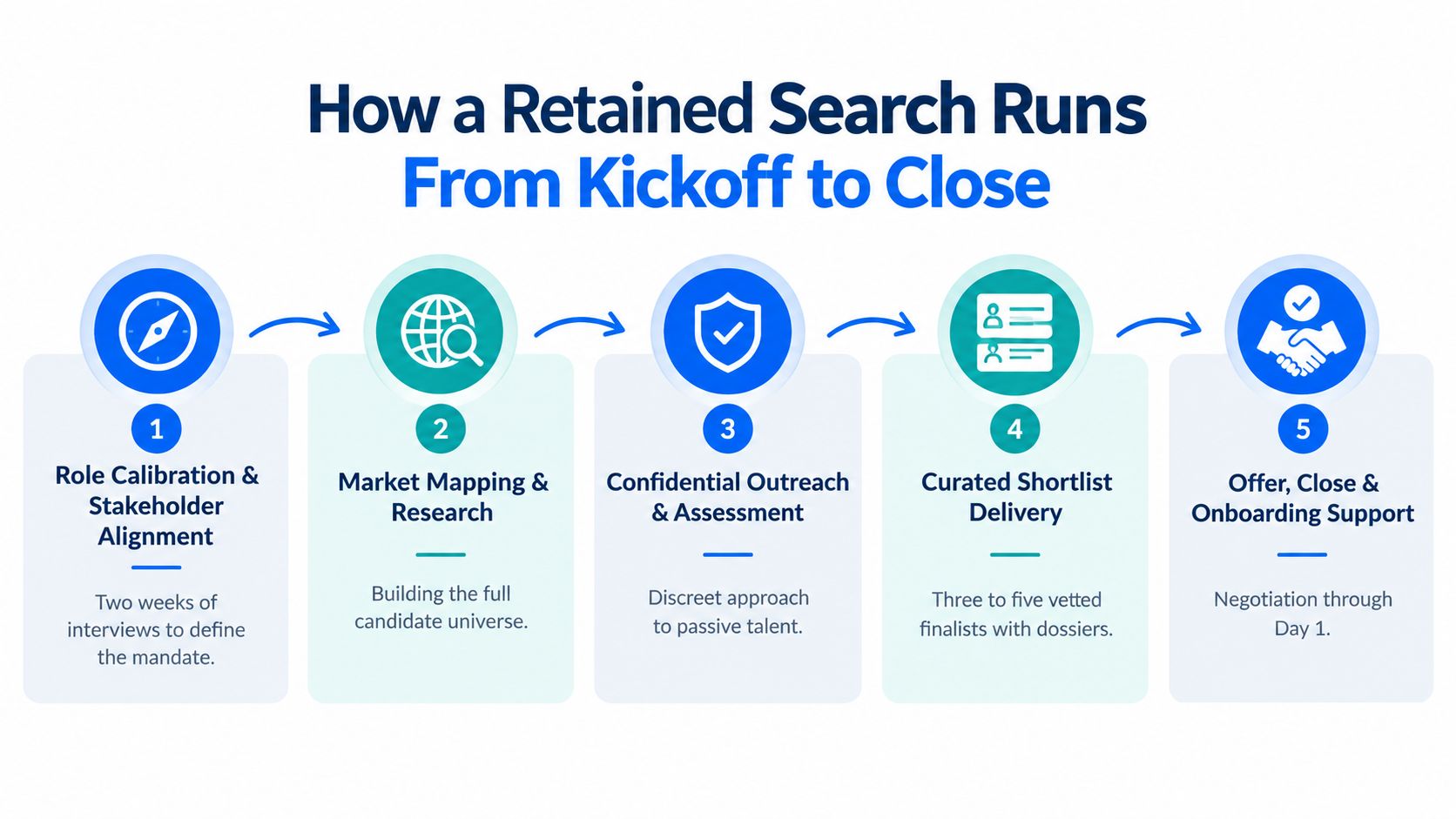
Stage four manages the decision and close
Finalist management is not administrative scheduling. The search partner should coordinate feedback, identify hesitation, support compensation discussions, and keep the strongest candidate engaged while the organization completes its approvals.
Compensation benchmarking matters because executive packages can include base salary, target bonus, and equity. A candidate may accept the headline offer and still withdraw when governance, reporting lines, relocation, or decision authority remain vague. The firm should help the client resolve those issues before the offer becomes a negotiation problem.
Stage five supports integration
The engagement should continue through acceptance and early integration. Useful support includes a transition plan, stakeholder preparation, onboarding priorities, and check-ins after the executive starts. The exact scope belongs in the contract.
C-suite searches often take months because the candidate pool is limited. An industry compilation reports an average 7.2-month time to fill for C-suite roles, with 35% of searches taking longer than nine months. Zipdo's executive search industry statistics provides those figures. A retained process should therefore make the work visible throughout the wait, rather than treating elapsed time as evidence of progress.
For BPO leadership mandates, begin with a structured leadership search questionnaire that captures operating scope, client exposure, transformation goals, and the decision criteria stakeholders will use.
Retained Search Pricing in Real Engagements
Retained search earns its premium when the mandate carries leadership risk. The firm is paid to test whether a leader can succeed in the role, fit the succession plan, and operate within the company's governance model, not just to produce a fast shortlist.
The standard commercial model is 25% to 33% of the hired leader's first-year total compensation, usually split across three payments: kickoff, shortlist delivery, and placement. iSmartRecruit's executive search pricing guide describes this structure and explains why total compensation, rather than base salary alone, determines the fee.
The payment schedule should match the work. The kickoff payment funds role calibration, stakeholder alignment, and research. The middle payment covers market mapping, discreet outreach, and assessment. The final payment covers finalist management, offer negotiation, and closing. You are paying for a more reliable leadership decision, including the work required to rule out impressive candidates who carry too much execution or succession risk.
For example, a $400,000 first-year compensation package at a 33% fee produces a $132,000 engagement cost. The absolute amount changes with role level, incentive structure, and equity treatment.
| Role Level | Total Compensation | Fee % | Total Fee Range | Payment Cadence |
|---|---|---|---|---|
| Senior executive mandate | Role-specific package | 25% to 33% | 25% to 33% of first-year total compensation | Kickoff, shortlist, placement |
| C-suite mandate | Role-specific package including applicable bonus or equity | 25% to 33% | 25% to 33% of first-year total compensation | Kickoff, shortlist, placement |
| Illustrative executive package | $400,000 first-year package | 33% | $132,000 | Three staged payments |
What the fee should cover
A serious proposal should specify whether the fee includes:
- Assessment work: Structured interviews, role-specific evaluation, and written candidate dossiers.
- Reference diligence: Planned references and a clear explanation of how performance claims are verified.
- Market research: Target-company mapping, compensation context, and passive-candidate outreach.
- Closing support: Offer construction, negotiation support, and counteroffer management.
- Integration support: The agreed level of assistance after acceptance.
Treat psychometric tools, international travel, relocation coordination, background checks, and special research as potential extras unless the proposal includes them. Travel pass-throughs can make the final cost difficult to audit.
Contract terms deserve as much attention as the percentage
Review the replacement guarantee in detail. Check its duration, exclusions, and whether the firm conducts a replacement search without charging a new fee. Examine cancellation terms, ownership of candidate relationships, conflicts with competing mandates, and non-solicit language affecting internal candidates.
Stress-test the firm against outcomes, not shortlist speed. Ask what research, reference work, succession analysis, and decision support the fee buys. If reducing the percentage removes senior researcher time, market coverage, or assessment depth, the discount shifts leadership risk back to your team.
Retained vs Contingency Search for Senior Hires
Retained and contingency search solve different operating problems. Contingency recruitment is usually optimized around speed, candidate flow, and payment on successful placement. Retained search is built around exclusivity, research depth, and sustained attention to one mandate.
Neither model is automatically superior. The mistake is using the payment mechanism as a proxy for quality.
| Dimension | Retained Search | Contingency Search |
|---|---|---|
| Exclusivity | One firm typically owns the mandate and commits dedicated effort | Multiple firms may compete for the same vacancy |
| Candidate access | Strong fit for passive and confidential prospects | Often stronger with active candidates and existing database traffic |
| Consultant effort | Market mapping, assessment, references, and closing are built into the engagement | Effort tends to follow the likelihood of a near-term placement |
| Timeline | Designed for deliberate senior hiring and complex stakeholder decisions | Often better suited to roles where the market is active and requirements are stable |
| Confidentiality | Clear process ownership supports discreet outreach | Confidentiality varies by firm and competing-channel activity |
| Price mechanics | Upfront and staged fee tied to the search process | Success fee typically paid when a hire is made |
| Buyer risk | Higher initial commitment, with more accountability for defined deliverables | Lower upfront commitment, but potentially less market coverage and assessment depth |
A contingency firm can be the rational choice for a repeatable functional role with an established scorecard, a visible candidate pool, and a hiring manager who can move quickly. It can also work well when budget constraints matter more than exhaustive market coverage.
Retained search becomes defensible when the best candidates aren't applying, the role is confidential, or the appointment affects the board's confidence in the business. A CEO succession search, a sensitive replacement, or a first-time functional leader with broad transformation responsibility needs more than competing recruiter submissions.
The cheaper model can become expensive when the organization pays for speed but receives the wrong leadership decision.
Exclusivity changes the work
A retained firm can challenge the role, map the whole market, and stay engaged after early candidates decline. A contingency recruiter has a stronger incentive to prioritize accessible candidates because the firm risks spending substantial time without payment.
That doesn't make contingency recruiters careless. It means the business model rewards a different behavior. Buyers should match the model to the consequence of failure.
Candidate quality also depends on assessment discipline, not merely on the sourcing channel. A retained firm that sends three attractive résumés without testing decision-making, motivation, references, and stakeholder fit is delivering contingency-style work under a retained invoice.
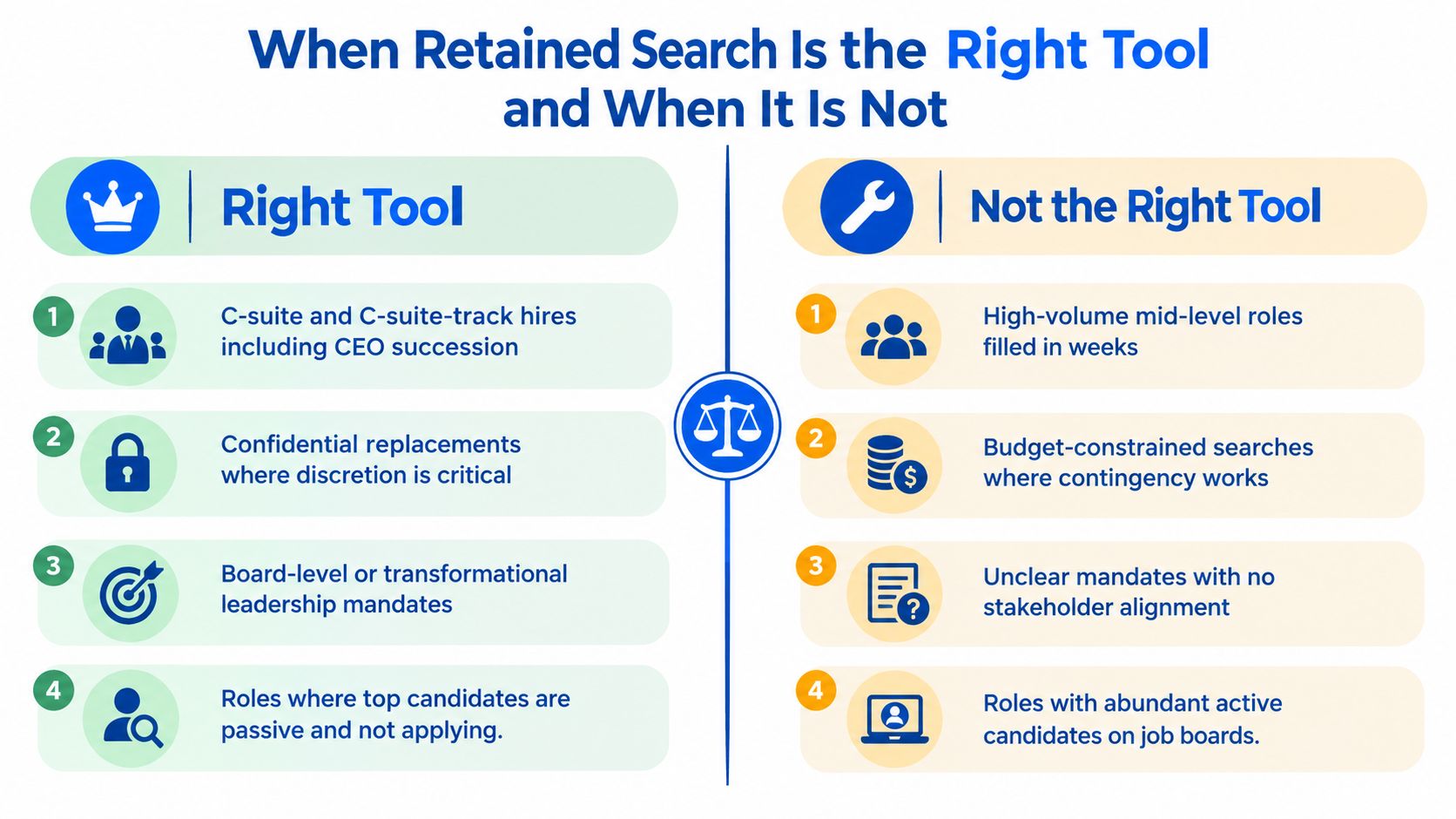
When Retained Search Is the Right Tool and When It Is Not
A retained mandate makes sense when the appointment changes the organization's leadership system. Consider a board planning CEO succession, a founder hiring a first CHRO or CFO, or a P&L leader moving into a role with broader geographic and commercial responsibility. In each case, the buyer needs to understand not only who can perform the job, but what kind of leader the next phase requires.
The same logic applies to BPO and shared-services leadership. A senior operator may influence service continuity, client trust, workforce scale, margin, technology adoption, and expansion into new markets. The candidate's ability to manage those relationships matters as much as functional expertise. A search partner should assess operating judgment and stakeholder behavior, not merely match industry keywords.
Where retained search earns its place
Use it when:
- The role is succession-critical: The board or founder needs a deliberate transition plan.
- The search must remain confidential: Public advertising could unsettle employees, clients, or investors.
- The capability is scarce: The strongest candidates are passive or sit in adjacent sectors.
- The leadership model is changing: The organization needs help defining whether it requires an operator, builder, transformer, or commercial leader.
These situations justify a partner that can challenge assumptions and maintain a controlled candidate experience.
Where it becomes expensive overhead
Retained search is usually excessive for a high-volume mid-level role with abundant active applicants and a stable job description. It is also a poor fit when the hiring team already has a strong internal pipeline or the recruiter already knows the relevant talent pool well enough to work quickly.
An unclear mandate is another warning sign. Paying a retainer won't resolve competing stakeholder expectations. It may only make the disagreement more expensive.
The most common misuse is paying retained fees for contingency effort. The firm presents readily available candidates, skips meaningful references, offers little market evidence, and waits for the client to choose. If the work would have looked the same under a success-only arrangement, the retained model hasn't earned its premium.
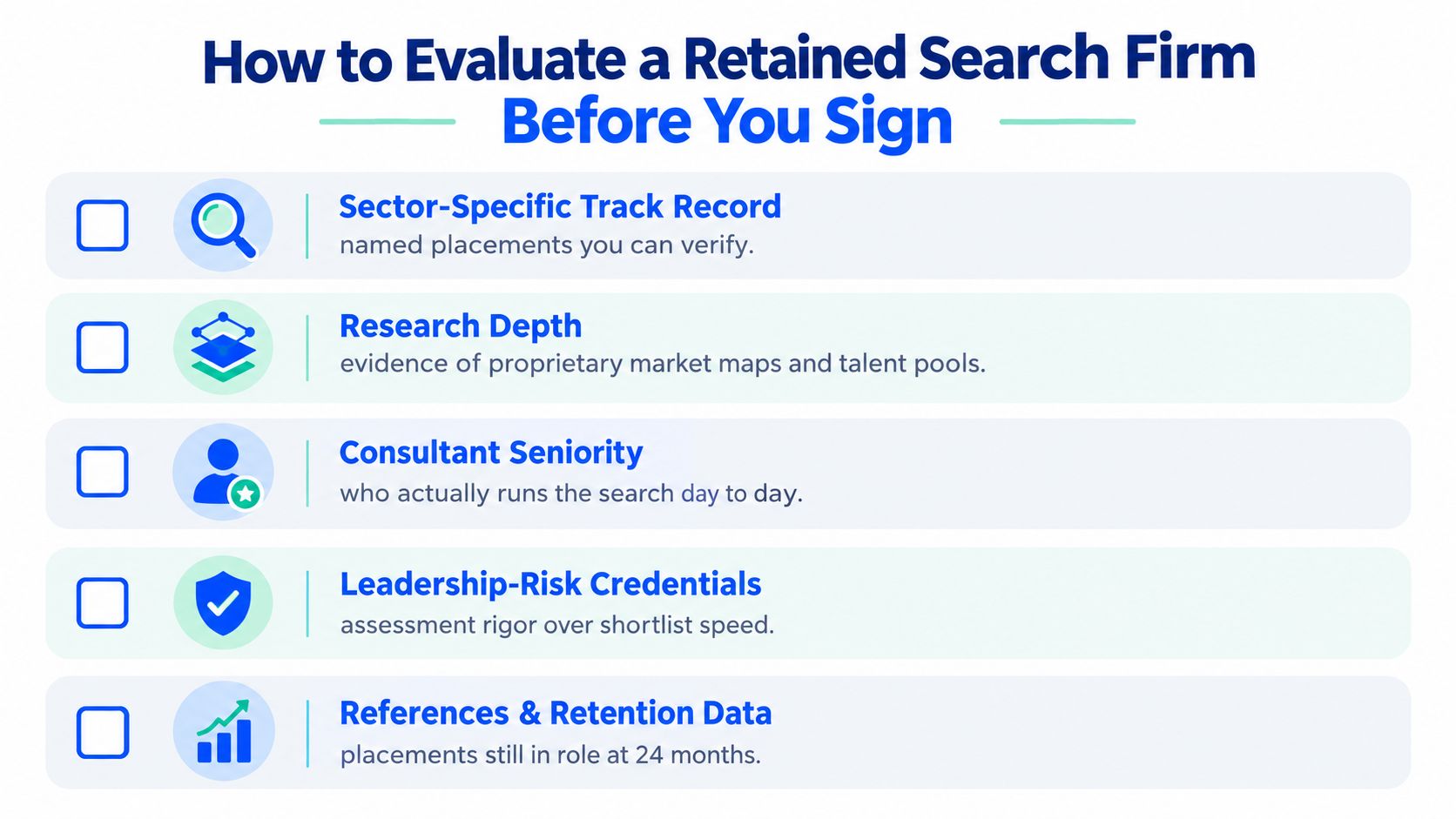
How to Evaluate a Retained Search Firm Before You Sign
A polished pitch deck proves that a firm can sell its process. It doesn't prove that the assigned team can diagnose leadership risk. Vet the people and working methods that will handle the mandate, not only the brand on the proposal.
Start with verifiable experience
Ask for named placements at the same level and in a comparable operating environment. Then ask whether you can contact those clients. A firm that claims broad sector experience should be able to explain what it learned from difficult mandates, not just list logos.
Request an anonymized example of a market map or candidate dossier. You should see the reasoning behind inclusion, the risks identified, and the evidence used to distinguish a plausible executive from a suitable one.
Test assessment depth
Ask the firm how it evaluates:
- Strategic judgment: Can the candidate set priorities when information is incomplete?
- Leadership behavior: How do former colleagues describe the person under pressure?
- Functional credibility: Has the candidate delivered in a context with similar complexity?
- Motivation: Is the move driven by a coherent ambition or temporary dissatisfaction?
- Transition fit: Can the executive operate within the company's governance and decision style?
Psychometric testing, cases, and reference triangulation can help, but tools don't replace judgment. The firm should explain which assessment method fits the role and what decision it informs.
Put confidentiality and AI in writing
Confidential executive work requires clear data handling. Ask where candidate information is stored, who can access it, how long it is retained, and whether it is used to train or improve third-party systems. Require a plain-language explanation of any AI-assisted sourcing, matching, screening, or note-taking.
AI can accelerate market mapping and shortlist generation. It can't independently determine whether an executive will handle a board conflict, retain a client, or lead through an unpopular restructuring. Human accountability must remain explicit.
Ask one blunt question: “Who will do the work every week, and what will I personally receive from that person?”
Confirm the senior consultant's involvement, reporting cadence, escalation process, replacement guarantee, cancellation terms, and conflicts policy. Ask how the firm handles simultaneous mandates involving competitors and whether the assigned team can be changed without your approval.
For a BPO leadership mandate, an executive advisory service can be assessed against those same criteria, including role calibration, leadership evaluation, and sector-specific context. The standard remains the same: process rigor should be visible before signature.
A Short Decision Framework for Your Next Senior Hire
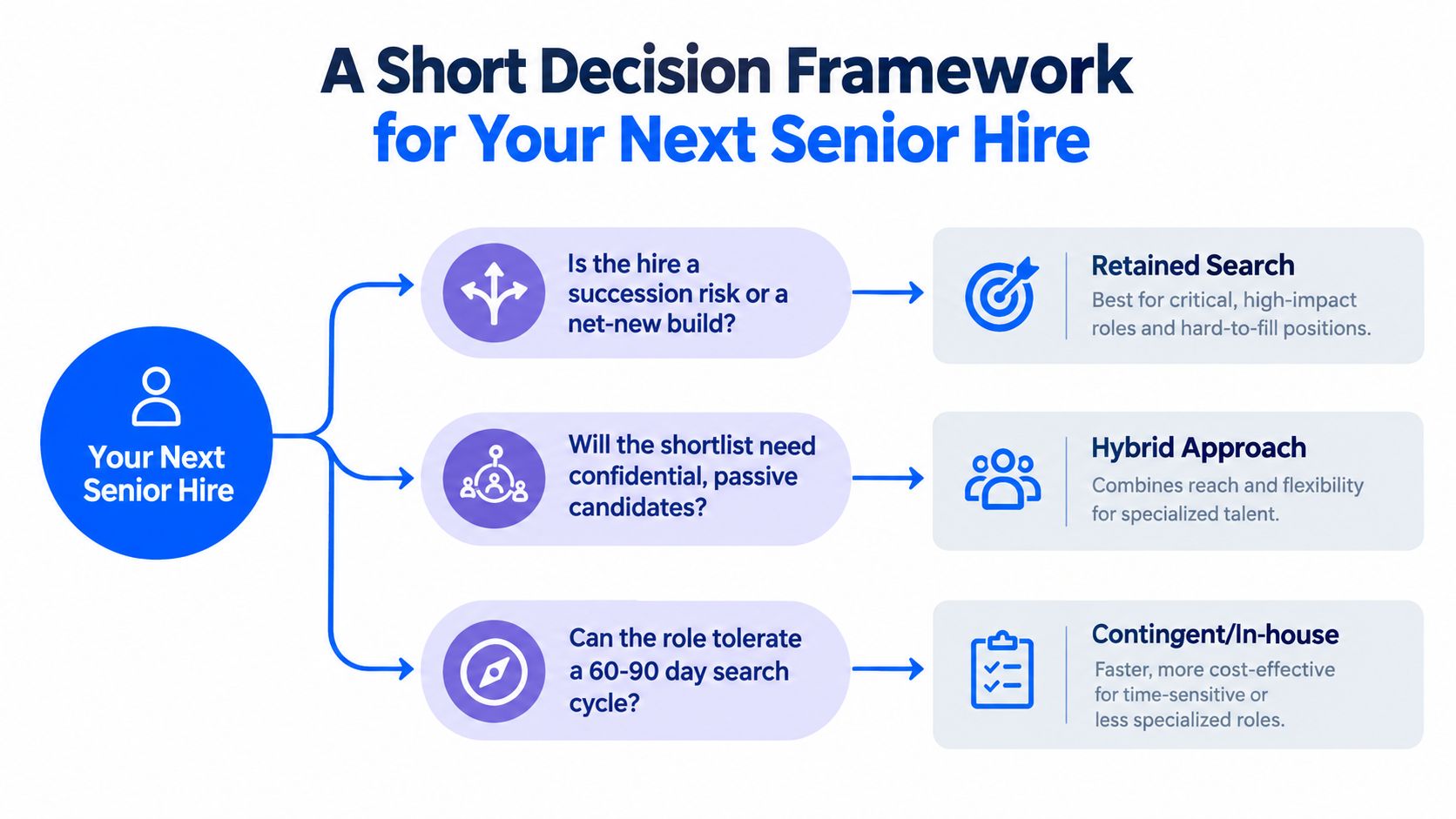
You can decide the search model without running a procurement exercise. Start with three questions.
First, is this hire a succession risk or a net-new leadership build? A replacement with a narrow, established remit is different from a leader expected to reshape the function. If the organization is uncertain what the next version of the role should be, advisory work belongs before candidate outreach.
Second, will the shortlist need confidential passive candidates? If the answer is yes, job-board response volume won't tell you whether the relevant leaders are reachable. The search needs careful market mapping and personalized engagement.
Third, can the role tolerate a deliberate search cycle? Some vacancies create immediate operational pressure. Others justify a slower, more rigorous process because the board, customers, employees, or investors will feel the consequences of a poor appointment.
If at least two answers point to succession exposure, passive talent, or high visibility, retained search usually earns serious consideration. If none apply, a hybrid or contingency model is often the more disciplined spend. A hybrid model might combine internal stakeholder ownership with external market mapping, or use a contingency recruiter for sourcing while the company retains assessment and decision control.
Select the firm with three tests
Don't choose on brand familiarity alone. Require proof of:
- Exact-level experience: The firm has handled the same leadership level in a comparable sector, operating model, and market.
- Assessment beyond the CV: The process tests judgment, motivation, leadership behavior, references, and transition risk.
- Named accountability: You know who runs the search day to day, who makes the outreach, and who advises the hiring group.
Use this kickoff checklist
Before authorizing the search, write down:
- Who has final decision authority?
- What does exclusivity mean in this engagement?
- Which firms and internal candidates are off-limits?
- What is the replacement guarantee, including exclusions and duration?
- What happens if the mandate changes or the search is cancelled?
- Which costs are included, and which are pass-through expenses?
- How will candidate data be stored, shared, and deleted?
- What evidence will the firm provide at each search stage?
- Which executive will support onboarding after acceptance?
The leadership hiring lessons from a role that looked perfect on paper reinforce the central point. A convincing résumé is an input, not a hiring decision. The decision becomes defensible when the mandate, market, assessment, references, and transition plan align.
Retained search is neither a prestige purchase nor a guaranteed outcome. It is a risk instrument. Use it when the leadership decision deserves dedicated research, honest challenge, and disciplined follow-through. Reject it when the firm is offering a premium label for ordinary sourcing.
If your next senior hire affects BPO operations, client confidence, transformation, or succession, AnyBPO can support role definition, executive assessment, and leadership placement through its sector-focused advisory and talent services. Visit AnyBPO to discuss the mandate, the risk you need to manage, and the right search model before you sign.