
The global outsourcing services market was valued at USD 3.8 trillion in 2024 and is projected to reach USD 7.11 trillion by 2030, implying an 11.3% CAGR, according to Grand View Research's outsourcing services market analysis. That scale changes the question for enterprise leaders. Outsourcing business services isn't a side tactic for trimming payroll. It's a major operating model spanning technology, customer operations, finance, analytics, and specialized delivery.
The strategic issue in 2026 is no longer whether an enterprise can outsource a process. It's whether the organization can use an external partner to gain scarce expertise, deploy AI-ready operations, increase resilience, and preserve control across a complex supplier network. A poorly designed contract can just move problems outside the building. A well-designed partnership can give internal teams capabilities they couldn't build quickly or efficiently on their own.
Table of Contents
- Beyond Cost-Cutting The New Era of Outsourcing
- What Business Services Can You Outsource
- Choosing Your Outsourcing Engagement Model
- The Strategic Benefits of Modern Outsourcing
- Establishing Effective Outsourcing Governance
- Partnering for Future Growth
Beyond Cost-Cutting The New Era of Outsourcing
Cost still matters, but it cannot carry the investment case. Executives who assess outsourcing business services through labor arbitrage alone may choose a provider that performs cheaper activity without improving the operating model. Ask instead: what capability will this partnership add, and what measurable business outcome should it produce?
Outsourcing now supports managed technology environments, customer experience, finance and accounting, human resources, analytics, and knowledge-intensive work. Enterprises use external providers to reduce operating expenses, access specialized skills, support digital transformation, and build delivery capacity across regions.
The Grand View Research market report projects that the global outsourcing services market will reach USD 7.11 trillion by 2030, up from USD 3.8 trillion in 2024. That projection signals sustained demand for partner selection, vendor management, process redesign, and transformation support. Supplier decisions deserve board-level attention when an outsourced function affects customers, regulated data, revenue, or operational continuity.
Strategic rule: Outsource capabilities and outcomes, not disconnected tasks.
What changed for buyers
Traditional outsourcing programs often started with a process inventory and cost comparison. Modern programs start with a capability gap. The enterprise identifies where it needs greater speed, technical depth, geographic coverage, or consistency, then tests whether an external provider can deliver that capability within defined risk limits.
Automation has changed the composition of outsourced work. Providers increasingly combine human judgment, workflow technology, data expertise, and AI-enabled operations. The Morgan Lewis analysis of outsourcing trends for 2026 describes a shift toward specialized talent, AI-ready operations, and complex, outcome-based arrangements rather than simple service-level agreements.
Procurement should therefore avoid awarding a strategic process to the lowest bidder that meets only a narrow activity metric. Select a partner that can improve the process, explain how automation will affect the workforce, protect critical data, and accept accountability for business results. Define governance, escalation rights, resilience requirements, and measurable outcomes before implementation begins.
What Business Services Can You Outsource
Business services should be assessed by operating purpose, risk, and required expertise. A provider can extend the enterprise's capacity, but the arrangement works only when process boundaries, data access, controls, decision rights, and target outcomes are defined before implementation.
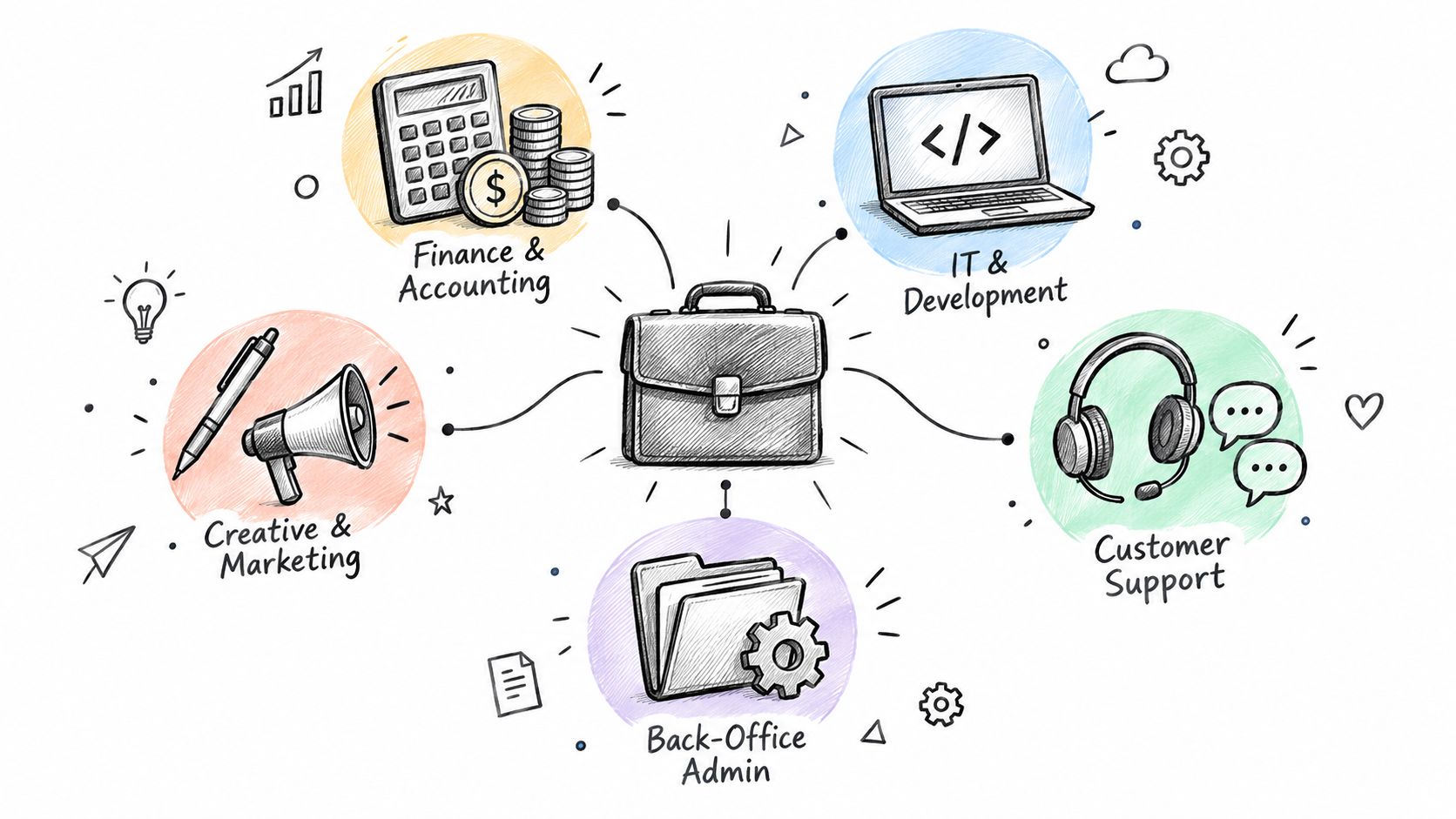
The BPO market was estimated at about US$358.6 billion in 2026 and is projected to reach US$695.8 billion by 2033. About 66% of U.S. companies outsource at least one department, according to Outsource Accelerator's BPO statistics overview. Outsourcing now supports mainstream operations across industries. The strategic question is which capabilities to place outside the enterprise, under what controls, and with what accountability.
IT services
IT outsourcing can include cloud management, infrastructure monitoring, application support, cybersecurity operations, service desks, software testing, and technology maintenance. These services suit external delivery when they require continuous monitoring, specialized tools, or skills that are difficult to retain internally.
Separate operational support from technology authority. An external team can monitor systems and resolve defined incidents, while internal architects retain control over platform standards, security principles, and major technology decisions. Require the provider to document automation, access controls, incident escalation, and recovery responsibilities.
Finance and accounting
Common services include accounts payable, accounts receivable, payroll support, reconciliations, general ledger work, reporting preparation, procurement administration, and spend analysis. Standardized workflows, documented controls, and disciplined exception handling make these processes suitable for external delivery.
Financial integrity remains an internal leadership responsibility. Assign approval rights, anomaly investigation, policy interpretation, fraud escalation, and reporting ownership before transition. A lower operating cost does not justify weaker segregation of duties or limited audit visibility.
Human resources
HR providers can handle recruitment coordination, onboarding administration, benefits administration, payroll processing, employee records, learning operations, and workforce service desks. High-volume, rules-based work often transfers well, provided employee data receives appropriate protection.
Recruitment process outsourcing requires particular scrutiny. A provider can expand sourcing capacity and coordinate candidates, but hiring standards, employer brand, and final selection criteria must remain aligned with the enterprise's talent strategy.
Customer experience and commercial operations
Customer support, technical assistance, order management, sales development, collections, and other front-office activities can be delivered through contact centers or specialist teams. Because these functions shape brand perception, measure more than volume. Quality, resolution, customer effort, compliance, and escalation judgment should determine performance.
Delivery location also affects resilience and service quality. Leaders comparing offshoring and nearshoring should assess time-zone coverage, language fit, talent availability, cultural proximity, and geopolitical exposure rather than selecting on labor cost alone.
Emerging knowledge services
Data analytics, market intelligence, claims administration, financial analysis, automation design, and AI operations extend outsourcing into knowledge process outsourcing. These services demand stronger oversight because the provider may influence decisions, train workflows, or handle sensitive business information.
Start with process maturity. If the work depends on one internal expert, document and stabilize it before transfer. Then examine strategic sensitivity, including whether outsourcing could expose a differentiating capability or create excessive dependency. Approval rights, audit access, data visibility, domain expertise, regulatory knowledge, technology capability, and change management capacity must all be confirmed during due diligence.
The screening question is straightforward: can the partner improve the capability without taking control of decisions the enterprise must retain? If the answer is unclear, redesign the scope, controls, or sourcing plan before signing.
Choosing Your Outsourcing Engagement Model
The engagement model determines who controls the work, who carries delivery responsibility, and how the enterprise pays for capacity or results. Choosing the wrong structure creates friction from the first transition. A company seeking temporary expertise shouldn't sign a contract that forces a provider to redesign an entire function. A company seeking transformation shouldn't use a staff-augmentation arrangement and expect outcome ownership.
Three models, three accountability patterns
Staff augmentation gives the enterprise people with defined skills while the internal team retains day-to-day management. This model suits temporary capacity gaps, specialist assignments, project surges, and situations where the enterprise already has mature processes and leadership.
Managed services transfers responsibility for a defined service or technology environment to the provider. The enterprise specifies required performance, governance, and outcomes, while the provider manages staffing, workflows, and operational execution.
Business process outsourcing goes further by transferring an end-to-end process, such as customer support, payroll administration, claims processing, or finance operations. The provider typically supplies the people, technology, process expertise, and management system. The enterprise retains strategic control and business accountability, but the vendor owns more of the operating machinery.
| Criterion | Staff Augmentation | Managed Services | Business Process Outsourcing (BPO) |
|---|---|---|---|
| Primary purpose | Add skills or capacity | Operate a defined service | Manage an end-to-end business process |
| Day-to-day control | Mostly internal | Shared, with provider operational control | Provider-led, with enterprise governance |
| Responsibility | Enterprise manages delivery | Provider manages service performance | Provider manages process performance and execution |
| Best fit | Temporary gaps and specialist work | Stable services requiring operational expertise | High-volume or complex processes suitable for structured ownership |
| Commercial focus | Time, capacity, or role coverage | Service performance and delivery scope | Business outcomes, process quality, and transformation |
| Main risk | Internal management burden | Ambiguous boundaries | Dependency, transition complexity, and loss of process visibility |
Match the model to the problem
If the issue is a short-term shortage of cloud engineers, analysts, or project specialists, staff augmentation may be the cleanest answer. If the issue is inconsistent service-desk performance, managed services can place operational discipline with a provider that already runs the necessary environment.
For a customer acquisition program, a specialized sales call center partner may work under managed services or BPO depending on whether the provider merely supplies agents or owns the broader sales process and its results.
The contract should reflect the intended transfer of responsibility. Don't describe a transformation mandate in activity language. Specify the baseline, target state, decision rights, data obligations, transition responsibilities, and the conditions that trigger remediation.
Commercial discipline: If the provider can't explain which decisions it owns, which outcomes it controls, and which dependencies remain with the enterprise, the model isn't ready for signature.
A hybrid structure often makes sense for large enterprises. Keep architecture, policy, risk, and strategic planning internal while outsourcing repeatable execution. This preserves control where judgment matters and gives the provider room to standardize and improve the operational layer.
The Strategic Benefits of Modern Outsourcing
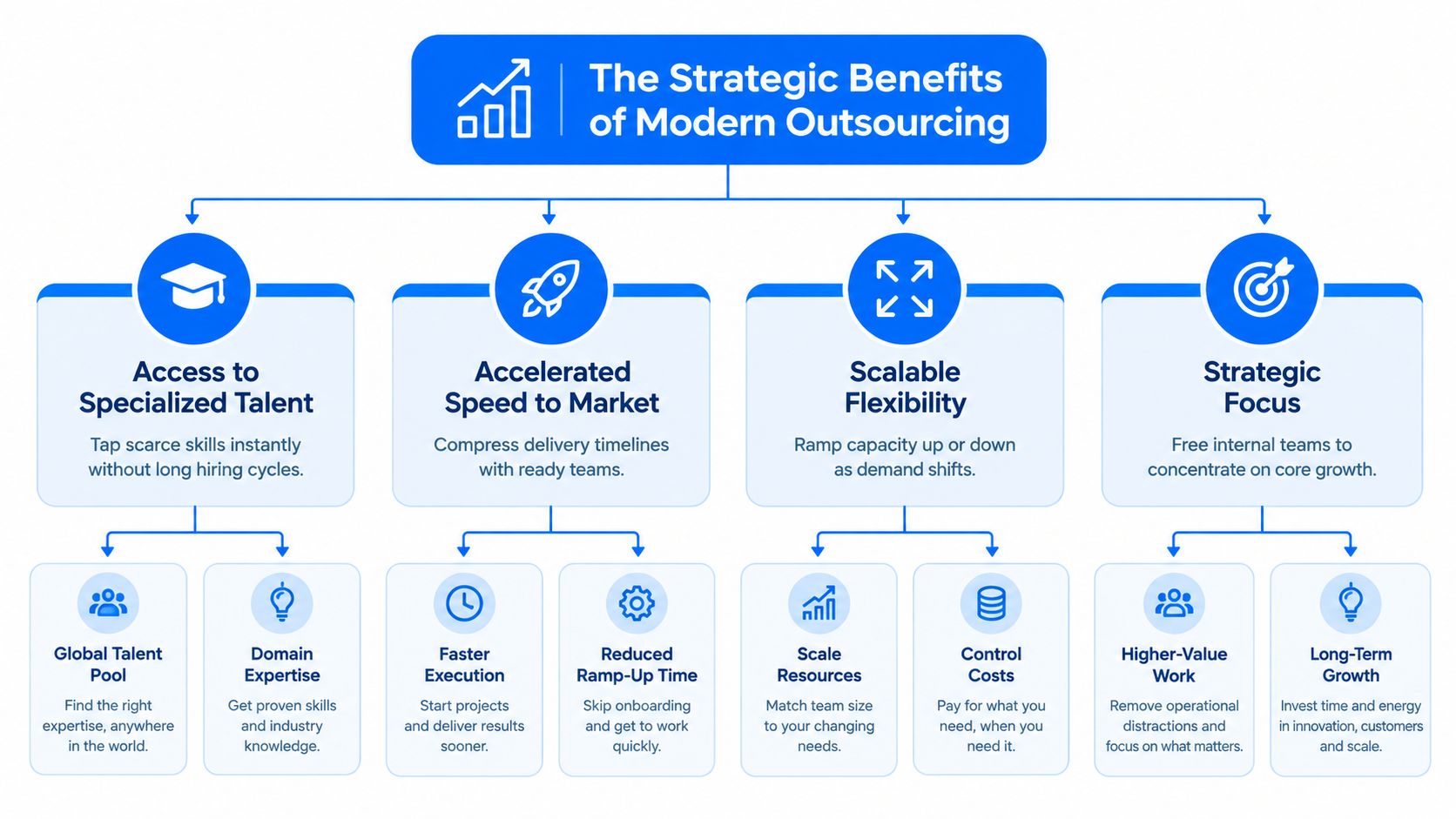
The strongest outsourcing business services programs build capabilities that enterprises would struggle to assemble alone. Senior leaders should approve these programs when they improve access to specialized talent, accelerate delivery, increase flexibility, or sharpen strategic focus. Lower cost can support the business case, but capability and resilience should determine the decision.
Modern outsourcing works best when the provider complements an AI-ready operating model. Buyers should define which work requires specialized human judgment, which tasks technology can support, and which outcomes the provider must own. That clarity prevents automation from becoming a substitute for sound process design and accountable delivery.
Access to specialized talent
AI governance, data engineering, multilingual customer operations, automation design, and industry-specific compliance skills can be difficult to hire and retain internally. A capable provider offers an established talent pool, tested operating playbooks, and delivery leadership.
That arrangement does not remove the need for internal expertise. It changes where the enterprise applies it. Internal leaders can set standards, prioritize investments, and make business decisions while the partner supplies specialized execution capacity. Require the provider to document how it recruits, trains, retains, and replaces scarce specialists.
Faster delivery
A provider with mature recruiting, training, workforce management, and technology integration can begin with an existing delivery base instead of building every capability from scratch. This shortens the path from strategy to operation when demand is urgent or the enterprise is entering a new market.
Speed creates value only when quality and control remain intact. Put transition gates, acceptance criteria, security reviews, and escalation routes into the implementation plan. Assign an executive owner to each gate and require evidence before the program advances.
A short video can help leadership teams frame the operational shift from traditional outsourcing to technology-enabled delivery:
Scalable flexibility
External capacity lets an enterprise adjust delivery resources as demand changes without making every staffing decision permanent. This flexibility supports customer operations, seasonal workflows, project delivery, and market expansion.
Variable capacity still has limits. Require the provider to document hiring lead times, training requirements, quality safeguards, and the operational consequences of ramping up or down. Include those conditions in capacity plans and commercial reviews so flexibility remains measurable rather than aspirational.
Strategic focus
A well-designed outsourcing program moves defined execution responsibilities outward and gives internal leaders more room to concentrate on product development, customer strategy, innovation, and risk decisions. The enterprise gains focus when ownership boundaries are clear and the provider has authority to improve the work it controls.
Retain approvals and controls that protect the business, while delegating routine execution and appropriate exceptions. If internal teams continue handling every escalation, the program will add coordination without creating meaningful capacity.
Executive test: Approve outsourcing when it gives the enterprise a capability advantage, strengthens resilience, or improves decision capacity, not merely a cheaper version of the existing workflow.
Establishing Effective Outsourcing Governance
A signed contract doesn't create control. Governance does. The enterprise needs a management system that connects performance measurement, ownership, communication, risk oversight, and continuity planning.
Third-party risk has become more complex because cyberattacks, regulatory change, geopolitical instability, fraud, and supplier concentration can interact across a global delivery network. The RSM guidance on outsourcing and third-party risk management emphasizes that resilience requires more than cost optimization. Leaders must preserve control across suppliers and jurisdictions.
Define performance in business terms
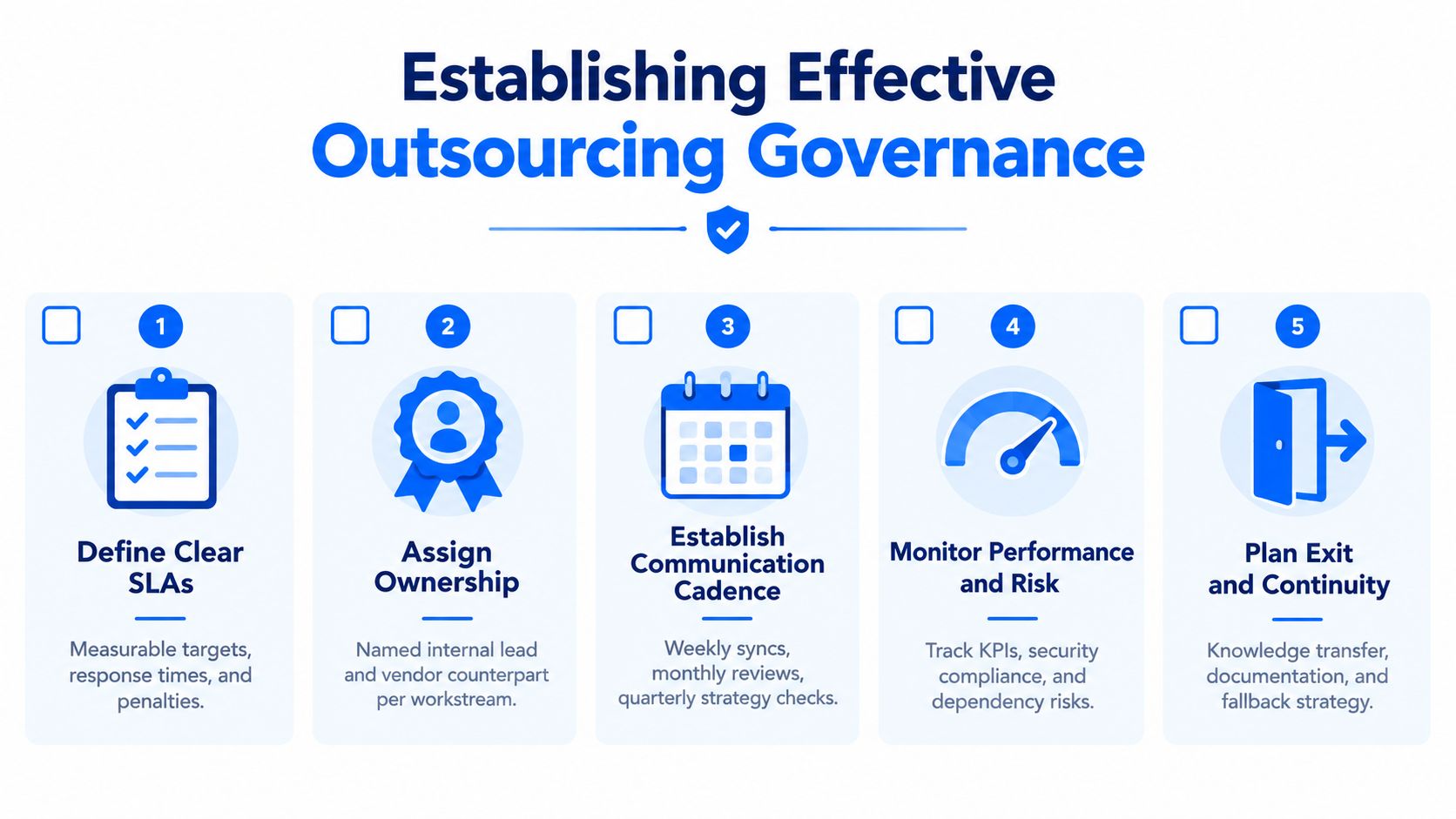
Start with service-level agreements, but don't stop at response times and throughput. Connect operational indicators to business outcomes. A customer operation may need measures for resolution quality and escalation accuracy. A finance process may require control effectiveness and exception resolution. An IT service may need reliability, recovery performance, and user experience measures.
Every metric needs an owner, a data source, a review rhythm, and a consequence. If a KPI can't trigger a decision, it may be reporting theatre rather than governance.
Assign named ownership
Create an internal executive sponsor, an operational owner for each workstream, and a corresponding provider lead. Clarify who approves changes, who accepts risk, who manages incidents, and who resolves disputes.
Use a responsibility matrix for transition, daily operations, information security, compliance, workforce changes, technology integration, and exit planning. Ambiguity is expensive because both sides can believe the other owns the problem.
Build a communication cadence
Daily operational management, regular service reviews, and executive governance serve different purposes. Keep them separate. Operational meetings should resolve blockers. Performance reviews should examine trends and corrective action. Executive sessions should address investment, risk appetite, scope changes, and strategic alignment.
Communication should also include escalation paths for incidents that cross business units or suppliers. A provider can meet its contractual SLA while the enterprise still experiences a serious customer or regulatory failure if dependencies aren't visible.
Monitor risk and resilience
Assess the provider before selection and throughout the relationship. Review access controls, data handling, subcontractors, business continuity, geographic exposure, workforce concentration, financial stability, and incident response. Map dependencies instead of evaluating each vendor in isolation.
Control principle: The enterprise can outsource execution, but it can't outsource accountability for customer trust, regulatory obligations, or business continuity.
Plan improvement and exit from the beginning
Continuous improvement needs a funded backlog, a decision process, and a way to share benefits. Ask the provider to identify automation opportunities, process defects, training needs, and recurring exceptions. Tie approved improvements to clear ownership and implementation dates.
Exit planning should cover documentation, knowledge transfer, data return, access revocation, transition support, replacement capacity, and fallback operations. You may never use the exit plan, but writing it forces the enterprise to understand its dependency before dependency becomes a crisis.
Partnering for Future Growth
Strategic outsourcing is a partnership model with explicit boundaries. The enterprise defines the business outcome, protects the controls that cannot move outside, and gives the provider enough authority to manage the work it has accepted. The provider contributes specialized talent, process expertise, technology, and operational accountability.
The sequence matters. First, identify the capability gap. Then select the engagement model that matches the intended transfer of responsibility. Next, define performance, governance, risk controls, and continuity before the transition begins. A provider that looks attractive in a presentation may still be a poor fit if its delivery footprint, technology approach, leadership depth, or risk posture doesn't match the enterprise.
Leadership standard: Don't ask whether a vendor can perform the process. Ask whether the relationship will leave the enterprise more capable, resilient, and strategically focused.
Provider discovery should include more than a directory search. Compare relevant experience, delivery locations, workforce model, technology integration, security controls, references, financial resilience, and willingness to share outcome accountability. A structured BPO provider evaluation can help decision-makers organize that assessment before commercial negotiations begin.
The future belongs to enterprises that treat outsourcing as part of operating-model design. They will combine internal judgment with external specialization, human expertise with automation, and global delivery with disciplined governance. They won't surrender control in the name of efficiency, and they won't keep every process internal just because ownership feels safer.
A successful program creates a deliberate division of labor. The enterprise owns strategy, risk appetite, customer promise, and critical decisions. The provider owns agreed execution, process discipline, capability development, and continuous improvement. That is how outsourcing business services becomes a platform for growth rather than a workaround for operational strain.
AnyBPO helps enterprises define outsourcing requirements, identify suitable BPO and technology partners, evaluate providers, and support transformation and performance programs across international markets. Visit AnyBPO to explore a structured path from partner discovery to a governed outsourcing relationship built around business outcomes.