
The biggest software outsourcing mistake is treating size as the main signal of fit. The largest firm is not automatically the safest choice, the fastest team, or the one that will understand your operating model. Software development outsourcing companies should be judged by the work they're best at, the geography they cover, the level of governance they expect, and how well they fit the product, modernization, AI, or compliance problem in front of you.
This roundup compares seven providers across engineering depth, AI and data specialization, regulated-industry experience, nearshore and global delivery, engagement flexibility, and program complexity. A practical shortlist starts with scope definition, then checks delivery geography, team structure, governance, security, proof of capability, commercial fit, and transition planning. If you need a broader, vendor-neutral view before narrowing the field, AnyBPO can help with vendor discovery and structured provider evaluation.
Table of Contents
- 1. EPAM Systems
- 2. Globant
- 3. Endava
- 4. SoftServe
- 5. Nagarro
- 6. Wizeline
- 7. Grid Dynamics
- Top 7 Software Development Outsourcing Companies Comparison
- Turn the Shortlist Into a Defensible Decision
1. EPAM Systems
EPAM is the clearest choice when the assignment is not just “build software,” but build and keep evolving a complex platform across markets, teams, and business units. The company's footprint spans 55+ countries and 62,750+ employees in Q1 2026, which signals the kind of operating scale that only works when the client can manage multi-team delivery with discipline. Its mix of platform development, cloud modernization, data, AI, and managed engineering suits programs that are already too large for a single specialist shop.
EPAM's global engineering and consulting profile lines up well with this pattern. The firm also sits inside a very large outsourcing market, where buyers can find specialized vendors across regions and providers compete on delivery quality, cost efficiency, and domain expertise rather than simple access to demand, as the market estimates show in the latest IT outsourcing outlook.
Where EPAM fits best
EPAM makes sense when architecture matters as much as delivery speed. Its breadth across product engineering, DevOps, QA, API integration, IoT, modernization, and cloud gives enterprise teams a single partner for long-lived programs that touch multiple systems. The trade-off is governance. Large global teams can add coordination overhead unless the buyer has clear decision rights, strong product ownership, and an operating cadence that keeps engineering aligned.
Practical rule: use EPAM when you need one partner to carry a complex roadmap across design, engineering, quality, and platform operations, not when you only need a quick bolt-on team.
The firm also benefits from deep enterprise ecosystem coverage, including SAP, Microsoft, Salesforce, Workday, and Oracle. That matters when the work sits inside a broader transformation program and the outsourcing partner has to integrate with existing enterprise platforms rather than replace them. For buyers comparing offshore and nearshore options, the internal trade-off is simple, more scale usually means more coordination, so governance has to be designed up front. The operational lens in this offshoring vs. nearshoring guide is useful if your team is still deciding how distributed the model should be.
2. Globant
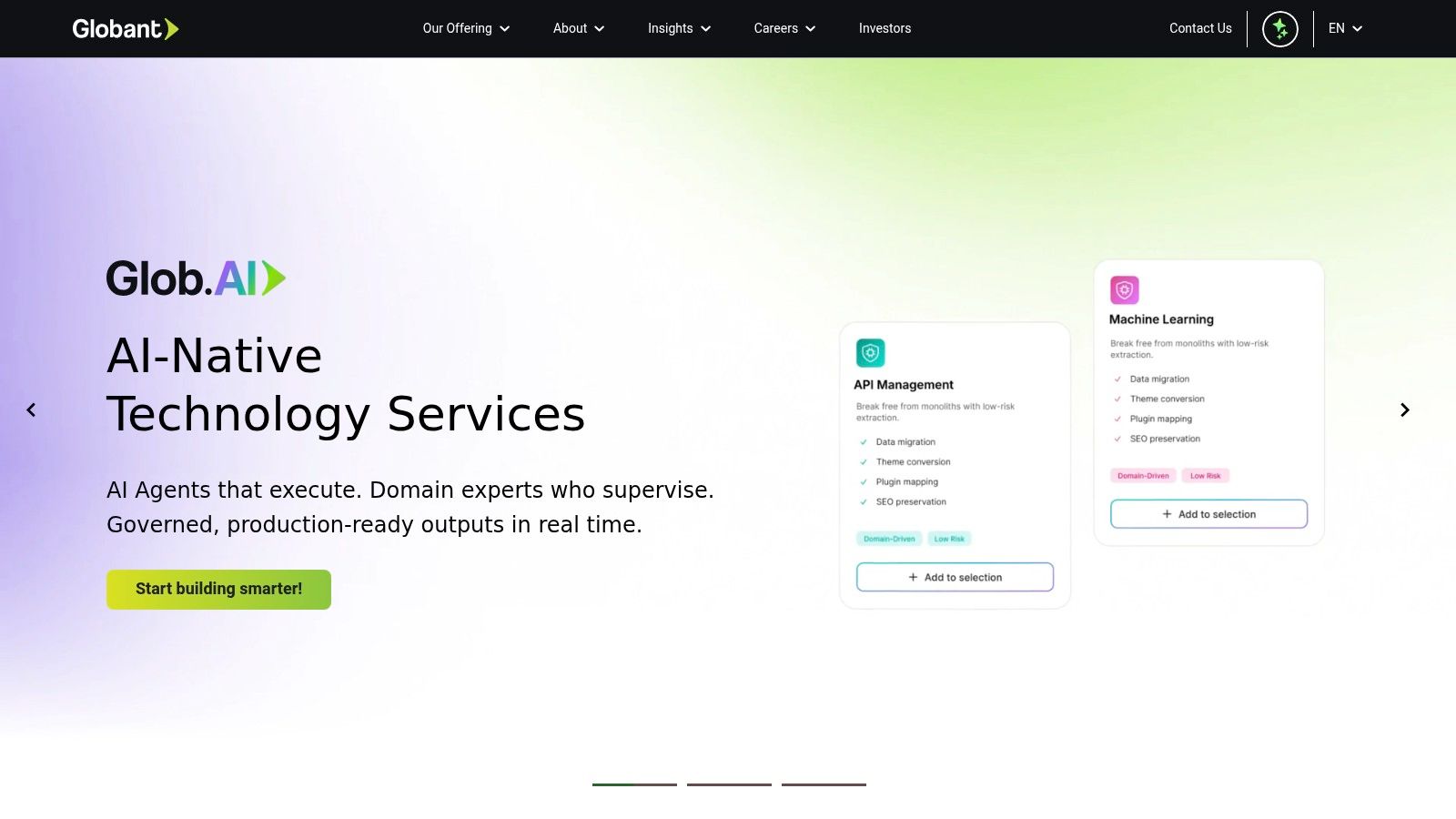
Globant is a strong fit when the outsourcing conversation is really about digital transformation with a visible product layer. Its delivery model is built around AI Studios and Core Studios, which gives clients a way to organize work by capability area instead of building a generic body-shop relationship. That structure is especially relevant for teams trying to modernize customer-facing products while also pushing into AI, cloud, and enterprise application work.
The company's public positioning on Globant's platform and AI services reflects a broad stack that includes data, engineering, cybersecurity, digital twins, and cloud operations. The other notable detail is its POD-based delivery model, which works best when the client can provide clear product ownership and fast decision-making. Without that, even a strong team can spend too much time waiting for approvals.
Why the POD model matters
Globant's strength is not just that it can staff work, it can structure work around context-adaptive teams. That makes it appealing for programs where product, design, and engineering have to move together, especially in enterprise ecosystems tied to SAP, Salesforce, Oracle, Microsoft, and Google Cloud. The upside is speed and cross-functional alignment. The downside is that enterprise onboarding can take longer, because the buyer has to define ownership boundaries, reporting cadence, and escalation paths before delivery really starts.
Its fit is strongest for large digital product builds that need both innovation and execution discipline. Analyst recognition in AI services adds credibility, but the buying question is whether your product team can keep pace with the POD model. If the answer is yes, Globant can be a strong partner for modern product roadmaps. If your internal team is still immature on product ownership, the model can feel fast at first and messy later.
3. Endava
Endava stands out where regulated-industry context matters and the software work has a direct connection to payments or financial infrastructure. The company's AI-native approach combines strategy, design, engineering, and operations, which is useful when a client wants more than development capacity. In practical terms, Endava is best when the code has to survive scrutiny from compliance, security, and business stakeholders at the same time.
Endava's service and sector profile makes its strongest case in payments, banking, and capital markets, with broader coverage in retail, healthcare, and media. That sector depth matters because buyers in these environments are usually not outsourcing a greenfield app, they're modernizing systems that already carry operational risk. A partner that understands merchant acquiring, real-time payments, gateways, and embedded finance can save months of translation work.
Sector depth beats generic scale here
Endava's real value is its industry-specific delivery judgment. When a team is modernizing a payments layer or adding new functionality to a regulated platform, domain fluency reduces rework and shortens the time between business requirements and engineering decisions. That's a better fit than a generalist vendor with more people but less sector memory.
A provider with strong sector depth often looks slower in the first few weeks because it asks better questions.
The downside is concentration. If your program sits outside financial services, Endava's strongest edge may be less relevant, even if the technical fit is still good. Governance also matters because cross-region delivery needs clear sprint ownership and escalation rules. For teams trying to compare engagement styles, AnyBPO's provider view can help frame the question around fit, not just brand familiarity.
4. SoftServe
SoftServe is a compelling option when the roadmap combines cloud, data, and AI with a need for practical enterprise delivery. The company's profile is especially relevant for buyers who want innovation without abandoning the basics of migration, modernization, DevOps, and run-state support. That balance matters in software outsourcing because many programs fail when the vendor can experiment, but can't sustain the platform after launch.
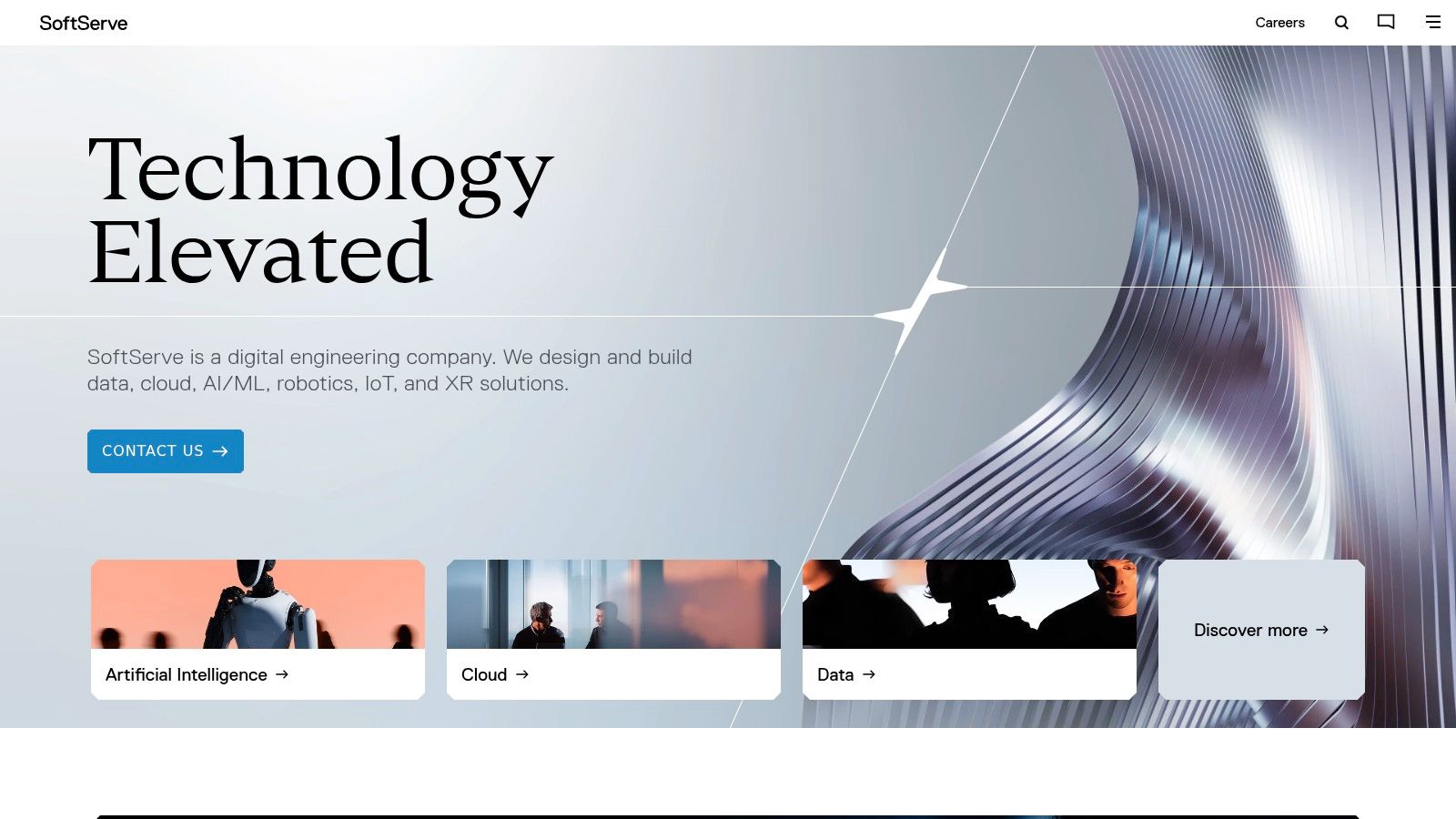
SoftServe's official site positions the company around data, cloud, and AI-first product engineering, with additional work in robotics, XR, and advanced automation. Its U.S. presence in Austin helps it bridge client communication while still operating globally, which is useful for teams that want real-time engagement without going fully onshore.
Best when innovation has to survive operations
SoftServe is strongest when a client needs a partner that can touch both the new and the legacy. The firm's AI and data stack makes it a practical candidate for product roadmaps that include analytics, automation, or AI-assisted workflows, while its cloud and DevOps work keeps the operating model grounded. That combination is especially valuable for enterprises that can't afford to treat AI as a side experiment.
The trade-off is visibility. Public analyst accolades aren't as prominent as they are for some larger peers, so buyers should rely more heavily on reference checks, team interviews, and delivery design during evaluation. That's not a weakness by itself, but it does mean the diligence phase has to do more work. If you need a vendor that can support both modernization and experimentation, SoftServe is worth a serious look.
5. Nagarro
Nagarro fits teams that want digital product engineering with a strong bias toward continuous improvement. Its focus on product engineering, platform engineering, AI/ML, cloud/DevOps, and quality engineering makes it a practical choice for programs that keep changing after launch. That matters because many outsourcing relationships fail when the vendor is treated like a build shop, even though the product needs ongoing iteration.
Learn more on Nagarro's website. The firm's Vanguard framework is notable because it embeds AI throughout the SDLC rather than treating AI as an add-on. That's a useful signal for buyers who want structured AI adoption inside delivery, not just an experimental toolset attached to one workstream.
Good for teams that iterate continuously
Nagarro's strengths show up in complex enterprise environments and integrations, especially where platform work has to connect to systems like Microsoft or Oracle. Its public positioning also suggests solid experience in automotive and high-tech environments, which typically demand careful engineering, testing discipline, and stable release processes. That combination makes it a better fit for product evolution than for one-off project rescue.
The limitation is visibility. Public proof points are less concentrated than what you get from the mega-vendors, so buyer diligence matters more. Scoping should cover the team's actual composition, the handoff model, and how AI is being used in delivery, not just in marketing. If your priority is SDLC acceleration with engineering rigor, Nagarro deserves a place on the shortlist.
Practical rule: judge Nagarro by how it handles change over time, not just by how it handles a clean initial build.
6. Wizeline
Wizeline is the nearshore-friendly choice on this list for teams that care about collaboration speed as much as technical output. Its model blends product engineering, cloud engineering, data engineering, and AI readiness with three clear engagement formats, Studio, Project, and Staff. That makes it easier to match the vendor to the shape of the work instead of forcing every need into a single contract structure.
Wizeline's platform and delivery model is especially relevant for buyers who want strong time-zone alignment across the Americas. Its nearshore coverage in Mexico, Colombia, and Argentina is a practical advantage for product teams that run daily ceremonies, move quickly on feedback, and want fewer delays between decision and delivery.
Flexibility is the point
Wizeline's appeal is that it doesn't force a single engagement shape. The Studio model suits embedded work, the Project model works for defined pods, and Staff helps when a client wants flexibility without a full managed-services commitment. That flexibility is useful when a roadmap is still shifting and the internal product team needs room to adjust scope.
The trade-off is scale. Wizeline is smaller than the largest global system integrators, so it may not be the best fit for the biggest multi-tower enterprise programs. Buyers should also validate pricing and team availability during discovery, since those details aren't usually resolved from public information alone. For organizations that want nearshore collaboration without giving up engineering depth, Wizeline is a sensible middle ground.
7. Grid Dynamics
Grid Dynamics fits buyers assessing providers by engineering depth and delivery proximity rather than company size. Its focus on AI, data, and cloud engineering supports projects where the architecture is still developing and business feedback must shape implementation. The GAIN platforms provide adaptable starting points for commerce, AI-SDLC, and Physical AI, reducing some of the work required to move from strategy to working software.
Grid Dynamics' official platform and engineering profile describes its use of Forward Deployed Engineers, who work closely with client teams and operational goals. This model suits complex problems, evolving architectures, and products that require frequent input from business stakeholders. Buyers should still clarify decision rights, security controls, and technical ownership before selecting an embedded arrangement.
Embedded engineering with reusable AI assets
Grid Dynamics has particular industry depth in retail, manufacturing, CPG, high-tech, and financial services. Its MACH Alliance partnership aligns with headless, composable, cloud-native commerce approaches, which may help organizations modernizing digital channels. The fit is weaker when legacy dependencies require extensive remediation before AI or composable architecture can deliver value.
Its smaller scale relative to major global vendors can support focused collaboration, but program capacity needs early validation. Enterprise buyers should confirm available skills, regional coverage, governance processes, and the operating model for scaling beyond an initial team. Use this scoping questionnaire to align requirements before shortlisting.
Choose Grid Dynamics when close engineering collaboration and reusable AI assets matter more than maximum vendor scale.
For organizations pursuing custom AI adoption in a modernizing environment, Grid Dynamics is a practical candidate. Its strongest fit combines substantial engineering complexity with a need for rapid feedback, industry context, and adaptable delivery.
Top 7 Software Development Outsourcing Companies Comparison
| Provider | Implementation complexity 🔄 | Resource requirements ⚡ | Expected outcomes 📊 | Ideal use cases 💡 | Key advantages ⭐ |
|---|---|---|---|---|---|
| EPAM Systems | High 🔄, complex, multi-region governance and multi-vendor integration | High ⚡, large cross-functional teams, partner ecosystem, significant budget | Enterprise-grade, scalable platforms and sustained product evolution 📊 ⭐⭐⭐ | Large regulated enterprises, global transformations, long-term managed engineering | Deep engineering coverage, proven delivery at scale, broad partner network |
| Globant | High 🔄, PODs and AI Studios require coordinated onboarding and governance | High ⚡, experienced AI/product teams and domain specialists | AI-driven product delivery and digital transformation impact 📊 ⭐⭐ | Large-scale digital product builds, AI-led transformation programs | AI-first delivery, POD model, strong platform and industry expertise |
| Endava | Medium-High 🔄, AI-native frameworks with sector-specific toolkits | Medium ⚡, domain experts (payments/BFSI) and engineering squads | Faster modernization for payments/BFSI and sector-aligned products 📊 ⭐⭐ | Payments, banking, regulated finance modernization and new product builds | Payments leadership, industry toolkits, AI-enabled service offerings |
| SoftServe | Medium 🔄, integration of AI/ML, cloud, XR and automation capabilities | Medium ⚡, data/AI engineers, cloud ops; US delivery presence | Data-heavy, AI-augmented products with balanced innovation and IT fundamentals 📊 ⭐⭐ | Data-centric roadmaps, cloud modernization, advanced automation/XR pilots | Broad AI stack, managed services, innovation in robotics/XR |
| Nagarro | Medium 🔄, Vanguard AI across SDLC to accelerate continuous delivery | Medium ⚡, full-stack engineers and AI-enabled delivery frameworks | Accelerated SDLC, improved quality and continuous product evolution 📊 ⭐⭐ | Continuous product evolution, enterprise integrations, high-tech/automotive | AI-native SDLC framework, strong integration experience, delivery focus |
| Wizeline | Low–Medium 🔄, Studio/pod models and flexible engagement options | Lower ⚡, nearshore teams, staff augmentation, lower ramp overhead | Faster product velocity and efficient nearshore collaboration 📊 ⭐ | Nearshore-focused digital products, rapid MVPs, Americas-centric projects | Nearshore footprint, repeatable activations, flexible engagement models |
| Grid Dynamics | Medium 🔄, GAIN platforms and FDEs suited to cloud-native adoption | Medium ⚡, pre-built AI components plus embedded Forward Deployed Engineers | Accelerated AI adoption with adaptable components; strong commerce/IoT impact 📊 ⭐⭐ | Omnichannel retail, IoT/automation, cloud-native AI/commerce projects | GAIN platforms, FDE delivery model, deep industry use-case expertise |
Turn the Shortlist Into a Defensible Decision
A serious outsourcing decision starts with the outcome, not the logo. Define whether you need product engineering, modernization, AI enablement, managed services, or a hybrid of all four. Then match the work to demonstrated delivery experience, because the best software development outsourcing companies usually win on fit, not on headline size.
Validate the operating model before you get attached to the pitch. Check geography, time-zone coverage, language capability, and how the team will work with your internal stakeholders. A partner can look perfect on paper and still fail if your team needs real-time collaboration but the delivery model is optimized for asynchronous handoffs.
Governance deserves the same attention as technical talent. Ask how the vendor handles security, quality, escalation, and knowledge transfer, and make them show you the team plan instead of promising flexibility in the abstract. If the work is regulated or business-critical, request comparable references and verify that the proposed team has handled similar environments before.
Commercial fit matters too, but headline rates rarely tell the full story. Model total cost, including onboarding, management overhead, rework risk, and transition effort. Then use a scored comparison matrix so your team can compare vendors on the same dimensions, with the same weightings, before you issue a final RFP.
A structured discovery phase is the cleanest way to reduce risk. Keep the first pass narrow, ask for a transparent delivery plan, and use the pilot to test communication, architecture judgment, and escalation behavior before scaling. If you want help with independent provider discovery, audited profiles, due-diligence inputs, or partner matching across a broad network, AnyBPO is a relevant option to explore.
AnyBPO helps enterprises compare software development outsourcing companies through vendor-neutral discovery, structured vetting, and partner matching. If you want a shorter route to a credible shortlist, visit AnyBPO and use its provider discovery process to line up options that fit your scope, geography, and governance needs.