
The hiring meeting starts with a familiar sentence: “I liked her energy.” A manager has skimmed the résumé, held an informal conversation, and now wants to move quickly. Nobody has agreed on what strong performance looks like, which evidence matters, or how the eventual decision will be tested after the hire.
That's where a talent assessment process earns its place. A sound process doesn't remove judgment from hiring. It gives judgment a role model, observable evidence, consistent scoring, and a feedback loop tied to what the employee does after joining.
Table of Contents
- Why Most Hiring Decisions Still Come Down to Gut Feel
- Defining the Role Before You Touch an Assessment Tool
- Picking Assessment Methods That Actually Predict Performance
- Running the Assessment Center or Virtual Equivalent
- Scoring, Calibration, and the Selection Conversation
- Post-Hire Tracking and Legal Defensibility at Scale
- Putting the Whole Talent Assessment Process Together
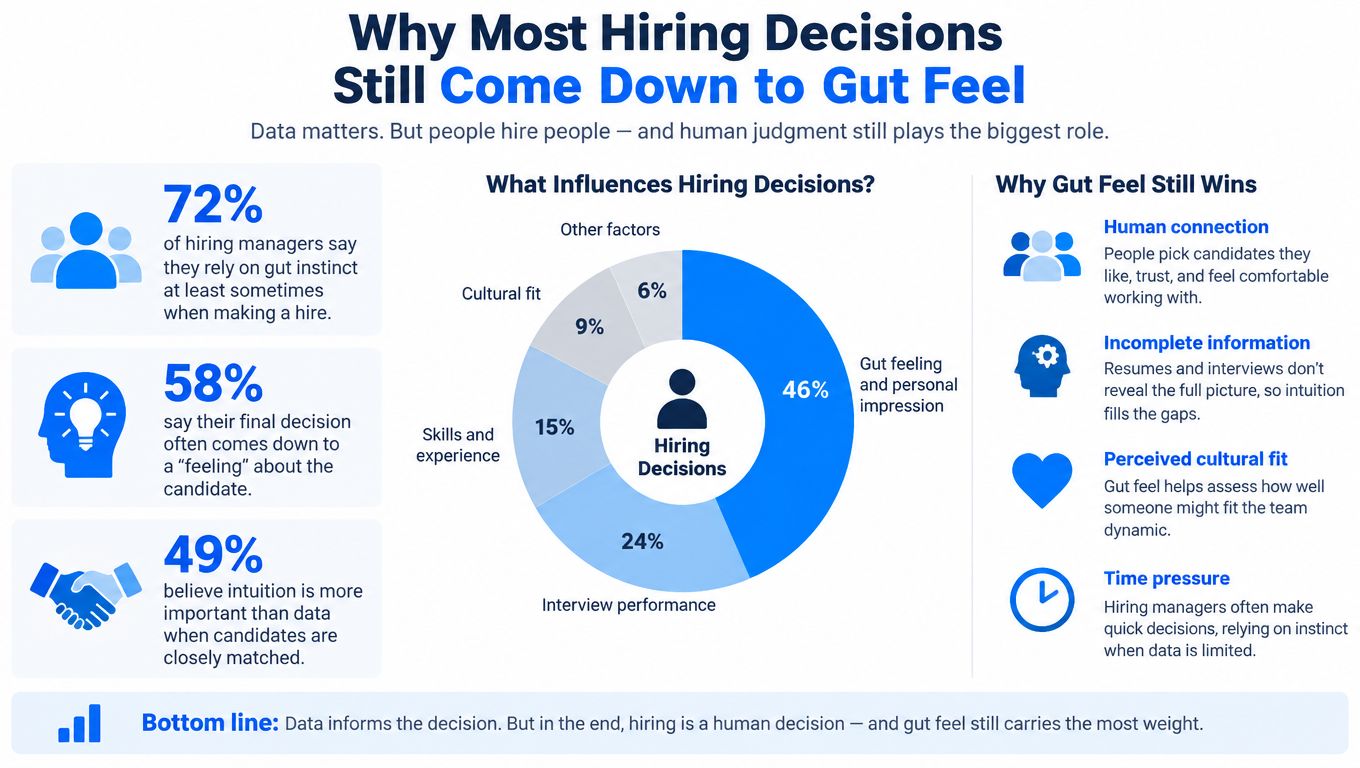
Why Most Hiring Decisions Still Come Down to Gut Feel
A sales manager fast-tracks a candidate who communicates exactly as she does. The candidate is confident, quick in conversation, and comfortable improvising. The panel describes the person as a “great fit,” while nobody records which behaviors demonstrated pipeline management, coaching ability, or commercial judgment.
Two quarters later, the new manager is missing targets and struggling to retain key accounts. The debrief turns into familiar territory: “They just didn't fit.” The original decision can't be reconstructed because the team captured impressions rather than evidence.
Why informal interviews survive
Hiring managers rely on informal interviews because they feel efficient. People believe they can read motivation, capability, and character from a conversation, especially when they're under pressure to fill a role. The problem is that an unstructured discussion gives each candidate a different opportunity and gives each assessor a different standard.
The resulting errors are practical, not theoretical:
- Recency bias: The last answer or strongest anecdote dominates the debrief.
- Similarity bias: “Culture add” often becomes comfort with the interviewer's communication style.
- Weak role linkage: Assessors discuss confidence or likeability without connecting either to future job outcomes.
- Unclear accountability: The hiring team owns the decision, but nobody owns the prediction after the person starts.
The historical development of assessment centers shows why organizations moved toward job-related, structured evaluation. Assessment centers were first used in Germany during World War I, expanded by the U.S. Office of Strategic Services during World War II, and later adopted by AT&T in the 1950s. The method evolved because selection decisions needed more than personal impressions.
Practical rule: If an assessor can't describe the observed behavior and its likely job impact, the score is an opinion, not evidence.
A workable alternative doesn't need to become a six-week assessment marathon. A short structured interview, a role-relevant work sample, and clear decision ownership can create a process managers will follow. The leadership hire that looked perfect on paper is a useful reminder that polished credentials don't replace evidence from the work itself.
Defining the Role Before You Touch an Assessment Tool
Most assessment failures begin before a vendor is selected. A vague job description produces vague competencies, which produce generic questions, which produce scores nobody can defend.
Start with the work. Interview strong performers, their managers, and the stakeholders who depend on the role. Review why previous employees struggled or left. Separate behavior that's essential on day one from capability that can be developed through coaching.
For a Customer Success Manager, a practical profile might look like this:
Sample Competency Matrix for a Customer Success Manager Role
| Competency | Weight | Level 2 Indicator | Level 4 Indicator |
|---|---|---|---|
| Customer diagnosis | High | Responds to stated issues but misses underlying causes | Uses questioning and account evidence to identify root causes |
| Commercial judgment | High | Escalates renewal risks without a clear recommendation | Builds a reasoned retention or expansion plan from customer context |
| Communication | Medium | Provides accurate updates but adjusts poorly to the audience | Explains complex issues clearly and adapts to customer and internal stakeholders |
| Prioritization | Medium | Handles visible requests first, with limited trade-off thinking | Ranks work by customer impact, urgency, and business consequence |
| Cross-functional influence | Medium | Passes issues to product or support without sustained ownership | Aligns internal teams around an agreed customer outcome |
| Learning agility | Low | Needs repeated direction when circumstances change | Applies feedback quickly and changes approach when evidence warrants it |
“High,” “medium,” and “low” should reflect the role's actual failure costs, not executive preference. If a Customer Success Manager loses trust because they can't diagnose account risk, customer diagnosis deserves more weight than a polished presentation style.
Build indicators before questions
Write behavioral indicators for weak, acceptable, and strong performance before drafting interview questions. “Strategic,” “resilient,” and “a team player” aren't scoreable until the team defines what those qualities look like in this job.
Avoid two common mistakes:
- Overloaded profiles: Too many competencies dilute signal and encourage assessors to score everything as average.
- Unexplained weights: If nobody can explain why one competency carries more influence, calibration becomes a negotiation rather than a review of evidence.
The profile also needs a development boundary. A candidate may lack a preferred industry background but still demonstrate the underlying capability. Treating every desirable trait as a must-have eliminates adjacent talent before the assessment begins.
The APA guidance on personnel selection procedures supports this discipline by treating validity as evidence for how score interpretations relate to external criteria. In operational terms, define the role first, map competencies to observable behavior, and decide in advance which later outcomes will test the prediction.
Picking Assessment Methods That Actually Predict Performance
No assessment method answers every hiring question. The useful choice depends on the role, the decision risk, the number of candidates, and the evidence the organization can maintain.
The strongest methods are structured and job-related. A synthesis reported by Test Partnership on structured and unstructured interviews places structured interview validity around 0.42–0.51, compared with approximately 0.19–0.38 for unstructured interviews. The same source reports newer meta-analytic estimates of about 0.40 for job knowledge tests, 0.38 for empirically keyed biodata, 0.33 for work samples, and 0.31 for cognitive ability tests.
Those figures are useful for comparison, not for blindly ranking vendors. A test's relevance, administration, scoring, and validation evidence still matter.
Compare signal with operating cost
| Method | Validity Range | Time per Candidate | Adverse-Impact Risk | Best Used For |
|---|---|---|---|---|
| Structured interview | 0.42–0.51 | Moderate | Manageable with standardization and monitoring | Competencies, judgment, communication |
| Job knowledge test | About 0.40 | Low to moderate | Depends on content and access to preparation | Role-specific knowledge |
| Empirically keyed biodata | About 0.38 | Low | Requires careful validation and documentation | Experience patterns linked to outcomes |
| Work sample test | About 0.33 | Moderate to high | Reduced when tasks are accessible and job-related | Direct demonstration of work |
| Cognitive ability test | About 0.31 in newer estimates | Low | Requires close fairness review | Learning and problem-solving |
| Unstructured interview | 0.19–0.38 | Low | Higher exposure to inconsistent scoring and bias | Informal exploration only, not a primary decision tool |
Cognitive ability can be useful when learning speed and problem-solving are central, but it shouldn't automatically become the foundation of every scorecard. A work sample often gives a more direct view of role performance, while a structured interview reveals reasoning, communication, and decision logic that a task alone may miss.
A blended design usually works better than a single test. Pair a short structured interview with a realistic work sample when you need both explanation and demonstration. Add a personality inventory only if it measures a job-relevant construct that the other methods don't capture. Don't add it because the vendor dashboard looks thorough.
For high-volume screening, a structured questionnaire can standardize early evidence, but the questions still need a clear competency link. A structured questionnaire for candidate evaluation is useful only when the answers feed a defined scoring model rather than creating another subjective review queue.
Use a defensibility budget
For junior, high-volume roles, prioritize short, accessible, job-relevant exercises. For senior roles, invest more time in simulations, multiple assessors, and documented calibration because the decision carries greater organizational risk. For regulated or multinational hiring, select tools whose content, data handling, accessibility, and validation documentation can survive review in every relevant jurisdiction.
The selection rule is simple: choose the smallest toolset that produces enough independent evidence to answer the role's critical questions. More assessments don't automatically create more accuracy. They often create candidate fatigue, administrative delay, and false precision.
Running the Assessment Center or Virtual Equivalent
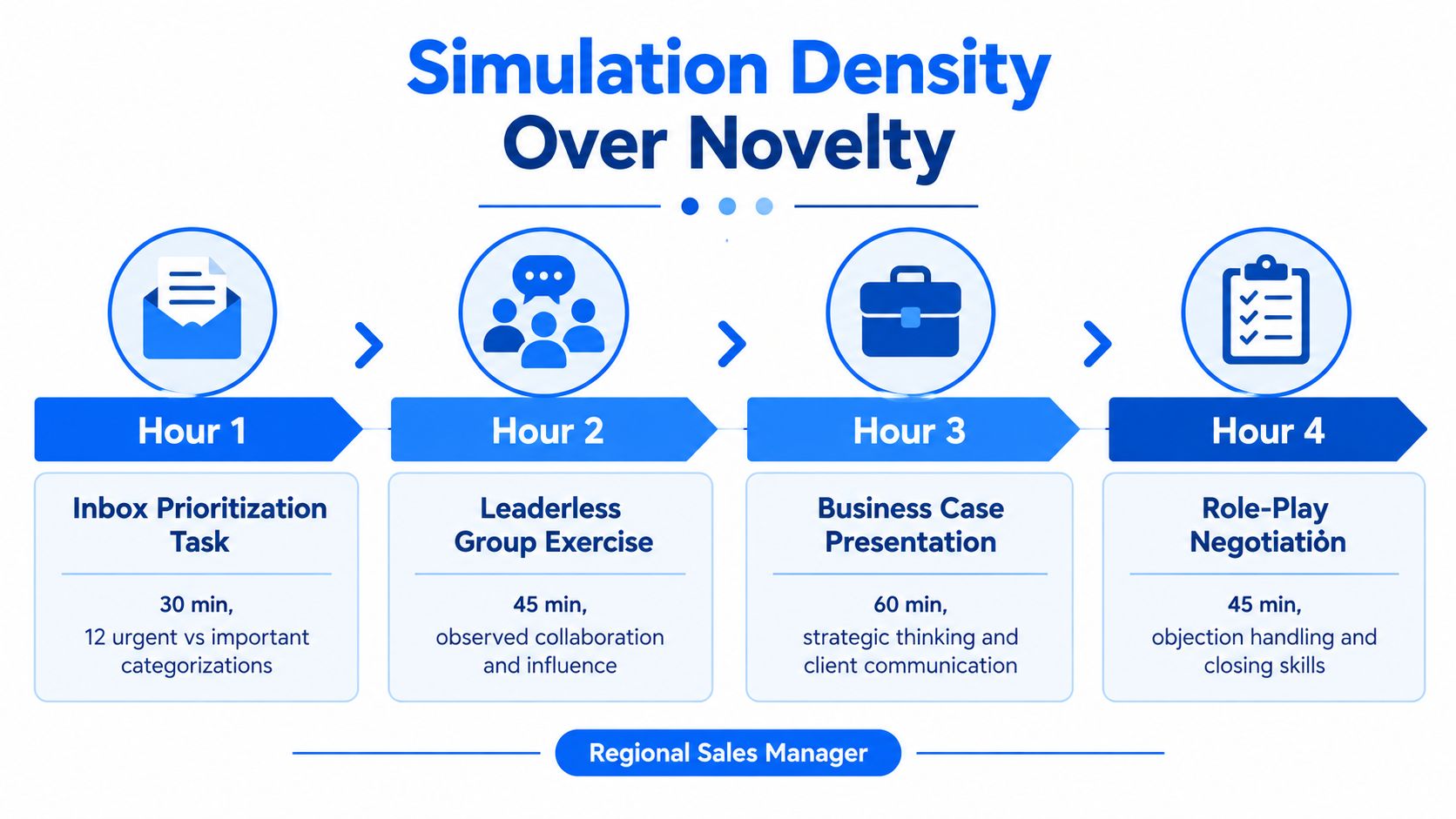
An assessment center should resemble the job, not an escape room. Novelty can impress assessors while producing little useful evidence. Design around simulation density, with each exercise exposing specific behaviors from the role profile.
For a Regional Sales Manager, a four-hour sequence might include a candidate briefing, an inbox prioritization task, a customer role-play, a group exercise, and a structured interview. The exercise design in the schedule below emphasizes realistic trade-offs rather than theatrical challenge.
Design the day around observable behavior
A practical run sheet includes:
- Candidate briefing, 15 minutes: Explain the process, timing, breaks, technology, and how candidates can request support.
- Inbox prioritization, 30 minutes: Give the candidate competing stakeholder demands and ask for a ranked action plan.
- Customer role-play, 20 minutes: Use a frustrated key account scenario to observe listening, diagnosis, negotiation, and ownership.
- Group exercise, 30 minutes: Ask candidates to defend territory plans while facing cost reductions.
- Structured interview: Use two trained assessors and the same questions for every candidate.
- Score consolidation, five minutes before each rotation: Give assessors time to record evidence before discussion begins.
The coordinator manages timing and logistics. The lead assessor for each exercise records observable behaviors against competency anchors. An HR observer flags deviations, such as an assessor adding an unscheduled question or giving one candidate extra coaching.
Keep candidate-to-assessor ratios at no more than 3:1 per exercise when the design requires close observation. Higher ratios make it harder to distinguish individual contributions and increase rater fatigue.
Make virtual delivery equivalent, not easier
A virtual equivalent needs breakout rooms, screen-shared stimuli, controlled timing, and recorded consent where recording is necessary. Test the candidate journey and the assessor journey separately, then rehearse the technology path twice before the first live session.
Give assessors a failure protocol. If a connection drops, the coordinator pauses the clock, records what happened, and applies the same remedy consistently. Don't let technical improvisation become an untracked advantage for one candidate.
A simulation should produce evidence that can be quoted in the score sheet. “Strong presence” isn't enough. “Asked the account lead two clarifying questions, identified renewal risk, and proposed a staged recovery plan” is usable evidence because another assessor can evaluate the same behavior.
The following video can support facilitator preparation, but it shouldn't replace a role-specific exercise design or assessor training.
Scoring, Calibration, and the Selection Conversation
A scorecard fails when it asks assessors to rate “executive presence” or “culture fit” on a scale without defining either term. Use behavioral anchors instead. For a 1–9 scale, describe what a 3, 5, and 7 look like for every competency, then train assessors to record evidence in two sentences: behavior followed by impact.
For example, a score of 7 for strategic prioritization might require the candidate to identify the highest-value customer or product problem, explain the trade-off, and connect the decision to measurable business consequences. A score of 3 might show activity without a clear prioritization principle. The anchor must describe the work, not the assessor's emotional response.
Sample Scoring Rubric for a Senior Product Manager Role
| Competency | Weight | Score (1-9) | Behavioral Anchors Used | Assessor 1 | Assessor 2 | Final Weighted Score |
|---|---|---|---|---|---|---|
| Strategic prioritization | 30% | 7 | States trade-offs, protects strategic outcomes, uses evidence | 7 | 6 | 1.95 |
| Cross-functional influence | 15% | 6 | Builds alignment, handles disagreement, maintains ownership | 6 | 6 | 0.90 |
| Customer insight | 20% | 7 | Distinguishes symptoms from needs, tests assumptions | 7 | 8 | 1.50 |
| Delivery judgment | 20% | 5 | Balances scope, risk, dependencies, and timing | 5 | 5 | 1.00 |
| Communication | 15% | 6 | Makes decisions clear and adjusts to stakeholders | 6 | 6 | 0.90 |
The table illustrates the mechanics, but the underlying calculation should be documented in the protocol. If strategic prioritization carries 30% and cross-functional influence carries 15%, the candidate file should state why those weights reflect the role's success conditions. A weighting scheme that exists only in a spreadsheet is difficult to defend when a finalist challenges the outcome.
Calibrate evidence before personalities
Have assessors score independently before meeting. Compare scores within each exercise first, then compare across exercises. A large difference within one exercise usually indicates confusion about the competency or the anchor. It's less useful to debate a candidate's overall “fit” before resolving that definition problem.
A 45-minute calibration meeting per candidate can follow this sequence:
- Independent review: Each assessor submits scores and evidence before discussion.
- Gap identification: Surface score differences above two points.
- Evidence testing: Ask what the candidate did, what impact followed, and which anchor supports the score.
- Risk review: Record missing evidence, inconsistent behavior, and limitations in any method used.
- Decision record: Document the threshold call and the conditions of the recommendation.
The final recommendation should fit on one page. Include a competency heatmap, weighted score, threshold decision, evidence summary, and risk notes. A structured executive search approach can incorporate this kind of evidence discipline when the role requires judgment beyond résumé screening.
Evidence beats advocacy: The loudest assessor shouldn't win the meeting. The strongest documented behavior should.
Post-Hire Tracking and Legal Defensibility at Scale
The hire isn't the deliverable. It's a sample that lets HR test whether the assessment predicted anything useful.
Track the employee against the original prediction band rather than celebrating a successful start and forgetting the process. Useful measures include performance ratings at six and twelve months, voluntary attrition, time in role before promotion or transfer, assessment score distributions, and the completeness of the documentation trail.
Build the evidence loop
The 2018 Talent Assessment Study compiled 2,338,734 assessments involving 1,757,736 candidates across 21 industries. It reported 744,000 assessments in 2016 and 1,594,000 in 2017, a 114% year-over-year increase, and summarized research reporting assessment-center use by 80–90% of Fortune 500 companies, with validity coefficients reaching 0.65 for predicting job performance.
Scale creates an obligation to learn from outcomes. Publish internal relationships between assessment bands and later performance so business leaders can challenge a weak role profile instead of blaming the tool after a poor hire. If scores don't distinguish outcomes, investigate the role model, administration, assessor behavior, and measurement itself.
Document decisions across jurisdictions
Compliance work has to be operational. UK and EU pressure is pushing organizations toward transparent, validated, skills-based assessment with documented adverse-impact monitoring, while fragmented tools can create hidden administration and compliance costs, as discussed in coverage of AI, fairness, and talent assessment trends for 2026. That source discusses a future-oriented topic, so treat its 2026 framing as forward-looking rather than as a settled current requirement.
A scalable control system should include:
- Fairness review: Run adverse-impact monitoring at a defined cadence and investigate any flagged stage, from application screen through final interview.
- Record retention: Set a documented retention policy for raw notes, score sheets, and recordings that reflects local law and legitimate business need.
- Access logging: Keep a separate audit trail showing who accessed each candidate file and when.
- Regional redundancy: Maintain assessor coverage across regions so one deletion request or local system failure doesn't erase the entire evidence base.
- Annual validation review: Retire exercises when their predictive value no longer justifies their candidate and administrative burden.
Don't promise candidates that an algorithm made the decision. State what was assessed, how it was scored, who reviewed it, and how candidates can request support or challenge process irregularities.
Putting the Whole Talent Assessment Process Together
A repeatable talent assessment process is a governed workflow, not a collection of tools. Run it in this order:
- Create the profile and competency matrix. Avoid buying an assessment before defining success.
- Select and pilot methods. Don't launch an untested exercise across regions.
- Train assessors. Skipping training saves time only by moving the cost into inconsistent scoring.
- Schedule candidates and explain the process. Don't surprise candidates with unexplained tests.
- Administer exercises consistently. Record deviations and technical incidents.
- Score independently and calibrate. Don't let seniority substitute for evidence.
- Issue the hiring recommendation. Include weighted results, threshold calls, and risks.
- Track post-hire outcomes and refine the process. Don't treat the offer acceptance as the endpoint.
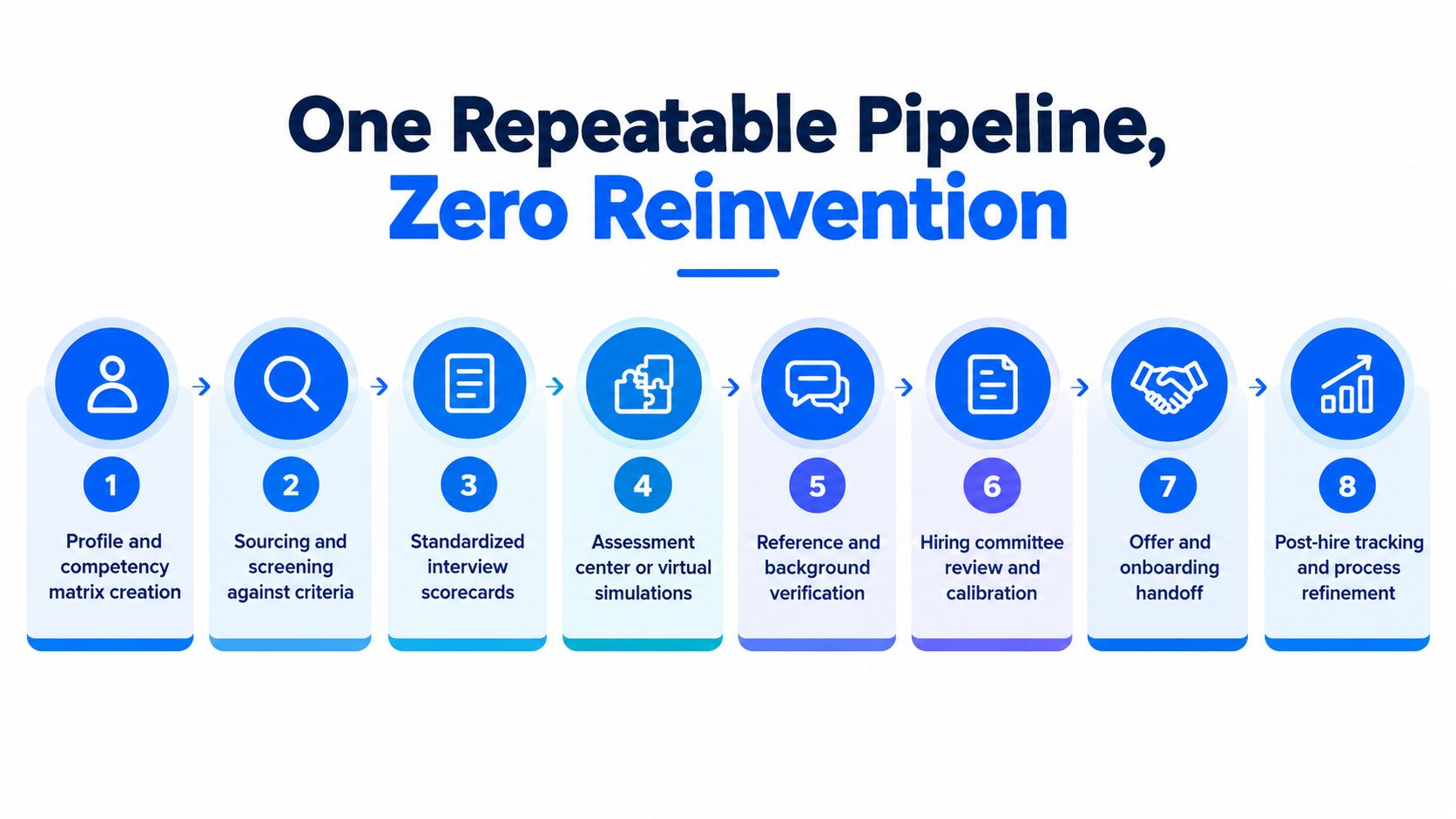
Two governance artifacts keep the workflow from drifting. The first is a written protocol that states what runs, why each method exists, how scores are combined, and what evidence assessors must record. The second is a recurring review of score distributions, process deviations, fairness indicators, and downstream performance relationships.
Review the program whenever the work changes, not only when hiring results deteriorate. Assessment processes decay when responsibilities, tools, markets, or leadership expectations move faster than the competency model.
AnyBPO helps organizations define and evaluate senior talent through structured assessment of skills, experience, leadership style, and cultural fit, with language assessment covering speaking, writing, reading, and listening where relevant. If your hiring process needs clearer role criteria, stronger executive evaluation, or a more defensible assessment workflow, visit AnyBPO to discuss the right support for your organization.