
Most enterprise buyers don't want a sales rep for every step, and they don't want to be left alone for the hard ones either. That tension explains why picking from the different Types of Sales is a strategic decision, not a personality test for your sellers. Get it wrong and a capable provider becomes a commodity bidder, judged on rate cards before anyone understands the problem.
Scale alone demands different motions. In 2019, worldwide e-commerce reached approximately $26.7 trillion, about 30% of global GDP, and B2B transactions accounted for $21.8 trillion, or 82% of all e-commerce, while B2C generated an estimated $4.9 trillion, according to UNCTAD's global e-commerce assessment. B2B deals carry multiple decision-makers, negotiated contracts, implementation work, and service-level agreements. B2C deals move faster, with standardized products and pricing built for personal use.
There's no single best model. An enterprise software sale, a strategic outsourcing agreement, and a referral-led market entry need different discovery methods, commercial structures, and relationship models. Use the nine approaches below as tools matched to deal complexity, buying group, contract value, service risk, channel access, and the outcome you can credibly influence.
Table of Contents
- 1. Consultative Selling
- 2. SPIN Selling
- 3. The Challenger Sale
- 4. Solution Selling
- 5. Strategic Account Selling
- 6. Account-Based Selling (ABM)
- 7. Channel and Partner Sales (Indirect Sales)
- 8. RFP and RFI-Driven Competitive Selling
- 9. Outcome-Based and Gainshare Pricing Contracts
- Comparison Guide: Choosing Between the Nine Approaches
- Build a Sales Model That Fits the Buying Decision
1. Consultative Selling
Consultative selling starts with diagnosis, not a deck. The seller acts as a trusted advisor, asks open-ended questions, finds root causes, and co-develops the plan before recommending anything. That matters in BPO because outsourcing changes operations, cost structures, and customer experience at the same time, so buyers expect advice before commitment.
The evidence points to a split preference you should design around. 61% of B2B buyers preferred an overall representative-free experience, yet buyers still wanted seller input for contextual tasks such as judging whether an offering fits their organization, per Gartner's 2025 sales survey on rep-free buying. So automate education and comparison, then bring in consultative help for fit, risk, and internal alignment.

What It Looks Like in Practice
A BPO provider runs a diagnostic workshop on a client's contact center performance before proposing a multi-channel support model. An advisory firm reviews cost-to-serve and recommends a phased nearshore transition instead of a full offshore move, even though the smaller first step means a smaller first contract.
- Prepare diagnostic questions: Tie three to five questions to KPIs the client already tracks, such as first contact resolution, average handle time, or cost per contact.
- Lead with benchmarks: Share market insight before any proposal so your recommendation reads as analysis, not a pitch.
- Reflect priorities back: Document the client's stated priorities and mirror them, in their words, in the final recommendation.
That independent posture is the product. If you want that vendor-neutral view built into your selection process, use AnyBPO's advisory support for provider decisions rather than relying only on seller-led discovery.
2. SPIN Selling
The visual below maps the four question types that give SPIN its structure.
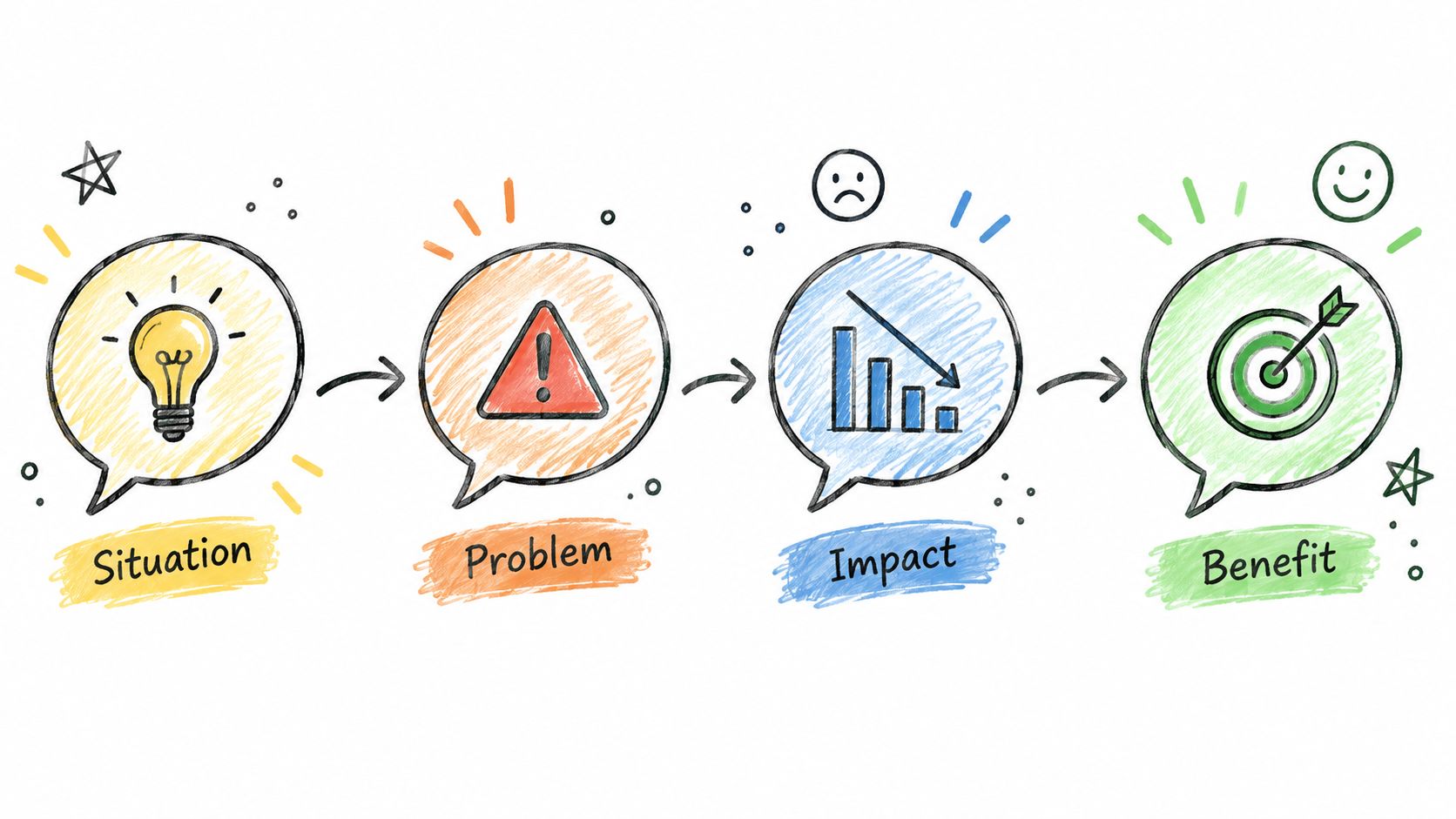
SPIN stands for Situation, Problem, Implication, and Need-payoff. You gather facts, uncover problems, explore what those problems cost, then let the buyer articulate the value of fixing them. It's built for complex, high-consideration purchases where a champion must justify investment to people who weren't on your call.
Run it on a contact center deal and it sounds like this. You ask about current average speed of answer (Situation), surface rising abandonment rates (Problem), quantify the revenue walking away with each abandoned call (Implication), then ask how faster resolution would affect retention (Need-payoff). The buyer builds the business case in their own words, which is exactly what they'll repeat internally.
Keeping the Question Balance Right
- Limit Situation questions: Facts bore senior buyers, so move to Problem questions quickly.
- Make Implications specific: Connect consequences to revenue, churn, or compliance exposure, not vague inefficiency.
- Let the buyer state value: Need-payoff answers carry more weight than your claims.
- Review recorded calls: Check whether your reps rush to pitch before implications are fully explored.
The walkthrough below shows how the sequence works in a live conversation.
Use SPIN when the problem is real but not yet urgent. Don't use it for simple, standardized purchases where deep questioning only slows a decision the buyer could make alone.
3. The Challenger Sale
Challenger reps don't wait for buyers to define the problem. They teach something new, tailor it to each stakeholder, and take control of the commercial conversation, including price. You challenge assumptions instead of politely responding to a requirements list someone else wrote.

A BPO advisor, for example, shows a client that its incumbent's per-minute pricing hides a rising cost per resolution, which reframes the buying criteria overnight. A provider teaches a retail client that AI-assisted routing can cut handle times, then tailors that insight to the CFO's margin goals instead of the CX team's satisfaction targets. Same insight, different conversation.
Practical rule: Challenge with a hypothesis, not an accusation. "Here's what the data suggests, let's test it against your numbers" opens doors that "you're doing this wrong" closes.
Build the Insight Before Outreach
Don't improvise your teaching point on the call. Build a unique insight library from benchmarks and delivery data first, then segment it by role. CFOs care about cost trajectory, COOs care about service levels, CX leaders care about satisfaction and effort scores.
Set commercial guardrails before negotiations start, too. A Challenger who wins the argument but caves on terms has just taught the buyer that pressure works. Decide your walk-away points on pricing, scope, and contract length in advance, and hold them.
4. Solution Selling
Solution selling maps a specific business problem to a customized bundle of products, services, and support, then ties every component to a measurable outcome. In BPO that usually means packaging people, process, and technology into one integrated service model instead of selling seats.
A telecom provider might combine omnichannel customer care, workforce management software, and quality assurance into a single service model. A multi-regional service desk offering might integrate ticketing tools, language coverage, and SLA reporting to fix fragmented support across countries. In both cases the buyer purchases an outcome, not a headcount.
Self-service fits this motion as an evidence layer, not a replacement for it. 75% of B2B buyers prefer a rep-free sales experience and buyers familiar with a service show a 64% preference for a fully digital buying experience, yet self-service purchases are more likely to produce buyer regret, according to Gartner's B2B buying journey research. Publish capability taxonomies, coverage, and compliance documents digitally, then escalate to solution design when scope or integration risk rises.
Design Discipline That Prevents Overselling
- Write the one-pager first: Current-state problem and target-state outcome on a single page before you propose.
- Keep bundles modular: Let clients start with a pilot scope instead of forcing a full transformation.
- Build a value map: Link each component to a named KPI.
- Bring delivery leads in early: They'll stop unrealistic commitments before they're signed.
5. Strategic Account Selling
Strategic account selling concentrates senior effort on a small number of high-value enterprise accounts over multiple years. You map the buying group, build executive relationships, and coordinate one team across regions and service lines. For global BPO accounts that span several countries, uncoordinated selling creates conflicting promises fast.
The buying group is the obstacle. 74% of B2B buying teams experienced unhealthy conflict during decisions, while groups reaching consensus were 2.5 times more likely to report a high-quality deal, and tailoring information to buying-group relevance improved consensus by 20%, as reported in Gartner's 2025 buying team survey. Your job is building defensible agreement among finance, operations, IT, legal, procurement, and executives.
How Strong Account Teams Operate
A global BPO provider runs quarterly executive business reviews with a Fortune 500 client to expand from one market into several. Another maps procurement, operations, and IT stakeholders before pitching expansion into service desk and digital support, so each group hears its own success criteria addressed.
- Maintain a stakeholder map: Record influence, sentiment, and decision authority for every buyer.
- Set a joint account plan: Agree shared success metrics with the client, not for them.
- Assign an executive sponsor: One named senior owner per strategic account.
- Review health monthly: Watch satisfaction scores and escalation trends as leading indicators.
Large accounts also need structured support on the buyer's side, which is where AnyBPO's enterprise services for complex outsourcing programs fit the selection and governance work.
6. Account-Based Selling (ABM)
ABM flips the funnel. Instead of casting a wide net, sales and marketing jointly pick a defined list of high-potential accounts and deliver personalized outreach to each one. You're investing in named companies that match your ideal customer profile, not hoping the right ones find you.

A BPO advisory firm might target mid-market companies planning nearshore expansion and send each one customized market-entry research referencing its actual countries and hiring plans. A private equity firm might build a target list of BPO providers with recurring revenue and run personalized outreach around acquisition criteria. Generic campaigns can't do either of those jobs.
ABM fails when the list is too long. If every account gets a "personalized" one-pager, none of them are personalized, and your team burns out producing content nobody reads.
Execution Priorities
- Define the profile tightly: Region, headcount, service lines, and growth signals.
- Write account-specific one-pagers: Reference the client's markets and challenges by name.
- Track at account level: Stakeholders reached and meetings booked matter more than raw clicks.
- Use intent signals: CX leadership hiring and expansion announcements tell you when to move.
Measure ABM on qualified pipeline per target account. If engagement rises but no buying group forms, you've produced content, not demand.
7. Channel and Partner Sales (Indirect Sales)
Channel sales reach buyers through third parties, including resellers, referral partners, system integrators, and alliance partners. The partner brings customer access and local trust, while you supply delivery capability. In BPO, referral and alliance routes are often how providers enter regions where they have no brand.
These routes coexist more than most org charts admit. In University of Mannheim B2B channel research, direct channels represented 64.9% of channel use, indirect 34.5%, and hybrid 0.6%, while 60% of B2B companies used indirect channels and nearly 90% used multichannel systems, per the University of Mannheim B2B channel analysis. Direct gives you control over pricing, data, and solution quality. Indirect lowers market-entry cost and speeds access to established networks.
A BPO provider partnering with a regional system integrator in Latin America to offer managed CX services is the classic pattern. Major enterprise software vendors run a similar model, with certified BPO firms delivering implementation and support under partner programs.
Governance Before Growth
- Vet partners consistently: Performance history, certifications, and client references for every partner.
- Set deal registration rules: Clear lead ownership prevents channel conflict before it starts.
- Arm partners properly: Playbooks, case evidence, and pricing guidelines, not just a logo.
- Review quarterly: Joint pipeline targets with consequences for partners who don't produce.
8. RFP and RFI-Driven Competitive Selling
Procurement-led selling runs on documents. Buyers issue a Request for Information to scan the market, then a Request for Proposal to compare shortlisted vendors against structured requirements, pricing templates, and scoring criteria. For large BPO contracts, this is still the dominant route because buyers need comparable bids and formal governance.
A Fortune 500 company might issue an RFI to a long list of providers, shortlist a handful, then run an RFP covering scope, SLAs, security, and data residency. A multi-regional service desk tender might score vendors on language coverage, tooling integration, and transition risk. If you first meet the buyer when the RFP lands, someone else already shaped the criteria.
Win Before the Document Arrives
- Engage early: Help shape requirements and evaluation criteria during the RFI stage.
- Qualify ruthlessly: Decline low-fit bids and protect your solution team's time for winnable deals.
- Answer every criterion explicitly: Reference evidence, including performance data and certifications, beside each response.
- Maintain an answer library: Security, compliance, and transition methodology responses ready to tailor, not rewrite.
Discipline check: A rigorous no-bid decision is a revenue decision. Chasing unwinnable tenders starves the deals your delivery team can actually win and perform on.
Track your shortlist rate and win rate separately. A high shortlist rate with a low win rate means your proposals are credible but undifferentiated, which is a positioning problem, not an effort problem.
9. Outcome-Based and Gainshare Pricing Contracts
Outcome-based contracts tie part of the provider's fees to agreed performance results, such as cost reduction, resolution rates, or customer satisfaction. Gainshare arrangements go further and split verified savings between client and provider. Buyers request these models because they shift delivery risk to the party claiming it can perform.
A BPO provider might accept a portion of fees tied to first contact resolution and satisfaction targets across a multi-year contract. A transformation program might share automation savings once agreed cost-to-serve reductions are verified against a baseline. Both structures align incentives, but only if measurement is airtight.
Contracting Rules That Keep Gainshare Honest
- Start with few KPIs: Pick a small set both parties can verify from the same data.
- Fix baselines in writing: Agree measurement methods, data sources, and adjustment rules before signing.
- Write dispute provisions now: Define data governance and resolution steps while everyone still agrees.
- Set targets from evidence: Use performance from past engagements, not sales optimism.
Don't accept outcome risk on metrics you don't control. If the client owns the product defects driving contact volume, tie your fees to resolution quality instead, and say so during negotiation. Providers structuring these deals should review AnyBPO's outsourcing business services and commercial models before committing to shared-risk terms.
Done well, gainshare turns a vendor into an investment partner. Done loosely, it turns every monthly invoice into an argument.
Comparison Guide: Choosing Between the Nine Approaches
| Approach | 🔄 Implementation Complexity | ⚡ Resource Requirements | 📊 Expected Outcome | ⭐ Ideal Use Case | 💡 Key Advantage |
|---|---|---|---|---|---|
| Consultative Selling | High; discovery-led and customized to each buyer | Skilled advisors; research and enablement | Stronger trust, better-fit deals, and long-term relationships | Enterprise buyers assessing BPO partners | Reduces scope mismatch and differentiates the provider |
| SPIN Selling | Moderate; structured four-stage questioning | Trained sellers; call preparation and review | Clearer business cases and progression of complex deals | Multi-stakeholder, high-value outsourcing decisions | Helps buyers quantify the cost of inaction |
| The Challenger Sale | High; requires relevant insight and confident delivery | Industry expertise; benchmark data and negotiation training | Greater differentiation, urgency, and pricing discipline | Complex enterprise deals with similar competing offers | Reframes buyer assumptions with role-specific insights |
| Solution Selling | High; involves coordinated solution design | Sales, operations, and technical teams | Custom bundles linked to measurable outcomes | Enterprises seeking integrated BPO services | Connects business problems to specific service components |
| Strategic Account Selling | High; ongoing planning and coordination | Dedicated account teams and executive sponsors | Higher retention, account growth, and share of wallet | Large, multi-region enterprise accounts | Builds durable relationships across the buying organization |
| Account-Based Selling (ABM) | High; sales and marketing must align | Account data, personalized content, and coordinated outreach | More engagement and pipeline from target accounts | Focused outreach to high-potential BPO buyers or partners | Concentrates effort on selected accounts |
| Channel and Partner Sales | Moderate to high; requires partner governance | Partner enablement, co-marketing, and deal management | Broader reach and faster entry into new markets | Providers expanding through alliances or local partners | Extends market access without a large direct sales team |
| RFP and RFI-Driven Competitive Selling | High; formal, deadline-driven process | Bid teams; compliance, pricing, and proposal resources | Comparable bids and qualified opportunities, with competitive win rates | Large enterprise outsourcing procurements | Provides clear evaluation criteria and a structured process |
| Outcome-Based and Gainshare Pricing Contracts | High; requires agreed metrics and governance | Reliable data, measurement systems, and contract expertise | Shared incentives and verified performance or savings | Long-term outsourcing or transformation with risk-sharing | Aligns provider fees with client outcomes |
Build a Sales Model That Fits the Buying Decision
Start with four decisions before you invest in enablement. Who owns the buyer relationship, how will value be discovered, how will the offer and risk be structured, and how will you reach the market? Every model above answers at least one of those questions, and none answers all four.
That's why strong enterprise and BPO teams combine approaches. They run consultative discovery with SPIN qualification, design integrated solutions, manage strategic accounts over years, and sign outcome-linked contracts, while ABM, channel partners, and formal RFP processes handle market access. The Challenger Sale sharpens the conversation inside any of those motions when a buyer's assumptions are costing them money.
The hybrid evidence supports that combination. More than half of surveyed buyers want a consistent experience across channels, and buyers are 1.8 times more likely to complete a high-quality deal when they use supplier-provided digital tools together with a sales representative, while 69% of B2B buyers observed inconsistencies between website information and seller information, as reported in McKinsey's research on how B2B winners keep growing. Build digital-first, human-assisted journeys with one synchronized knowledge base, so your website, partners, and reps tell the same story.
Match the model to the buying task, not to your org chart. Use self-service for education and comparison, consultative and solution selling for fit and risk, and strategic account selling where consensus across a buying committee decides the outcome. A large but standardized purchase may only need efficient transactional support, while a smaller deal carrying regulatory or reputational risk deserves full consultative facilitation.
Pilot your chosen model on one segment before rolling it out widely. Measure channel handoff quality, time to qualified opportunity, proposal conversion, implementation success, and post-sale regret, not just lead volume. Two quarters of pilot data will expose enablement gaps, pricing problems, and handoff failures while they're still cheap to fix.
For independent selection, partner vetting, market expansion, and post-contract optimization, AnyBPO can support requirements definition through its provider network, advisory services, and AI-assisted matching capabilities. That gives buying teams verified evidence and structured comparisons instead of seller-supplied claims, which is the foundation every model in this guide depends on.
AnyBPO helps enterprises and BPO providers choose partners through independent advisory, structured provider vetting, and AI-assisted matching across its global network. If you're redesigning your sales model, evaluating outsourcing partners, or entering a new market, visit AnyBPO to define your requirements and get matched with vetted providers that fit your scope, regions, and commercial goals.