
Most advice about the delegate leadership style tells managers to step back and trust capable people. That advice is incomplete, and in a distributed BPO operation it can be expensive. A regional operations director can give a delivery team broad autonomy, stop attending its working meetings, and then discover that quality decisions, adherence responses, and client communication have drifted in different directions.
The failure doesn't prove delegation is ineffective. It proves that autonomy without decision boundaries is abandonment. A strong delegate leader pushes authority downward, but also pushes down the data, escalation rights, success measures, and feedback channels required to use that authority responsibly. In global outsourcing, delegation isn't a personality trait. It's an operating system for deciding who acts, within which limits, and who remains accountable when the result affects customers, employees, or the client.
Table of Contents
- Why the Set and Forget Leadership Myth Is Costing You
- What Delegate Leadership Means
- What the Research Shows
- Strengths Weaknesses and the Quick Decision Test
- Putting the Style to Work in BPO and Outsourcing Teams
- Calibrating Delegation Across Cultures and Power Distance
- When Your Delegate Is an AI Agent
- A 90-Day Plan to Adopt or Adapt the Style
Why the Set and Forget Leadership Myth Is Costing You
The “set and forget” version of delegation fails because it confuses less intervention with less leadership. A manager who disappears after assigning ownership hasn't built real autonomy. They've created uncertainty about priorities, approval rights, and the point at which a local decision becomes an enterprise risk.
That uncertainty spreads quickly across a BPO network. One site may protect service quality by adding coaching time, another may prioritize productivity, and a third may change a process without checking its effect on compliance. Each team can believe it is acting reasonably while the account produces inconsistent outcomes. By the time the client notices, the executive is reviewing symptoms rather than managing the original decision design.
The correct model is structured autonomy. The leader defines the destination, the operating constraints, the measures that matter, and the circumstances that require escalation. The team decides how to execute inside those boundaries. This distinction matters because a delegated owner needs both discretion and the means to exercise it.
Operational rule: If an employee owns a decision, give that employee the information, authority, and escalation path needed to make it.
Research connects delegation with psychological empowerment, and links it with feedback-seeking behavior, while also showing that cultural power distance can affect how delegated authority translates into genuine authority. The evidence comes from a Frontiers in Psychology study on delegation and empowerment, but the operational lesson is straightforward. Teams don't experience autonomy because a leader uses the word “empowerment.” They experience it when managers consistently respect defined decision rights and respond constructively when teams raise risks.
A delegate leadership style therefore needs visible architecture behind a relatively quiet manager. Without that architecture, hands-off leadership looks like neglect. With it, leaders can reduce unnecessary approvals while preserving control over client commitments, compliance, workforce changes, and financial exposure.
What Delegate Leadership Means
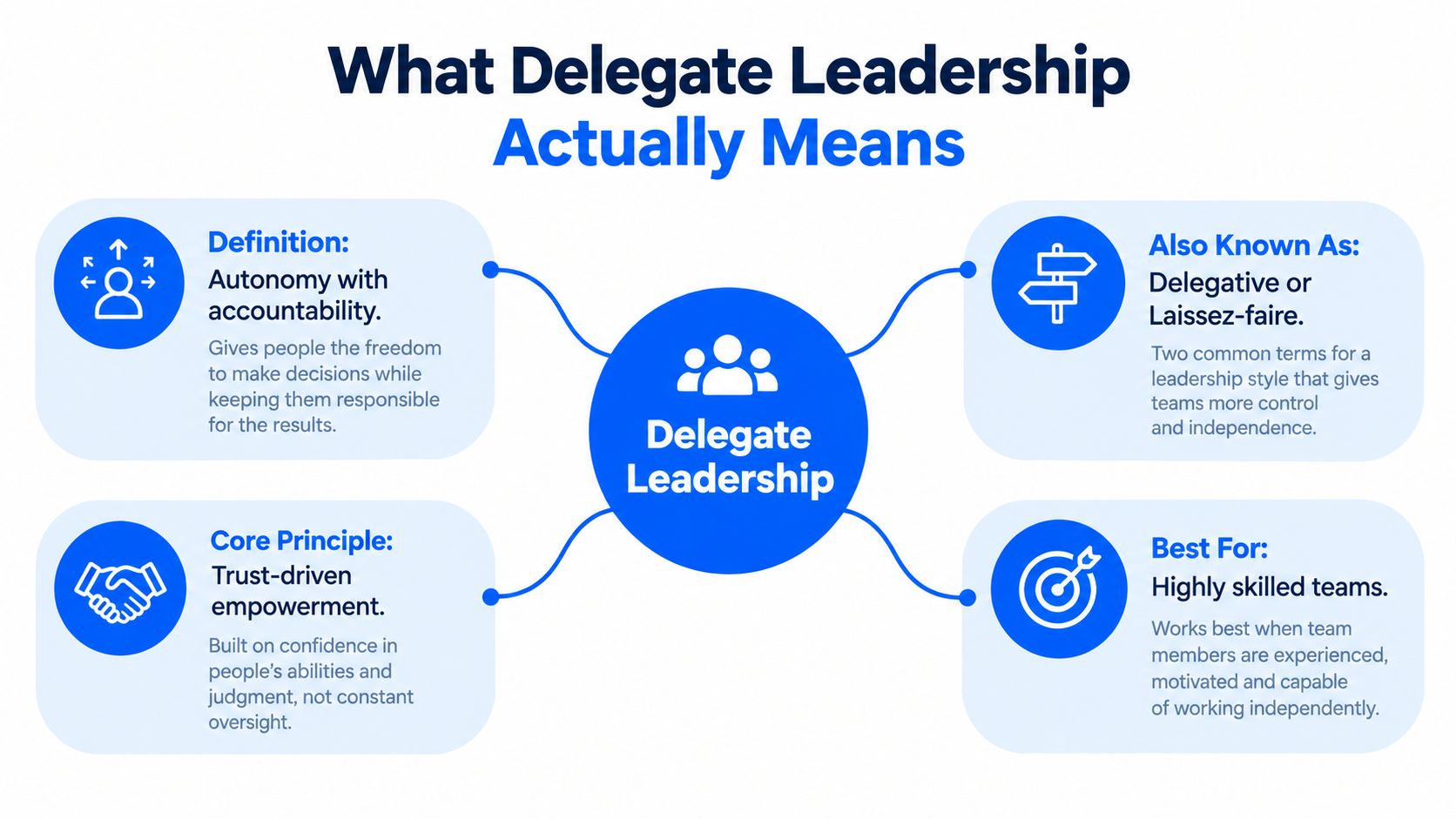
The delegate leadership style, also called delegative or laissez-faire leadership, gives employees authority over selected decisions while the leader remains accountable for results. The decisive question is whether the employee can choose the method, change the process, allocate resources, and resolve exceptions. Assigning a task without those rights is workload transfer, not delegation.
A ship captain provides a useful comparison. The captain sets the destination, confirms safety rules, and remains accountable for the voyage. Navigation officers choose routes around changing conditions because they have the information and expertise. The captain does not approve every course adjustment, yet stays available when a storm demands intervention.
Authority is different from participation
A participative or democratic leader asks employees for input before deciding. A transformational leader aligns people around change and a future state. A directive leader keeps decision authority and tells the team what to do. A delegate leader transfers ownership of selected decisions, not merely the opportunity to comment.
The leader still defines:
- Outcome requirements, such as service quality, client commitments, or risk limits.
- Decision boundaries, including what the owner may change independently.
- Escalation conditions, such as material customer impact or regulatory exposure.
- Review mechanisms, including the measures and cadence used to assess results.
Delegation works when a team can choose how to achieve an agreed result without requesting permission for every operational adjustment. It becomes task dumping when the leader assigns work but withholds the authority, information, or resources required to complete it.
For global BPO teams, this structure should be written into operating procedures. Specify which decisions an agent, team lead, or vendor manager owns, and define the conditions that return a decision to the client or senior manager. That risk-calibrated design gives skilled employees room to act without turning distributed operations into unmanaged discretion.
The style suits experienced teams that can interpret data, assess trade-offs, and act without constant supervision. Coaching continues, but it targets capability, judgment, and outcomes rather than control of every step.
The accompanying explainer video on delegative leadership can give teams shared terminology. Terminology does not fix unclear governance. Document who decides, who must be consulted, and who answers for the result.
What the Research Shows
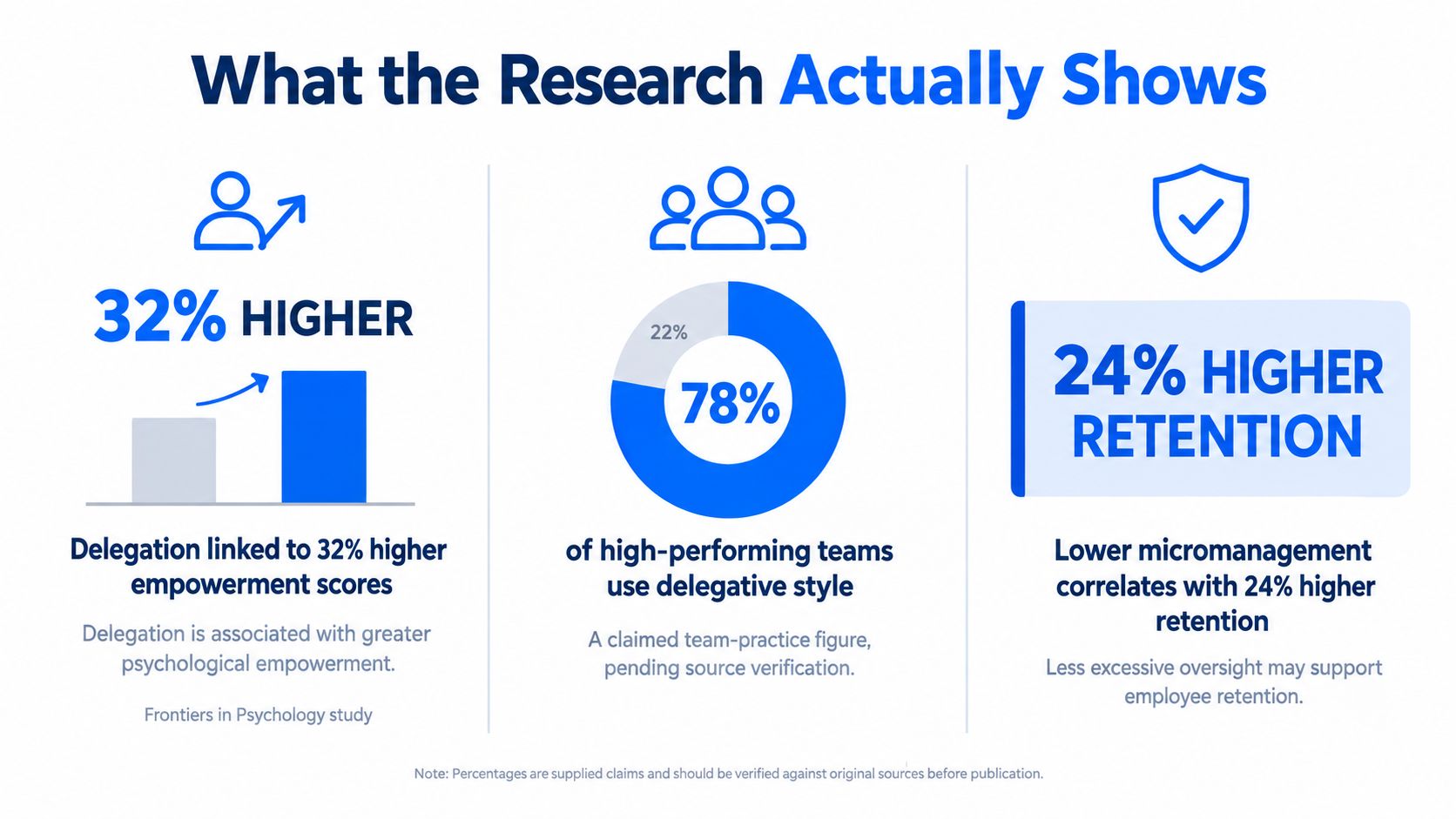
Research supports delegation when authority matches capability, information, and risk. It does not support the claim that more autonomy automatically improves performance. As noted in the Frontiers in Psychology study cited earlier, delegation is linked through earlier findings summarized in the study with job satisfaction, organizational commitment, novel behavior, and task performance. The study also connects delegation with psychological agency, which is associated with feedback-seeking behavior.
That relationship matters in operations. Teams with real decision rights are more likely to seek information, challenge assumptions, and request feedback before an issue becomes a client escalation. Power distance moderates the result. National and organizational cultures that accept larger authority gaps can affect whether delegated power feels like genuine autonomy or merely a transfer of responsibility.
A 2022 peer-reviewed study of 368 employees in Portugal measured task complexity, engagement, shared leadership, flexibility, and delegation on a five-point scale. The average delegation score was 3.69, compared with 4.37 for task complexity, 4.31 for engagement, 4.22 for shared leadership, and 4.28 for flexibility, as reported in the study published in Social Sciences. The relationship between delegation and task complexity was statistically significant, with a reported test statistic of 18.58 and p < 0.001.
The lower delegation average points to an operational problem. Organizations may endorse autonomy while applying it inconsistently. In complex BPO work, leaders often ask teams to take ownership, then override them when the first difficult trade-off appears. That pattern teaches employees to wait for approval.
Information quality determines decision quality
Research on shared leadership adds a necessary constraint. It found a statistically significant positive relationship between shared leadership and decision thoroughness, reported as γ = 0.256, p < 0.01**. Its direct relationship with decision quality was not significant, reported as **γ = 0.108, p > 0.05. Decision thoroughness mediated the path to better decision quality, according to the research paper available through the University of Trento repository.
Delegation creates value when it improves the information entering a decision. Stopping managerial approval is not enough. Distributed ownership should include pre-decision input, documented assumptions, structured dissent for material choices, and outcome reviews.
A study of 2,478 U.S. participants found that delegating a decision can create interpersonal costs for managers compared with retaining authority while soliciting advice. Those costs were more likely when the decision could produce serious negative consequences, fell outside the employee's normal role, or primarily affected other stakeholders, as described in research on strategic decision delegation. Strong leaders accept that discomfort and still assign decision rights according to risk instead of keeping every visible decision for themselves.
Strengths Weaknesses and the Quick Decision Test
Delegation works best when the people closest to the work can act faster and understand the local conditions better than an executive several layers away. A workforce planning lead may see an adherence risk before the account director does. A QA manager may understand a sampling problem before the regional president sees a trend. Authority at the point of knowledge can improve responsiveness and ownership.
The weaknesses are equally practical. Distributed decisions can create inconsistent methods, especially when teams interpret broad goals differently. New or underprepared managers may treat delegated responsibility as permission to improvise without checking dependencies. A senior leader may also delegate a visible decision, dislike the result, and reclaim authority, teaching the team that ownership is temporary.
Use four questions before you delegate
Ask these questions before assigning decision rights:
- Can the decision be reversed? A reversible staffing adjustment is safer to delegate than an irreversible client commitment.
- Does it fit the employee's normal role? Role alignment reduces confusion and lowers the interpersonal cost of delegation.
- Does the employee have the capability and data? Trust doesn't compensate for missing access, context, or technical judgment.
- Who carries the impact? If the decision primarily affects other customers, functions, or regulated obligations, set a higher escalation requirement.
If most answers support delegation, delegate the decision with a clear boundary. If the answers are mixed, coach the employee, retain final approval, or delegate a recommendation rather than the final call.
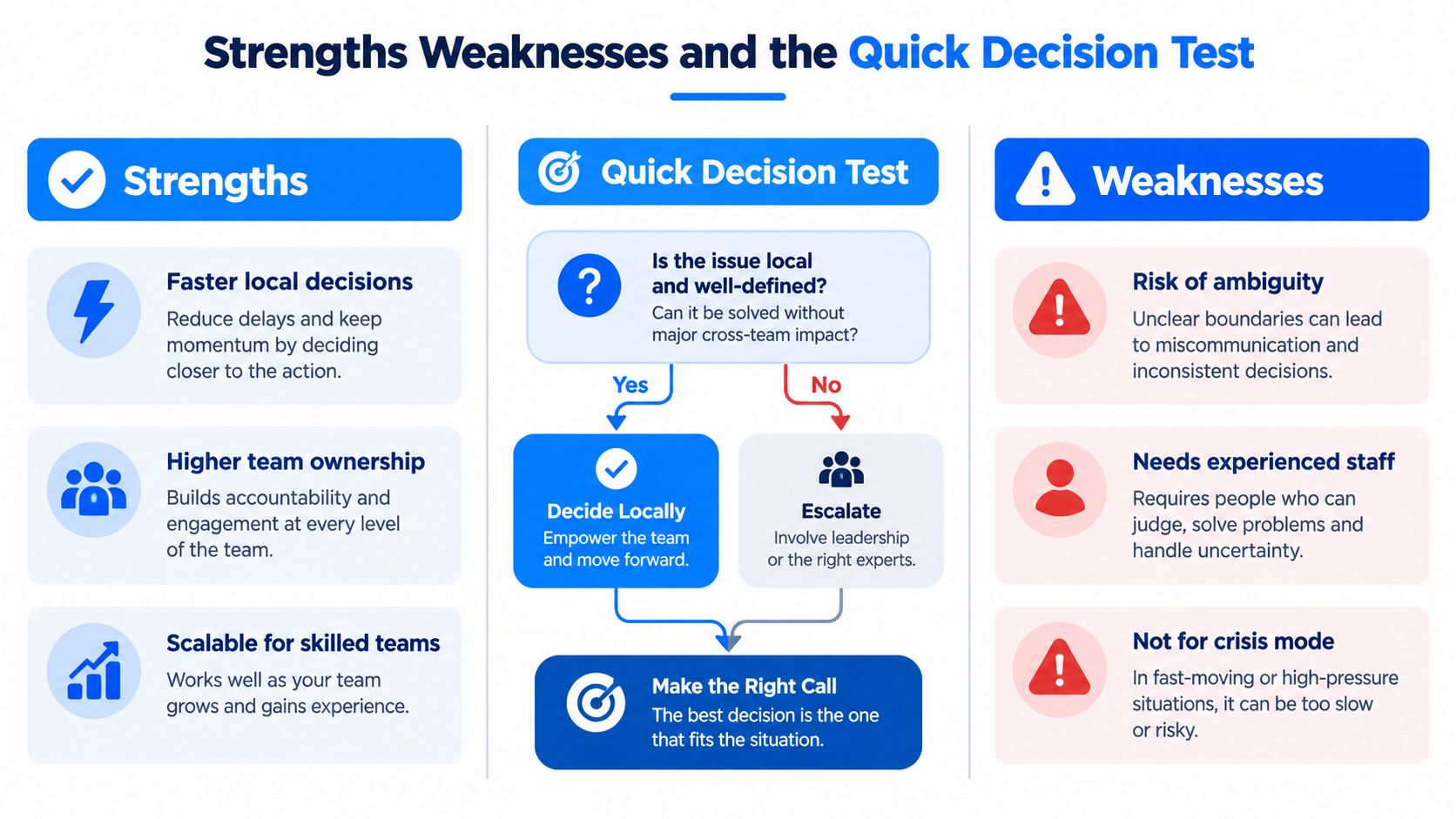
Decision standard: Delegate routine, reversible, role-aligned decisions. Escalate decisions with material client, compliance, financial, or cross-functional consequences.
This test prevents two common errors. The first is micromanagement, where capable employees wait for approval on ordinary work. The second is task dumping, where a manager transfers an uncomfortable problem without transferring meaningful authority.
Putting the Style to Work in BPO and Outsourcing Teams
A BPO leader should delegate decision domains, not vague responsibilities. “Own the account” is too broad. “Set the weekly intraday response within the approved staffing, service-level, and escalation limits” gives an operations manager something they can act on.
For an account manager, the executive can define the target outcomes, client commitments, escalation threshold, and review cadence. The account manager then decides how to coordinate regional teams, prioritize operational fixes, and respond to ordinary performance variation. The executive doesn't attend every working session. They review the measures and intervene when the agreed boundary is crossed.
A QA lead can receive authority to redesign sampling and coaching workflows within approved compliance requirements. That owner can test a better review sequence, adjust calibration sessions, and coordinate with operations without waiting for a sign-off email for every process change. The executive retains accountability for the quality framework and material client risk.
A transformation lead can sequence workstreams while keeping the business case, dependencies, and risk register current. If a proposed change affects client scope, data permissions, workforce obligations, or commercial terms, the matrix should require consultation or escalation.
Build a decision-rights matrix
Use a simple matrix with five fields:
| Field | What it records |
|---|---|
| Accountable executive | The leader who remains answerable for the outcome |
| Delegated owner | The person with authority to decide or execute |
| Consultation requirements | Functions or stakeholders that must provide input |
| Escalation threshold | The condition that moves the decision upward |
| Review cadence | When results, assumptions, and risks are assessed |
Apply the matrix to seat utilization, shrinkage, AHT, CSAT, quality, workforce planning, and client escalation. For example, a workforce lead might adjust intraday staffing within agreed guardrails, while a change that affects contractual coverage requires account-level review.
Distributed teams also need a shared source of operational truth. That can be a structured dashboard, a documented workflow, or an approved case-management system. The tool matters less than the discipline. Delegated owners must see the data behind the decision and record the assumptions that shaped it.

A useful reference point for designing distributed delivery structures is customer support center operations. The same principle applies across account management, QA, workforce planning, and transformation. Push routine judgment toward the team that has the clearest operational context, but keep outcome ownership and escalation rules visible.
Calibrating Delegation Across Cultures and Power Distance
Delegation doesn't feel the same everywhere. In one market, a manager who sets clear outcomes and stays out of daily work may signal trust. In another, the same behavior may look like indifference, weak leadership, or an attempt to avoid accountability.
A 2026 study of 157 Albanian employees found that delegation strengthened trust and, through trust, psychological safety, but psychological safety didn't translate into better outcomes. The study also reported that intensive manager communication weakened delegation's trust-building effect because employees could interpret frequent communication as inconsistent with genuine autonomy, according to the research on delegation, trust, and psychological safety.
That finding challenges the standard recommendation to communicate more whenever employees feel uncertain. More messages can make autonomy feel conditional if the manager continually checks, redirects, or reopens decisions. In some teams, the better move is fewer visible interventions paired with clearer written rights.
Calibrate the operating model market by market
Use three adjustments when teams span cultures and power-distance expectations:
- Document what the owner controls. State which decisions the manager won't override unless an escalation condition is met.
- Match check-ins to local expectations. Some teams need structured touchpoints to interpret autonomy as support. Others need space to act without repeated managerial presence.
- Separate availability from intervention. A leader can remain reachable for escalation without inserting themselves into ordinary decisions.
Power distance is a design parameter, not a soft-skill footnote. The Frontiers in Psychology findings on delegation and empowerment show that cultural and organizational acceptance of authority differences can affect how delegated power becomes real authority. A global operating model should therefore define decision rights explicitly, train managers to explain them locally, and review whether teams experience delegation as trust or abandonment.
The right question isn't, “How hands-off should this leader be?” Ask, “What level of authority, communication, monitoring, and escalation support lets this team act confidently in its context?” That answer may differ by market, account, role, and capability level.
When Your Delegate Is an AI Agent
Managers now delegate work across a mixed workforce of people and software agents. Traditional leadership advice assumes that the delegate can ask a clarifying question, recognize a conflict, learn from coaching, and carry accountability in a human sense. An AI agent does none of those things reliably without controls.
The shift is already visible in workplace adoption. A 2025 McKinsey survey reported that 88% of respondents regularly used AI in at least one business function, while 62% said their organizations were experimenting with AI agents. Almost two-thirds had not started scaling AI enterprise-wide. The same reporting cited Anthropic Economic Index data showing directive task delegation in AI interactions rising from 27% to 39% over eight months, as reported by HR Leader's coverage of AI management.
These figures don't mean an agent should receive the same authority as a skilled employee. They mean leaders need a delegation architecture that explicitly separates human and machine decision rights.
Set controls before assigning the work
For an AI agent handling quality checks, case classification, workforce recommendations, or customer interaction support, define:
- Human review thresholds, including the cases that cannot be finalized automatically.
- Audit trails, so the organization can reconstruct the input, instruction, output, and approval path.
- Error and bias escalation, with a named owner who can pause or modify the workflow.
- Data permissions, limiting what the agent can access, retain, or transmit.
- Consequence ownership, identifying the human executive accountable for an AI-assisted decision.
An agent can execute a workflow, but it can't own the consequences. A manager must decide when the agent's recommendation is sufficient, when a qualified employee must review it, and when the process must stop.
Operational teams building automated quality assurance should treat the agent as a delegated operator inside a controlled system, not as an independent manager. The right model is autonomy within an information and governance system. People and agents may control execution methods, but their work remains connected to shared goals, transparent evidence, and escalation rules.
KPMG's 2025 American Worker Survey also found that 80% of respondents said they were directly responsible for employee well-being, up from 63% the previous year, according to the same reporting. That responsibility expands when managers coordinate human employees and digital workforces. Delegate leadership is becoming an operating model for allocating work between both groups, not just a description of managerial temperament.
A 90-Day Plan to Adopt or Adapt the Style
Don't roll out delegation as a broad cultural slogan. Start with a narrow operating experiment where the risks are visible and the decisions are reversible.
Days 1 to 30
Select two or three decision domains that meet the quick decision test. Suitable starting points might include intraday workforce adjustments, QA workflow design, or internal process sequencing. Avoid beginning with decisions that alter contractual commitments, regulated controls, financial approvals, or high-impact workforce outcomes.
Write one decision-rights entry for each domain. Name the accountable executive, delegated owner, consultation requirements, escalation threshold, review cadence, required data, and evidence the owner must record. Then tell the team what the leader will no longer approve. Employees won't believe they own a decision if every ordinary choice still returns to the executive.
Days 31 to 60
Pilot the model with one team and observe behavior rather than collecting opinions alone. Track whether decisions move faster, whether owners escalate at the right point, whether other functions receive enough information, and whether the leader keeps reopening settled questions.
Run a retrospective with three direct questions:
- Which decision boundary was unclear?
- Which data or capability was missing?
- Where did managerial visibility help, and where did it interfere?
Adjust check-in frequency to the team's capability and cultural context. Don't respond to uncertainty by adding constant status meetings. Clarify the rule, improve the data, or coach the judgment that the team lacks.
Days 61 to 90
Extend the model to a second domain and add lightweight integration for material decisions. Require input from affected functions, document assumptions, and use structured dissent when a decision carries meaningful cross-functional impact. Review outcomes against quality, customer, productivity, risk, and employee measures that fit the operation.
Treat the model as a living system. New clients, new markets, new tools, and new leaders can change the right level of authority.
Delegation readiness scorecard
| Question | Safe to Delegate | Keep or Escalate |
|---|---|---|
| Is the decision reversible? | The team can correct the choice without material damage | The decision creates lasting client, compliance, or financial exposure |
| Is it within the owner's normal role? | The owner regularly handles the relevant work | The decision crosses role, account, or executive boundaries |
| Does the owner have the data and capability? | Required information, tools, and judgment are available | The owner lacks context, access, training, or confidence |
| Who bears the impact? | Effects remain local and understood | Customers, employees, other functions, or external stakeholders carry the risk |
Two questions leaders usually ask
What should we do after delegation has already failed? Restore clarity before restoring control. Review the decision, identify whether the problem came from capability, missing information, unclear boundaries, or poor escalation, then narrow the authority temporarily while coaching the owner. Don't reclaim every decision because one delegated choice went wrong.
How can we assess delegate-style fit during executive hiring? Test for more than a candidate's preference for autonomy. Ask for examples of decision-rights design, escalation thresholds, feedback systems, and recovery after a team made a poor decision. A structured talent assessment process should examine whether the candidate can transfer authority while retaining accountability, adapt across cultures, and govern both human teams and AI-enabled workflows.
AnyBPO helps enterprise and BPO leaders assess leadership fit, select partners, and design transformation programs around clear decision rights and accountable execution. If you're building a distributed operation or hiring an executive to lead one, visit AnyBPO to connect with the right advisory, talent, and partner capabilities.