
A customer in one market reaches your “global” support line and gets a fluent, confident agent. A caller in another hears long pauses, has their name or account number misheard, and repeats the issue after an unresolved transfer. A third market receives an automated answer that sounds translated rather than understood. The dashboard still says 30 languages supported, but complaints, repeat contacts, abandonment, and compliance exposure cluster in the same few languages.
That's the operating failure most multilingual call centers miss. Language coverage is treated as a list, while customers experience it as a quality decision.
The right question isn't “How many languages can your partner handle?” It's “What evidence proves that each language is safe, effective, and commercially viable for this use case?” That question should shape staffing, routing, technology, QA, KPIs, and procurement. It should also determine when you expand coverage, restrict automation, or return a language to human-only support.
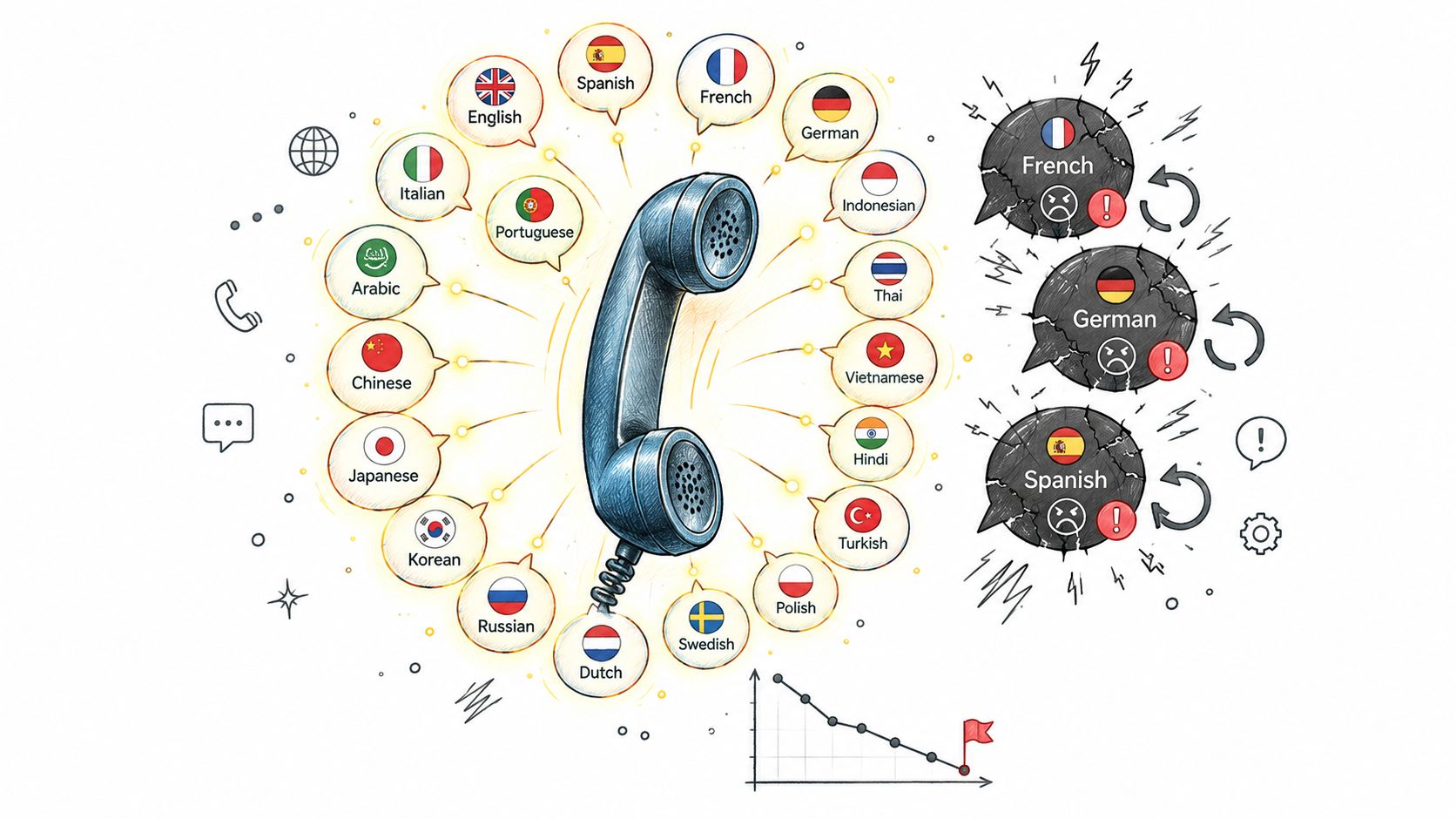
Table of Contents
- When Multilingual Support Quietly Breaks
- What a Multilingual Call Center Actually Is
- Why Language Counts Are a Dangerous Proxy
- Designing a Language Coverage Portfolio
- Staffing Models That Actually Scale
- Technology, Routing, and the ASR Gap in Production
- QA, Compliance, and Metrics by Market
- Selecting a Partner and Governing the Outcome
When Multilingual Support Quietly Breaks
The rollout looked successful on paper. A global CX leader had launched support across thirty markets, staffed a shared platform, published translated knowledge articles, and enabled language selection in the IVR. Most markets performed acceptably. Three did not.
In those three languages, customers waited longer, explained the same problem more than once, and escalated cases that should have been routine. Agents struggled with local terminology and mixed-language conversations. Automated transcripts changed names, numbers, and product terms. The global average concealed the damage because high-volume languages carried the score.
This pattern is common because leaders approve coverage, then discover they needed operational proof. A language can be available in an IVR menu while lacking native-speaking agents, reliable escalation, localized scripts, qualified quality reviewers, or a safe fallback when automation loses confidence.
Operating rule: A language isn't live because a vendor lists it. It's live when the service can meet its agreed quality, risk, and availability thresholds in real customer interactions.
A practical multilingual call center has to answer four questions for every market:
- Who handles the conversation? Native agents, fluent agents, interpreters, or an AI layer?
- How does the system recognize and route the language? The process must account for accents, dialects, code-switching, and caller corrections.
- Who verifies quality? Global QA cannot reliably judge nuance without native or in-market reviewers.
- What happens when confidence falls? High-risk interactions need a rapid human path, not a polished automated guess.
This guide focuses on those decisions. It covers delivery models, language prioritization, staffing, routing, automatic speech recognition, quality measurement, compliance, and partner governance. The central principle stays constant: measure and manage performance by language, not by the size of the language list.
What a Multilingual Call Center Actually Is
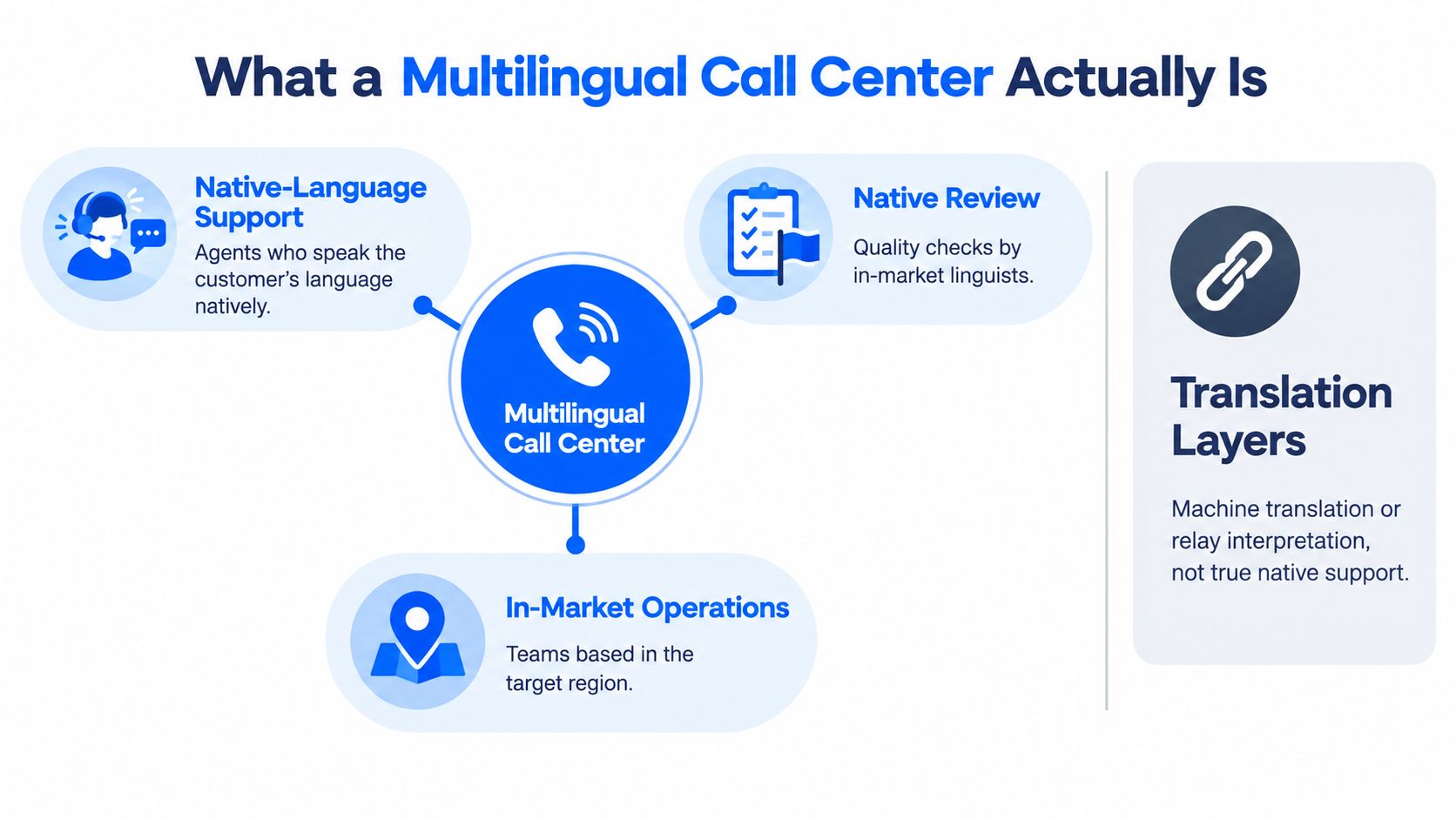
A multilingual call center delivers customer interactions in more than one language through a coordinated operating model. It may handle voice, chat, email, messaging, technical support, sales, retention, or regulated service interactions. The defining feature isn't translation alone. It's the ability to provide an appropriate combination of language fluency, cultural context, process control, and quality assurance.
A translation layer can help a strong agent communicate with a caller. It doesn't automatically create native-language support. Think of the difference between an airport help desk staffed by people who know the local language and a translation app held between two strangers. Both may enable communication, but they carry different risks when the conversation involves emotion, technical detail, identity verification, or a legal disclosure.
Four delivery models
Fully outsourced multilingual BPO. A specialist partner recruits agents, manages workforce planning, operates the technology stack, and conducts language QA. This model suits companies entering several markets without wanting to build local operations, but the buyer must inspect language-level evidence rather than accepting the provider's global capability statement.
Hybrid in-house and partner delivery. Internal teams retain strategic, sensitive, or high-complexity interactions while a BPO handles volume, after-hours coverage, or selected languages. This provides control, but it can create inconsistent scripts, duplicate QA, and unclear ownership unless both teams use the same scorecards and escalation rules.
In-house global hubs. The company builds regional teams and owns hiring, training, systems, and governance. This is suitable when language quality, customer intimacy, or regulatory control justifies the operational burden. It also leaves the company responsible for recruiting scarce native talent and maintaining coverage during demand changes.
Technology-only overlays. Existing agents use machine translation, real-time interpretation, language identification, or an agent-assist copilot. This can extend capacity without creating a separate team, but it should be treated as assisted service, not equivalent to native delivery.
How to identify the model you actually operate
Review a sample of real calls, not recruitment brochures. Ask whether agents can explain product terminology naturally, whether a native reviewer checks interactions, whether routing preserves the caller's language, and whether customers can reach a qualified person when the automated path fails. If the answer varies by language, your operation has a portfolio of service models, not one unified multilingual capability.
Why Language Counts Are a Dangerous Proxy
A provider can claim support for dozens of languages while delivering dependable service in only a subset. The gap appears when buyers ask how many trained agents are available at each service window, who performs native QA, which dialects are covered, and what happens when the language is spoken alongside another language.
Lower-resource languages create a particular measurement risk. A global average can look healthy while a smaller market experiences poor intent recognition, more transfers, repeated contacts, and higher human escalation. A benchmark that rewards the dominant language can therefore hide the exact customers most exposed to service failure.
A multilingual benchmark translated 11,829 questions into 29 languages and evaluated 36 leading models, finding performance gaps of up to 24.3% between high-resource and lower-resource languages on otherwise identical material. The benchmark discussion and operational implications support a clear procurement position: language count is not a service-level guarantee.
Require evidence before approving each language
Don't approve “multilingual” as one line in a contract. Require a language-level acceptance record covering:
- Intent recognition: Can the system identify what the caller needs in spontaneous speech?
- Transcription quality: Does the transcript preserve the words that matter to the workflow?
- Semantic similarity: Does the output retain the caller's meaning, even when the wording changes?
- Critical-entity accuracy: Are names, account numbers, addresses, product terms, and regulated disclosures captured correctly?
- Resolution outcomes: Do first-contact resolution, repeat contacts, abandonment, and escalation remain acceptable for that language?
- Human review: Can native speakers audit calls and challenge model or agent scores?
- Rollback rules: Is there a defined trigger for restricting automation, changing routing, or returning the language to human handling?
Research on diverse accents has found significantly poorer ASR performance than for a reference Midwestern American accent, with statistically significant differences across tested systems. The same research also highlights why transcription accuracy alone can be insufficient, because a readable transcript may still lose meaning. The accent and semantic-evaluation research supports testing each language, dialect, demographic group, and interaction mode separately.
Buyer's standard: If a provider can't show language-specific evidence, treat the language as unproven, regardless of how prominently it appears in the sales presentation.
Designing a Language Coverage Portfolio
Language coverage should be managed like a risk-weighted portfolio. Start with customer demand, revenue concentration, regulatory exposure, complaint severity, and the consequences of misunderstanding. Then assess the language itself, including regional accents, code-switching patterns, terminology, and the availability of qualified agents and reviewers.
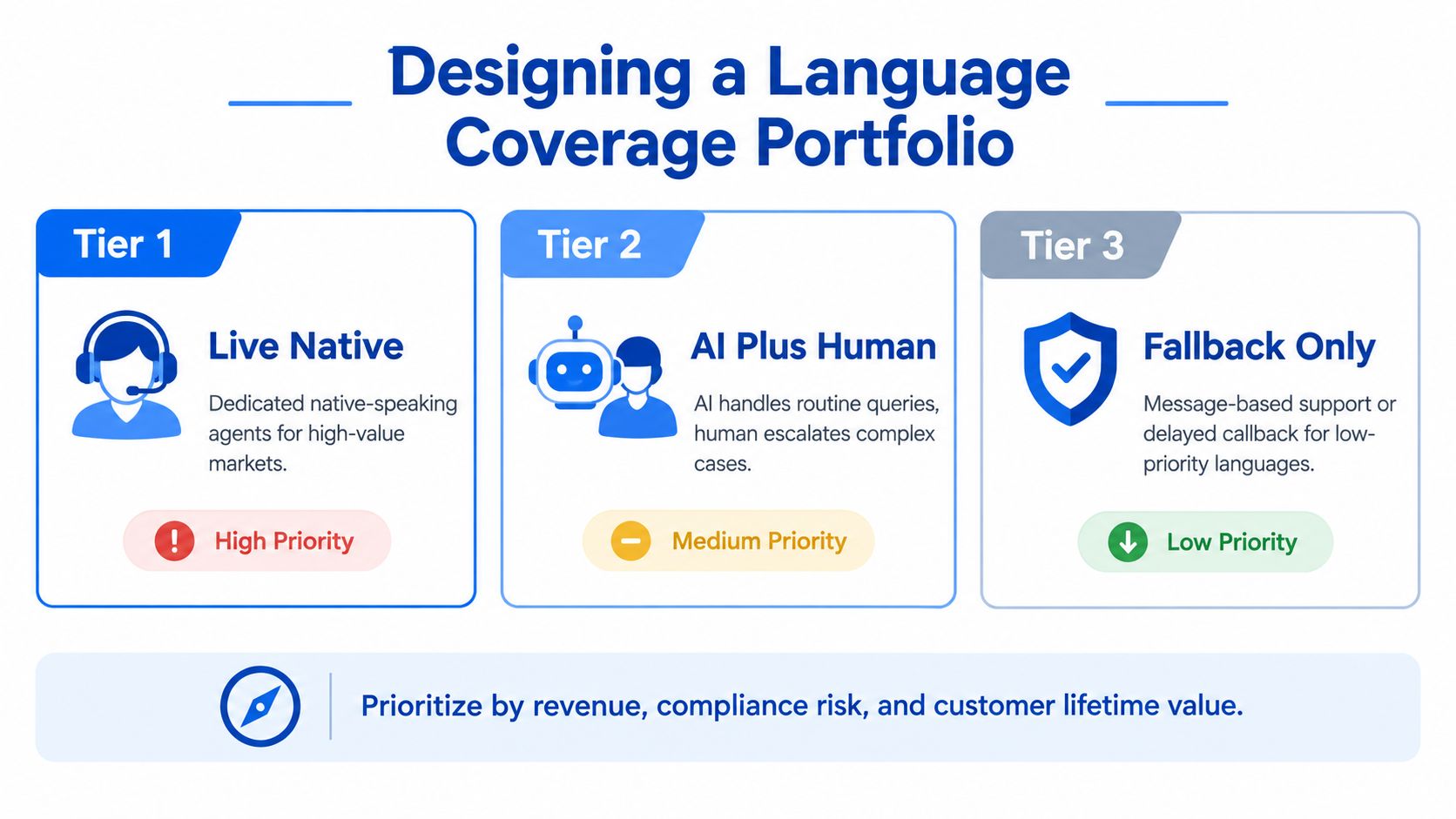
A practical portfolio has three service tiers.
Tier 1 for live native delivery
Use dedicated native-speaking or demonstrably fluent agents for high-value, high-risk, or high-volume markets. These teams should receive localized training, maintain a language-specific knowledge base, and undergo review by people who understand local phrasing and cultural expectations. Voice authentication, financial instructions, healthcare explanations, public-service access, and formal complaints generally belong here when language errors could create material harm.
Tier 2 for AI plus human support
Use automation for routine requests, classification, retrieval, or translation, with a clear human escalation path for ambiguity and complexity. This tier only works when the routing system carries language metadata forward, the agent sees the original audio or message, and the handoff doesn't force the customer to start again.
Tier 3 for fallback-only access
Offer message-based support, delayed callback, interpreter access, or a limited service path where live native coverage isn't justified yet. Be honest about the experience. A controlled fallback is safer than presenting an automated interaction as fully supported when it can't handle local speech or critical terminology.
Accent diversity belongs inside the coverage decision. A single language may include regional pronunciation, vocabulary, speech rhythm, and code-switching behavior that materially affect routing and transcription. Callers may move between languages in one sentence or switch after an agent prompts them, so language identification must operate continuously rather than only at the start of the call.
Promote a language when its evidence shows stable completion, resolution, entity accuracy, and customer outcomes under representative conditions. Demote or retire a language when demand is low and quality remains weak, especially if a reliable interpreter or delayed callback provides safer access. Underused doesn't mean unimportant, but it does mean the service model should be deliberate.
Staffing Models That Actually Scale
The staffing model determines whether language coverage is dependable or merely advertised. Three models dominate enterprise operations, and each solves a different problem.
Single-shore multilingual hubs concentrate several languages in one location. They simplify management, training, technology, and workforce planning. They can work well for predictable demand and related language groups, but they expose the program to local hiring constraints, regional accent gaps, and a single-site disruption.
Follow-the-sun regional hubs distribute teams across time zones and geographies. This improves resilience and makes it easier to recruit native speakers close to their markets. The trade-off is operational complexity. Handoffs, knowledge consistency, permissions, and QA calibration require active governance.
Onshore specialist teams place agents near the customers or within the target market. They're often the strongest option for regulated service, premium B2B support, complex technical work, and interactions where cultural nuance matters. They also tend to demand more careful workforce planning because the available talent pool may be narrower.
A high-volume consumer program often benefits from regional hubs plus automation for routine work. A regulated provider should favor native or in-market capability for high-risk interactions, with interpreters and documented fallback paths. A premium B2B operation may prefer smaller specialist teams that understand local business terminology over a broad shared queue.
Hire for language performance, not résumé claims
“Fluent” is too vague for procurement. Test spontaneous conversation, listening comprehension, product terminology, written communication, and the ability to explain a complex process naturally. Add scenario testing for names, numbers, accents, interruptions, and code-switching. A language test should measure the work the agent will perform.
BPO buyers should also inspect attrition by language, recruiting lead times, training completion, schedule coverage, and the depth of the backup bench. A partner may have excellent agents in a language but insufficient resilience when demand spikes or staff leave.
The customer support center operating model should match the service tier. Don't place a Tier 1 language in a shared queue designed for basic translation, and don't build a costly local team where a measured AI-plus-human path already meets the risk threshold. The decision belongs to evidence, not convenience.
Technology, Routing, and the ASR Gap in Production
A multilingual technology stack should run as a controlled sequence:
- Identify the language and likely variant.
- Route the interaction using language, intent, risk, and availability.
- Transcribe or translate while preserving the original audio.
- Assist the agent and expose uncertainty.
- Escalate when confidence or entity accuracy falls below the threshold.
- Send the result into language-specific QA and reporting.
Automatic speech recognition is a frequent failure point in business cases. Published comparisons indicate that leading systems can reach approximately 1.6% to 3.4% WER on clean speech, while real contact-center recordings commonly produce roughly 8.6% to 11% WER, and may reach 18.5% when accent diversity, speaker overlap, and poor call clarity are present. The ASR comparison and production-audio guidance explains why benchmark performance should not determine a production launch.
Telephone codecs reduce bandwidth, while background noise masks phonetic cues. Overlapping speakers confuse segmentation, and language or accent shifts can make the system select the wrong acoustic or language model. A transcript with 10% WER may look readable while changing a name, account number, product term, or compliance disclosure.
Measure what can cause harm
WER matters, but it does not provide enough control. Measure entity accuracy separately for names, numbers, addresses, regulated terms, and product vocabulary. Test production-like recordings by language, regional accent, call type, speaker overlap, and audio condition. Compare baseline ASR with domain vocabulary, custom pronunciation dictionaries, noise suppression, and agent confirmation workflows.
Real-time agent assistance can tolerate less error than a searchable internal transcript. Automated authentication and regulatory recordkeeping require stricter controls. Set procurement thresholds by use case, rather than applying one global ASR score.
Routing should preserve the original audio, detected language, confidence score, and escalation history. If a caller changes language, the system should update the route without discarding context. If a high-risk entity is uncertain, it should request confirmation or transfer the interaction to a qualified human.
A strong fallback may combine a bilingual agent, rapid interpreter escalation, translated confirmation messages, accessible IVR alternatives, and a post-contact check for unresolved issues. Success here is measured by how reliably the system recognizes when human involvement is necessary and hands over without losing context.
QA, Compliance, and Metrics by Market
Global QA scores create false comfort. A language-specific program samples calls by language, market, accent, customer segment, channel, and risk type. Native reviewers calibrate the scorecard, while dual-language QA compares what the customer said, what the agent understood, what the system transcribed, and what the case record captured.
Semantic similarity belongs beside transcription accuracy. A transcript can contain many correct words and still change the customer's meaning. QA should also inspect whether the agent selected the correct intent, explained the policy accurately, confirmed critical details, and offered a suitable escalation path.
Use a measurement matrix like this in the RFP and operating review:
| KPI | Definition | Tier 1 Target, native | Tier 2 Target, AI plus human | Source of Truth |
|---|---|---|---|---|
| Intent recognition | Correct classification of the customer's need | Contractual threshold by language and intent | Threshold with human override tracking | QA sample and case audit |
| Entity accuracy | Correct capture of names, numbers, addresses, and regulated terms | Strict threshold for high-risk entities | Human confirmation before action | Call audio, transcript, CRM record |
| First-contact resolution | Issue resolved without an avoidable repeat contact | Language-specific threshold | Separate automated and human outcomes | CRM and contact history |
| Repeat-contact rate | Customers returning about the same unresolved issue | Monitored by language and reason | Escalation cohort reported separately | CRM and telephony |
| Abandonment | Customer exits before resolution or qualified contact | Threshold by queue and language | Include automated-path abandonment | Telephony and IVR logs |
| Average handle time | Talk, hold, and after-call work duration | Compared within similar intents | Split AI-assisted and human-only calls | Workforce and telephony systems |
| Customer satisfaction | Post-contact customer rating | Reported by language and channel | Exclude unrepresentative routing failures only with explanation | Survey platform |
| Escalation rate | Transfers or human interventions caused by uncertainty or complexity | Reviewed by intent and risk | Expected to be higher, but controlled | Routing logs and QA |
| Diarization error | Incorrect separation of speakers in a transcript | Required for voice analytics use cases | Required before automated evaluation | Audio and transcript audit |
A platform such as automated quality assurance for contact centers can accelerate sampling and flag unusual interactions, but automation shouldn't replace native calibration. The buyer should require access to raw samples, score definitions, reviewer qualifications, and disagreement handling.
Regulated organizations need more than translated scripts. TriMet's 2025 Language Access Plan describes community and frontline surveys, with materials translated into 16 languages, and identifies the need for expanded training, clearer procedures, and more consistent communication. The plan's language-access approach reinforces a practical point: safe access depends on process, staff capability, and fallback design, not translation alone.
Selecting a Partner and Governing the Outcome
Select a multilingual call center partner by asking for proof at the language level. Require production-like test calls, native-speaker audits, entity-accuracy results, staffing evidence, escalation performance, and rollback rules. Put those requirements into the contract, with separate service levels for native delivery, AI-assisted support, and fallback access.
Run monthly reviews by language, not only by region or account. Each review should identify where to scale, retrain, change routing, restrict automation, or retire a service path. The lowest-volume languages deserve early attention because global averages can hide their failures.
A vendor-neutral sourcing process can help buyers define requirements, compare providers, and evaluate fit across locations, channels, and operating models. Outsourcing business services guidance is relevant when multilingual support is part of a broader international CX program rather than a standalone voice queue.
Your next 90 days should produce three concrete outcomes:
- Write per-language acceptance criteria into every provider agreement.
- Audit the lowest-volume and highest-risk languages before expanding coverage.
- Instrument entity-level accuracy before scaling automated interactions.
AnyBPO helps enterprise teams define multilingual outsourcing requirements, discover and evaluate BPO partners, and structure transformation programs around measurable fit rather than language-count claims. Visit AnyBPO to assess potential partners and build a language-level operating model before you scale automation.