
You're down to three BPO finalists. Each deck claims strong security, resilient operations, and happy clients. None of them is backed by evidence you can compare side by side, and your steering committee wants a recommendation next week.
That gap between claim and proof is where deals go wrong. Outsourcing due diligence isn't how you fill a folder before signature. It's how you decide, on the record, whether a provider can run a business critical process without creating risk you can't explain later.
Table of Contents
- Why Outsourcing Due Diligence Is a Control Cycle, Not a Checklist
- Mapping Requirements Before You Send a Single Questionnaire
- Requesting and Validating the Evidence Package
- Scoring Vendors With a Risk-Based Decision Matrix
- Choosing Between On-Site, Remote, and Hybrid Assessments
- Using AI Screening Without Losing the Human Decision Trail
- Decision Gates, Remediation, and Post-Selection Monitoring
Why Outsourcing Due Diligence Is a Control Cycle, Not a Checklist
Most failed selections don't fail on price. They fail because someone treated diligence as a questionnaire, filed the answers, and discovered the real operating model after transition began.
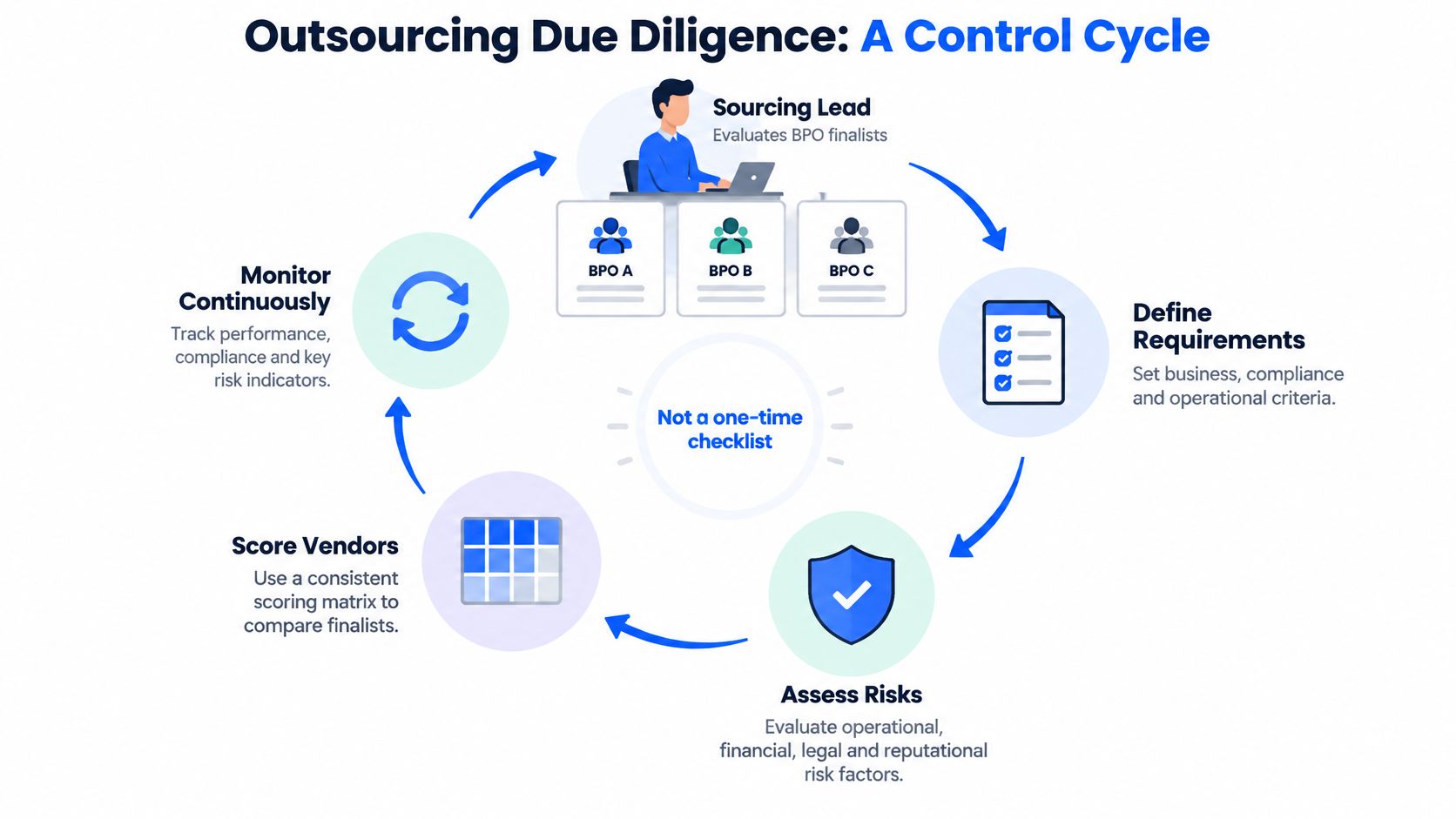
Run it instead as a five stage control cycle. Collect a complete inventory of services, data flows, system access, subcontractors, and cloud dependencies. Validate answers against independent evidence rather than self attestation. Analyze risk by impact and likelihood so you don't review every supplier the same way. Remediate by turning findings into owners, deadlines, contract clauses, and acceptance criteria. Monitor after onboarding through reassessment, incident notification, and trigger based reviews.
Practical rule: If a material finding doesn't map to evidence, business impact, mitigation, a contractual remedy, and residual risk approval, you have document collection, not decision grade diligence.
The market has already moved this way. KPMG's 2026 Global Third Party Risk Management Survey reports that more than 80% of organizations use managed services, outsourcing, or co sourcing for core third party risk activities, including due diligence, onboarding, monitoring, and remediation, but only about 5% use a fully end to end managed service model, with 44% using managed services for ongoing monitoring and 27% outsourcing due diligence itself in that same survey.
Read that pattern carefully. Buyers externalize volume, evidence collection, and assessment processing. They keep governance, escalation, and final decisions in house. That's the right split for outsourcing business services too, because accountability doesn't move with the workload.
The cycle below keeps that split visible from the first workshop to the tenth quarterly review.
Don't start by asking vendors who they are. Start by proving you know what you're handing over.
Mapping Requirements Before You Send a Single Questionnaire
If you send a questionnaire before you've mapped your own scope, you'll get polished answers to the wrong questions. Vendors will fill gaps with assumptions, and you'll only find those assumptions during a site visit or, worse, during transition.
Begin with scope decomposition. Break the service into processes, sub processes, systems touched, languages, hours of coverage, and locations. Separate what's in scope on day one from what might move later. Then build three artifacts before any vendor sees a question.
The Three Artifacts You Need First
- Requirements traceability matrix: Every requirement links to a business outcome, a diligence question, the evidence that proves it, and the contract clause that protects it.
- Data flow and access map: Show what information the provider receives, where it's stored, which systems it can access, and whether access is privileged, customer facing, or regulated.
- RACI and regulatory touchpoint table: Name who decides, who approves exceptions, and which legal regimes apply in each delivery country. Don't assume a provider will absorb every regime you operate in.
Add volume forecasts with seasonality, your onshore, nearshore, and offshore mix, and a data classification table that distinguishes public, internal, confidential, and regulated data. That classification drives how deep diligence goes later.
Coverage is where most programs are already weak. A Thomson Reuters commissioned study summarized in the 2026 third party risk materials found organizations performed due diligence on an average of only 62% of their third parties, with 74% coverage in the United States and 53% in Germany, and 62% of respondents conducted due diligence only on tier one relationships, rising to 69% among U.S. respondents in the same research.
That blind spot matters because providers rely on subcontractors you haven't mapped. In the United States, 61% of respondents said they did not know the extent to which their third parties outsourced work to other suppliers in that same study. If you don't define subcontracting boundaries upfront, you can't diligence them later.
Ask vendors this exact question early. "Which parts of this scope would you deliver with your own employees, and which parts would anyone else touch?" Make them answer in writing.
Requesting and Validating the Evidence Package
A questionnaire is an index, not evidence. Your job is to request proof in each domain, then independently check whether that proof is current, in scope, and issued to the entity that will deliver your work.
Use a standardized intake so finalists are comparable. The SBAI 2024 Operational Due Diligence Practices Survey found 59% of respondents use bespoke due diligence questionnaires for initial information gathering, which helps explain why so many buyers end up with answers they can't score consistently.
| Evidence Domain | Documents to Request | Independent Validation Move |
|---|---|---|
| Financial stability | Audited financial statements, insurance certificates, ownership records | Pull corporate registries and reconcile the contracting entity to the audited entity |
| Security controls | SOC 2 Type II or ISO 27001 report, penetration test summary | Confirm dates, scope, and auditor with the issuing body and check exceptions |
| Continuity and recovery | Business continuity plan, disaster recovery and failover test results, RTO and RPO | Ask for the most recent tabletop or failover result, not the policy alone |
| Legal and regulatory | Litigation and breach history, licenses, regulatory records | Search breach disclosures and regulatory actions under current and former names |
| People and subcontractors | HR and labor practices, material subcontractor list, data locations | Sample how access is granted and require flow down terms for fourth parties |
Where Vendors Bluff Most Often
Certificates are the classic bluff. A logo on a slide isn't a scope statement. Say this directly. "Please show me the certificate page that lists this delivery site, this legal entity, and an expiry date that covers our first year." If the site isn't listed, score it as uncertified.
Continuity claims come second. Vendors describe failover in the future tense. Ask, "When did you last move live work to the backup site, how long did it take, and who declared the test complete?" A real answer has a date, a duration, and a named owner.
Subcontractor lists shrink under pressure. Push on cloud platforms, labor agencies, translation tools, AI services, and after hours support. Those are subcontractors if they touch your data or your customers.
AnyBPO is one example of an advisory option that provides structured provider vetting and due diligence insights for BPO selections, alongside work your own risk, legal, and security teams should still do. Whoever helps you collect evidence, you still own the validation moves in the table above.
Don't accept summaries when the underlying report exists under NDA. Summaries are where exceptions disappear.
Scoring Vendors With a Risk-Based Decision Matrix
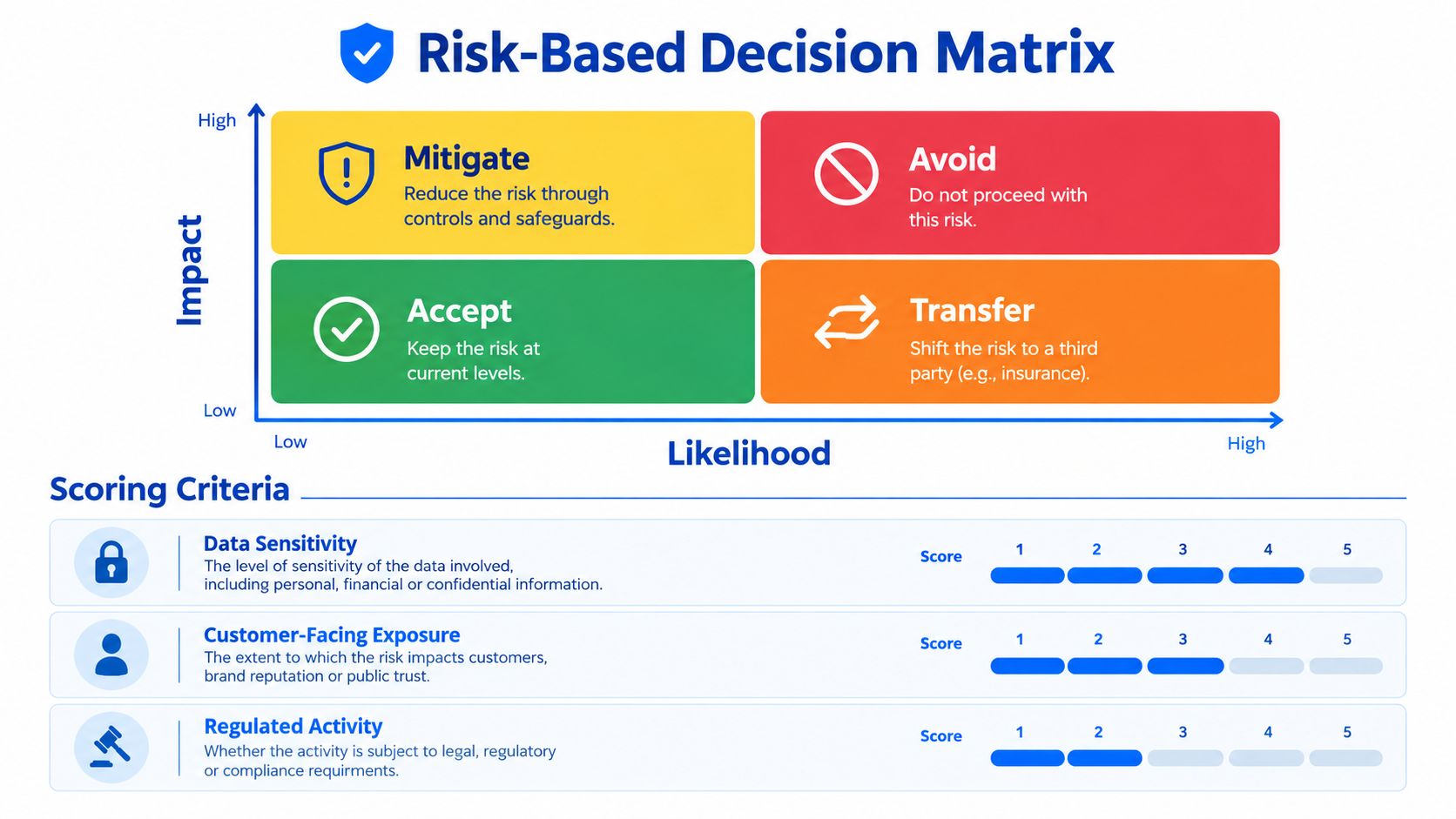
Score risk in layers, or every finalist will land in the same vague middle band. Start with inherent risk before controls. Rate impact and likelihood using data sensitivity, privileged access, customer facing exposure, regulated activity, geographic exposure, and how hard the provider would be to replace.
Then score the response, not the pitch.
- Evidence strength: How recent is it, who issued it, and does it cover the exact site and service you're buying?
- Control maturity: Are controls documented, tested, and owned by named roles, or described only in policy language?
- Residual risk: What remains after mitigations, compensating controls, and contract remedies are applied?
The matrix below is the comparison view your steering committee should see, with inherent and residual risk kept separate.
Weight the matrix before you see the scores. If you set weights after reviewing a favorite vendor, you're reverse engineering a decision. For regulated or customer facing work, security governance, identity and privileged access, continuity, and subcontracting should outweigh minor price or tooling differences. The same discipline applies when you're comparing software development outsourcing companies, where code access, privileged environments, and subcontracted engineering change the risk profile fast.
Keep two views separate. Your go or no go scorecard decides whether a provider is acceptable at all. Your finalist comparison view decides which acceptable provider fits best on delivery, commercials, and culture. Mixing them lets a strong price cancel out a failed control.
This walkthrough shows how risk based scoring conversations play out in practice.
For each domain, write one line an executive can act on. "Residual security risk is moderate because the SOC 2 report is current but privileged access reviews are manual, closing by contract requirement before go live." That sentence beats a color with no reason.
If two vendors tie, your rubric is too generic. Tighten the criteria to your data, your customers, and your recovery needs, then rescore.
Choosing Between On-Site, Remote, and Hybrid Assessments
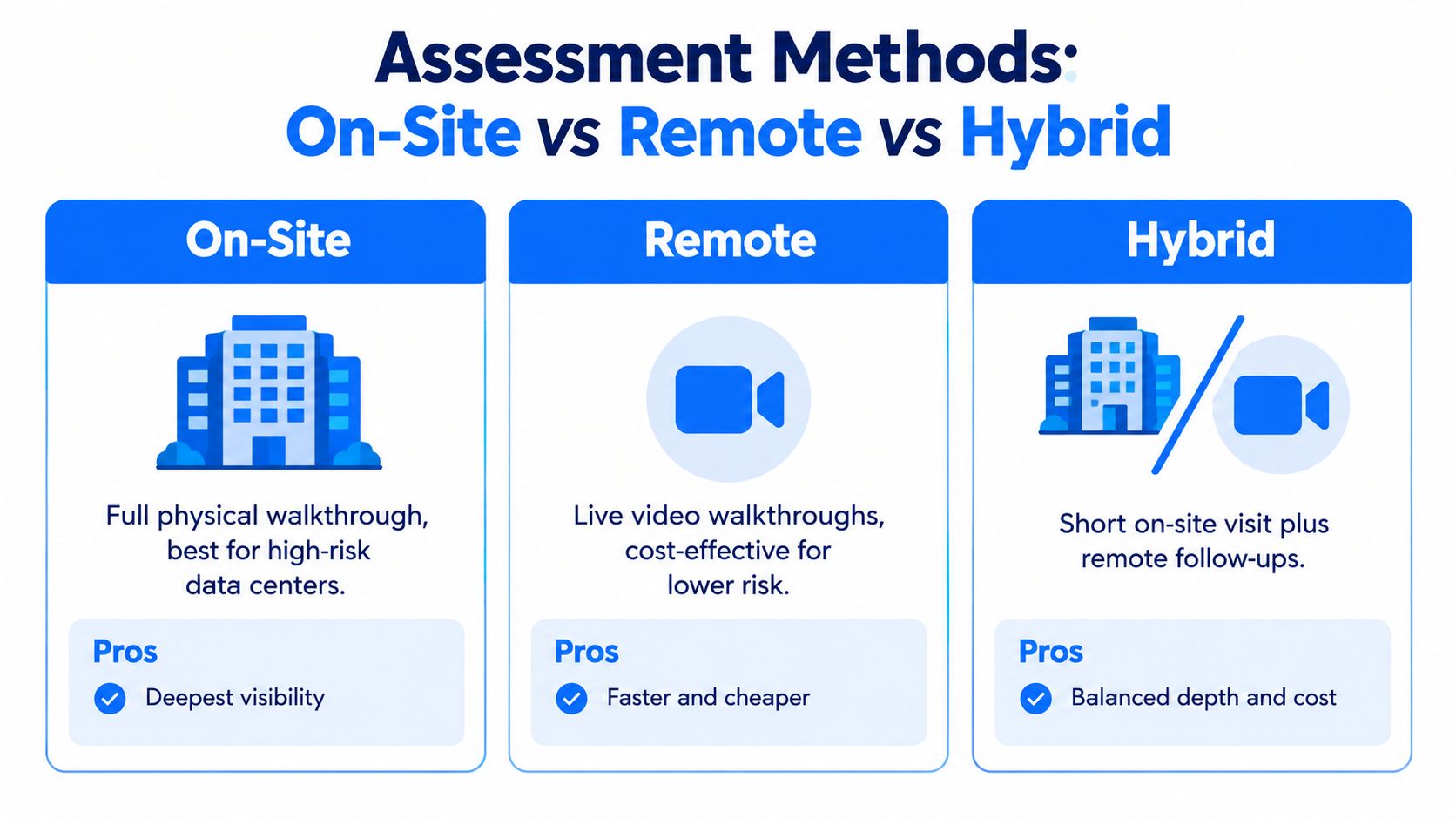
How you assess determines what you'll find. A remote call surfaces what a vendor chooses to show you. An on site visit surfaces how work moves between teams, systems, and supervisors.
Use this comparison to defend your choice to leadership.
When Each Model Is Enough
Remote assessment fits low risk, non regulated, easily substitutable work with no privileged access. Run live video walkthroughs, screen shared control evidence, and interviews with operations leads. Don't accept a recorded marketing tour. Ask the guide to turn left, open the access log, and show you the room where backup media is secured.
Hybrid assessment is the right default for most mid risk BPO deals. Do document review and specialist interviews remotely, then send a small team on site for a short, focused visit. You get physical verification without paying for a multi day audit of areas you've already cleared on paper.
Full on site assessment is non negotiable when the provider handles regulated data, privileged system access, payments, health information, or customer facing operations you can't quickly bring back in house. It's also non negotiable when the vendor's claims are ambitious and the evidence is thin. Big claims require physical proof.
Don't let the sales team run your tour. Ask to speak with the operations lead, the quality lead, and the person who owned the last incident, without sales in the room.
On site, watch for basics that decks can't fake. Check badge access and visitor logs. Look at whether screens lock, whether agents can access personal devices on the floor, and whether supervisors can explain escalation without reading a script. In the control room, ask who can grant privileged access, how quickly access is removed for leavers, and where the last access review is filed.
Red Flags That Predict Post Selection Pain
Treat vendor risk as operational resilience, not procurement paperwork. The ABA vendor contracting cybersecurity checklist highlights backup retention, failover capability, backup facility security, continuity plan access, periodic testing, contingency communications, and force majeure provisions as diligence considerations, and the available figures cited with that guidance report 72% of organizations experienced at least one significant disruption linked to a third party relationship and 62% of network intrusions reportedly originated with a third party.
Confirm or clear each flag with a specific probe.
- Financial fragility: Concentrated customer revenue, weak cash conversion, or thin covenant headroom. Probe with audited statements and ask which client loss would force site consolidation. Contract for financial reporting and step in or termination rights.
- Stale security evidence: An outdated SOC report or reluctance to share a penetration test summary. Ask for dates, scope, and remediation of critical findings. Make go live conditional on closure.
- Single site dependency: One building, one network provider, or one team with no tested alternate. Demand RTO, RPO, and the last failover result. Contract for tested recovery, not promised recovery.
- Opaque subcontracting: Vague answers on fourth parties, data location, or AI tools. Require a material subcontractor register and prior approval for changes.
- Evasion on audit rights: Pushback on audit, incident notification deadlines, or exit assistance. That's a governance signal, not a negotiating tactic. Hold the line or walk away.
When a vendor pushes back, use plain language. "We can't approve residual risk we can't inspect. Either we see the evidence under NDA, or we score this control as not in place." Serious providers understand that sentence. Providers who argue with it are telling you how they'll behave during an incident.
Choose the assessment model based on the risk you'd own if the vendor fails, not on the travel budget you wish you had.
Using AI Screening Without Losing the Human Decision Trail
AI is useful for triage. It isn't a decision maker you can hide behind when a regulator, auditor, or board member asks why you approved a provider.
Investment is moving fast. KPMG's 2026 reporting on resilience in third party risk management finds 39% to 47% of organizations expect moderate AI use in core TPRM tasks over the next three years, and in the EY findings cited alongside it, AI or machine learning for enhanced due diligence and contract performance monitoring was cited by 31% of respondents as the top future investment priority, followed by data driven third party monitoring at 28% and automated due diligence at 27%.
Separate AI into four uses, with different controls for each.
A Four Layer Control Model
- Extraction: AI pulls dates, entities, and clauses from documents. A human samples the output against the source page.
- Continuous monitoring: AI sweeps adverse media, sanctions, breach disclosures, and ownership changes. A human confirms identity matches before anyone escalates.
- Prioritization: AI ranks providers or findings for attention. A human can override the rank and must record why.
- Decision support: AI drafts a risk summary or score. A named approver owns the final score and signs the residual risk decision.
For every AI generated conclusion, require a cited source, a confidence signal where available, and a link back to the underlying evidence. Test false positives and false negatives on known cases. Check performance across countries, languages, and smaller suppliers, because a model trained on large listed companies will misread a smaller regional provider.
Ask your AI vendor two uncomfortable questions in writing. "Will our confidential provider data be used to train your model?" and "Can we export a complete, auditable record of inputs, outputs, and human overrides?" If either answer is vague, don't use the tool for decision support.
Automation improves coverage. It doesn't interpret sanctions exposure, labor practices, ownership complexity, or a weak incident story for you. Keep contextual judgment with people who can be accountable for it.
Decision Gates, Remediation, and Post-Selection Monitoring
Your final decision should produce gates, not just a winner. Each gate needs evidence before it, a named approver, and an output that someone owns after signature.
Run four gates in order. Gate one is go or no go on residual risk. Gate two is conditional approval, where critical gaps get owners, deadlines, compensating controls, and acceptance criteria. Gate three is executive risk acceptance for anything that remains open. Gate four is contracting, where diligence becomes audit rights, incident notification deadlines, subcontractor flow down, service levels, and exit and transition assistance.
Don't let contracting soften what diligence required. If you required failover testing to approve the provider, the contract should require periodic testing and evidence delivery. This is also where performance controls belong, including the kind of ongoing checks supported by automated quality assurance for delivered work, tied to remediation when quality drifts.
Triggers That Force Reassessment
Post selection monitoring is where the lifecycle view pays off. EY's 2025 global third party risk management survey found operational risk became the leading factor companies monitor in subcontractors, cited by 57% of respondents versus 40% in 2023, while business continuity and resilience rose from 14% to 23% in the same survey.
Reassess immediately when any of these change.
- Ownership or leadership: A new owner, investor, or delivery executive can change risk appetite overnight.
- Security or service incident: Require notification, root cause, and evidence that the same failure cannot recur.
- Material subcontractor or location change: New fourth parties, new countries, and new AI tools restart relevant diligence.
- Regulatory action or SLA drift: Repeated misses are a control signal, not just a performance conversation.
Set a cadence by criticality. Critical providers get periodic reassessment, access reviews, SLA and incident trend reviews, continuity test evidence, and concentration risk checks. Lower risk providers get lighter monitoring, but they still get trigger based review.
Keep exit readiness current while the relationship is healthy. Confirm data return formats, transition assistance, knowledge transfer, and who owns customer communications if you leave. You'll negotiate those terms best before you need them.
Outsourcing evidence collection can add capacity and consistency. It doesn't outsource accountability. Governance, escalation, and decision rights stay with you, and that's exactly how a defensible program should work.
If you're building a shortlist and need evidence you can compare, AnyBPO can help you define requirements, vet audited providers across regions, and structure diligence through selection and post selection optimization. Visit AnyBPO to discuss your scope and get matched with providers that fit your risk, location, and delivery requirements.