
Your outsourcing team has spent weeks reviewing providers. The proposals look polished, the workshops have gone well, and procurement is pressing for a decision. Then the comparison narrows to a familiar question: which vendor has the lowest price?
That question matters, but it won't tell you whether the provider can keep service running when a subcontractor fails, a delivery location becomes unavailable, or a technology platform changes. A sound selection of vendor is a resilience decision as much as a capability contest. It needs evidence, explicit trade-offs, and a clear view of what could break after signing.
Table of Contents
- What a Strong Vendor Selection Process Actually Looks Like
- Defining Requirements the Shortlist Can Be Measured Against
- Choosing Between an RFI, an RFP, and a Lighter Discovery Path
- Building a Weighted Scorecard That Survives Scrutiny
- Running Due Diligence That Actually Reveals Risk
- Negotiating Price, Scope, and Exit Without Losing the Deal
- Locking the Decision In With a Pre-Signature Checklist and Governance Loop
What a Strong Vendor Selection Process Actually Looks Like
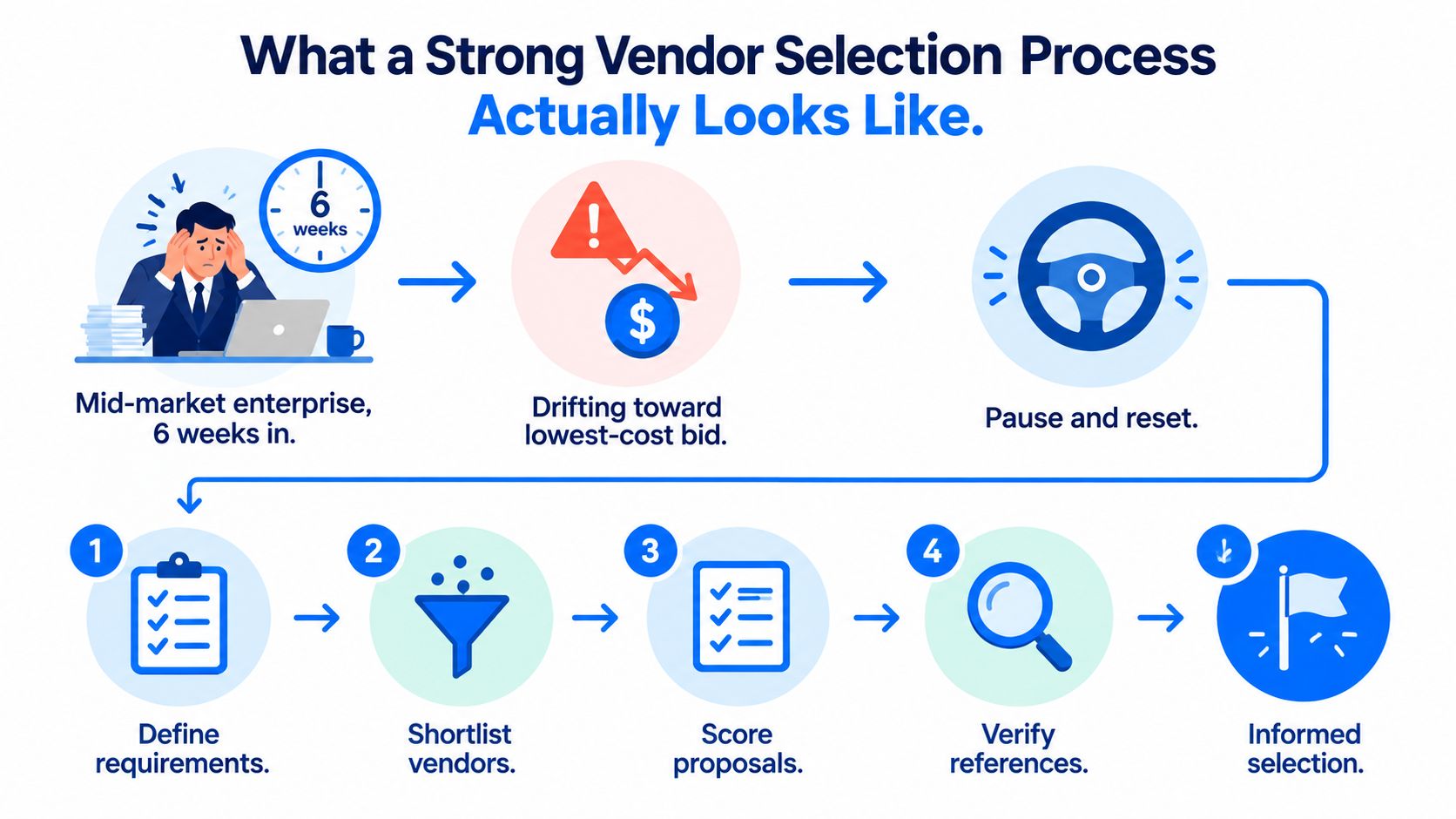
Six weeks into a search, a mid-market enterprise's shortlist can start to look like a price ranking. One provider offers an attractive rate, another has stronger delivery coverage, and a third seems more responsive in meetings. Procurement wants to move. Operations is still debating what the service must include, and nobody has agreed how much continuity risk the business can tolerate.
That's not a vendor comparison yet. It's a sales conversation with a spreadsheet attached.
A 2007 review of outsourcing research reported that an Accenture survey found 80% of participating companies used some form of outsourcing, with many allocating nearly 45% of their total budgets to outsourced activities. The review also cited Aberdeen research in which more than 83% of outsourcing organizations achieved significant purchasing-cost reductions, over 73% reduced transaction costs, and more than 60% shortened sourcing and procurement cycles. Those findings help explain why provider choice can affect much more than the purchase price: it can shape operating expenditure, transaction efficiency, and procurement speed (the academic review of outsourcing research).
Reset the decision before price sets the agenda
The first move is to pause and define what the business is buying. Build a requirements brief, decide which providers qualify, and compare proposals against the same evidence. Then verify what vendors claim, negotiate service and continuity protections, and review performance after award.
That sequence sounds basic. It prevents a common failure: evaluating providers against shifting expectations. When the requirements change halfway through the process, the loudest sales pitch or lowest quote can end up setting the standard.
Price, lead time, and quality have historically been leading supplier performance measures, but outsourcing decisions also need to account for delivery reliability, scalability, service capability, and continuity. The selected provider may influence customer experience and daily operations, especially in BPO and technology services. A low-cost bid that depends on brittle delivery arrangements isn't automatically a good deal.
Practical rule: Choose the provider that best meets the business need under realistic operating conditions, not the one that gives the smoothest presentation.
Defining Requirements the Shortlist Can Be Measured Against
A vendor can't be evaluated fairly against requirements the buyer hasn't defined. Before contacting providers, write an internal brief that describes the work, its operating context, and the evidence you'll require. This gives procurement, operations, finance, security, and legal a shared basis for decisions instead of a set of separate expectations.
Make the scope concrete
For a customer-care program serving English- and Spanish-speaking customers across two regions, the brief should spell out what channels the provider will handle, where work will be performed, and which systems the team must use. Define expected volumes and patterns, service-level targets, quality expectations, escalation paths, and any regulatory or data-handling obligations. If the service depends on a CRM, telephony platform, or knowledge base, specify integration and access requirements rather than asking vendors to confirm a vague “technical fit.”
Translate each need into a measurable question. “Strong service” is not useful by itself. Ask how the vendor will report quality, manage coverage, route urgent cases, and recover when normal delivery is disrupted. State which claims need documentary evidence and which should be demonstrated.
The brief should also describe commercial boundaries: the budget envelope, what counts as in-scope work, how changes will be priced, and which transition activities the provider must support. Include assumptions about training, knowledge transfer, staffing, and ramp-up. Buyers often postpone exit planning because they don't want to make a new provider feel unwelcome. That is backwards. Transition and exit obligations belong in the requirements before the courtship starts, when the buyer still has negotiating power.
Resolve internal disagreements first
Name the business owner who approves the scope, the operational lead who will manage the relationship, and the functions responsible for finance, security, and legal review. Agree how the team will resolve conflicts. If finance prefers a lower rate while operations requires stronger coverage, record that trade-off before bids arrive.
An internal brief should answer:
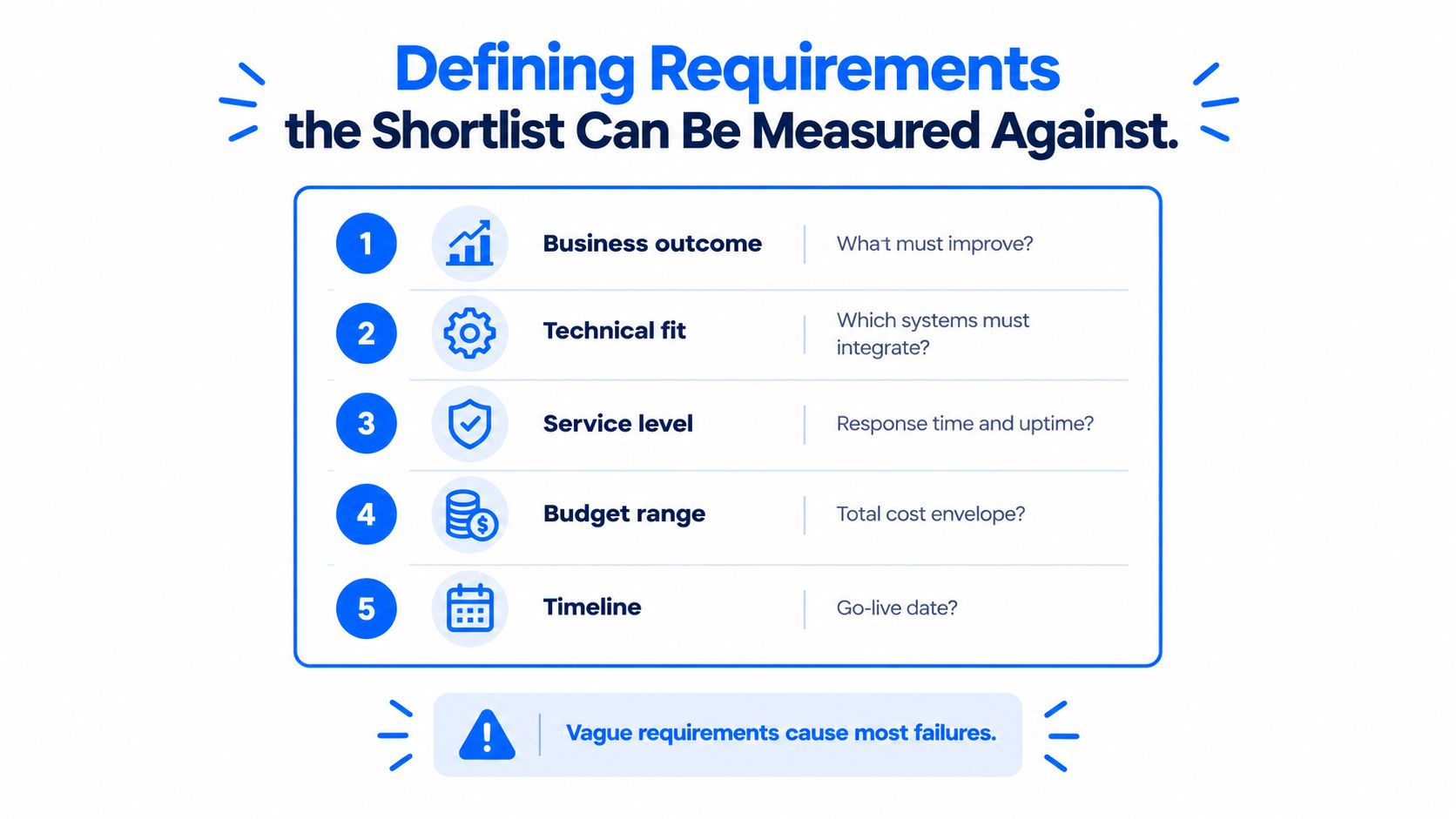
- Business outcome: What must improve, and how will the team recognize progress?
- Service scope: Which tasks, customer groups, languages, channels, and locations are included?
- Operating needs: What volumes, coverage, service levels, systems, and dependencies must the provider support?
- Risk and compliance: Which legal, security, regulatory, insurance, and continuity conditions are mandatory?
- Commercial and lifecycle terms: What are the cost boundaries, transition assumptions, change rules, and exit requirements?
A complete brief gives vendors a fair chance to respond and gives the buyer a basis for rejecting attractive but unsuitable offers.
Choosing Between an RFI, an RFP, and a Lighter Discovery Path
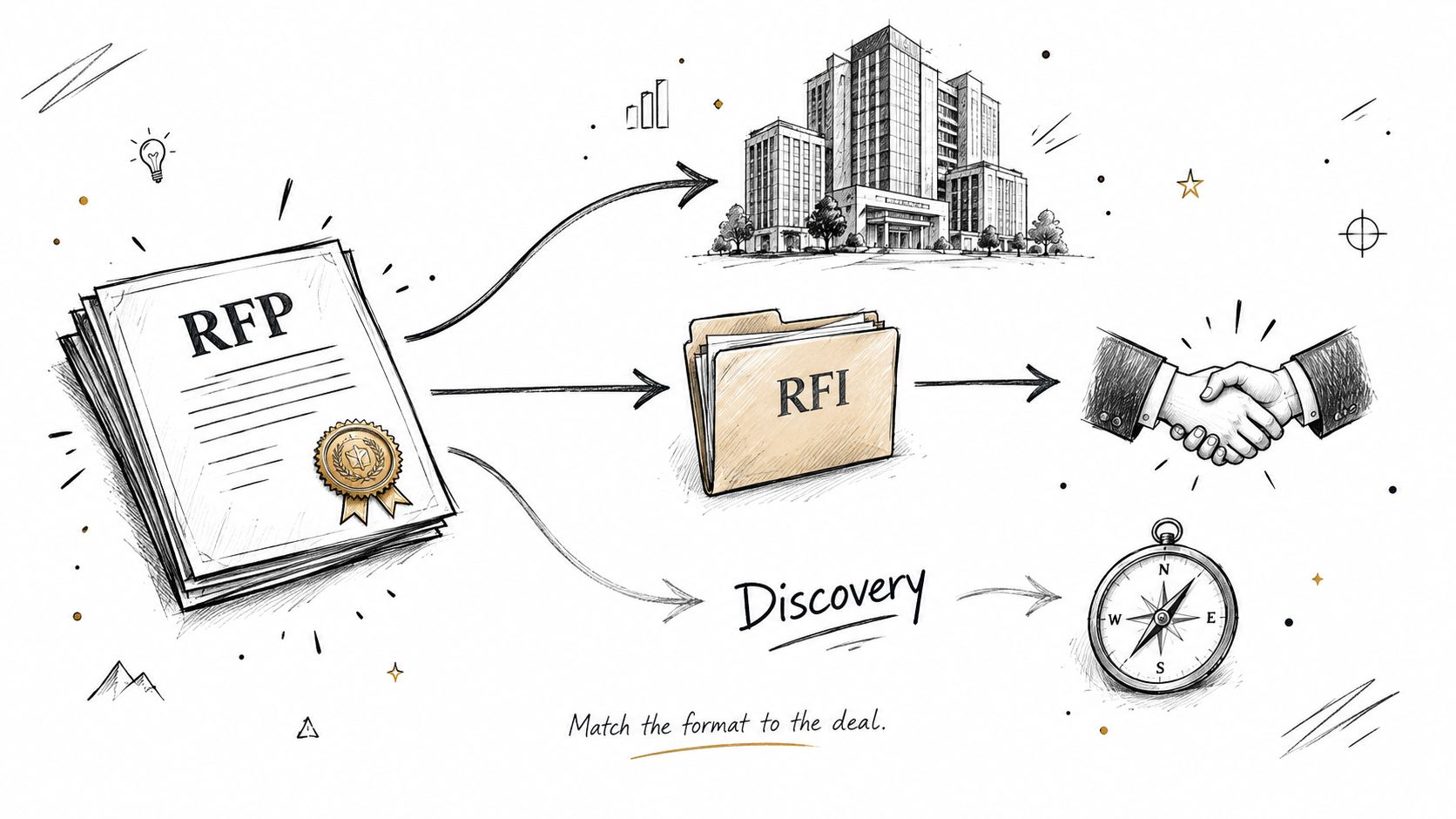
The right sourcing format depends on the deal. A formal request for proposal isn't automatically more rigorous, and a lightweight process isn't automatically careless. Choose the path that matches the complexity of the work, the buyer's ability to assess responses, and the need to maintain meaningful competition.
Pick the process that fits the decision
A request for information (RFI) is useful when the buyer needs to understand the provider market or refine an early view of the solution. Keep it focused on capabilities, operating models, geographic options, and key dependencies. An RFI can help shape the next step, but it shouldn't be mistaken for a final competitive evaluation.
A request for proposal (RFP) suits complex, high-impact programs with several stakeholders, detailed requirements, or significant continuity and compliance concerns. It gives vendors a common response structure and lets evaluators compare proposals against defined needs. It also takes time. If the team lacks the expertise to review what it asks for, a large RFP can generate impressive documents without improving the decision.
A lighter discovery path may work for a contained scope where the buyer knows what it needs, can assess providers directly, and doesn't need a lengthy formal process. Use structured conversations and a consistent question set. Keep enough competitive tension to challenge assumptions, but don't burden a modest decision with process for its own sake.
The right choice also depends on what the buyer can evaluate. If the organization can't validate security claims or compare delivery models, issuing a more elaborate questionnaire won't solve that problem. Bring in the relevant expertise or narrow the questions to evidence the team can assess.
An RFP should make it easy to compare providers, not easy to submit boilerplate. Request answers in a standardized format, ask for scenarios based on the actual service, and require vendors to describe the proposed delivery team and its responsibilities. Ask how they would handle a service spike, a delayed transition, or an unavailable delivery location. Generic corporate references can look reassuring while telling you little about the team that would do the work.
The following video offers another perspective on structuring the sourcing conversation.
Building a Weighted Scorecard That Survives Scrutiny
A scorecard only helps if it stops ineligible providers before they win on averages. Use a gate-plus-score method: first apply mandatory eligibility tests, then compare qualified vendors against weighted criteria. This separates “can this provider safely do the work?” from “which qualified provider fits best?”
A practical starting allocation is 25–35% for total cost of ownership, 20–25% for quality, 15–20% for delivery and capacity, 10–15% for financial and operational risk, and 10–15% for service, sustainability, and innovation (supplier-selection methodology). Choose exact weights that match the service, and document why.
Apply gates before scoring
Set pass-or-fail requirements for legal compliance, required certifications, minimum delivery capacity, financial viability, security controls, and insurance. A vendor that fails a genuine gate should not remain in the running because it scored well on price or presentation.
For qualified bidders, define an anchored rating scale. On a 1–5 scale, for example, a low rating might mean the proposal provides no evidence for a requirement, while a high rating means it provides specific, verifiable evidence that meets or exceeds it. Make the anchors explicit for every criterion. Otherwise, one evaluator's “good” is another's “excellent.”
Here is a simplified illustration. Ratings are hypothetical examples, not findings about actual vendors. The weighted contribution is the weight multiplied by the rating; totals use a common 1–5 rating scale.
Sample Weighted Scorecard for Two BPO Bidders
| Criterion | Weight | Vendor A rating | Vendor B rating |
|---|---|---|---|
| Total cost of ownership | 30% | 5 | 3 |
| Quality | 25% | 3 | 5 |
| Delivery and capacity | 18% | 3 | 4 |
| Financial and operational risk | 12% | 3 | 4 |
| Service, sustainability, and innovation | 15% | 3 | 4 |
| Weighted total | 100% | 3.66 | 4.00 |
The table doesn't make Vendor B the right choice by itself. It shows how a structured comparison can make the trade-off visible: Vendor A rates higher on cost, while Vendor B performs better in several other areas. To see whether the ranking holds up, raise the cost weight and lower another high-impact weight, then recalculate. If a modest change reverses the result, the team has a fragile decision and should examine its assumptions rather than hide them.
Keep an audit trail with the requirements, scoring anchors, evidence sources, evaluator identities, conflict-of-interest declarations, and approval rationale. When evaluating a technical-services provider, keep the capability criteria tied to the actual scope rather than a generic market list, such as the one used to identify software development outsourcing companies.
Running Due Diligence That Actually Reveals Risk
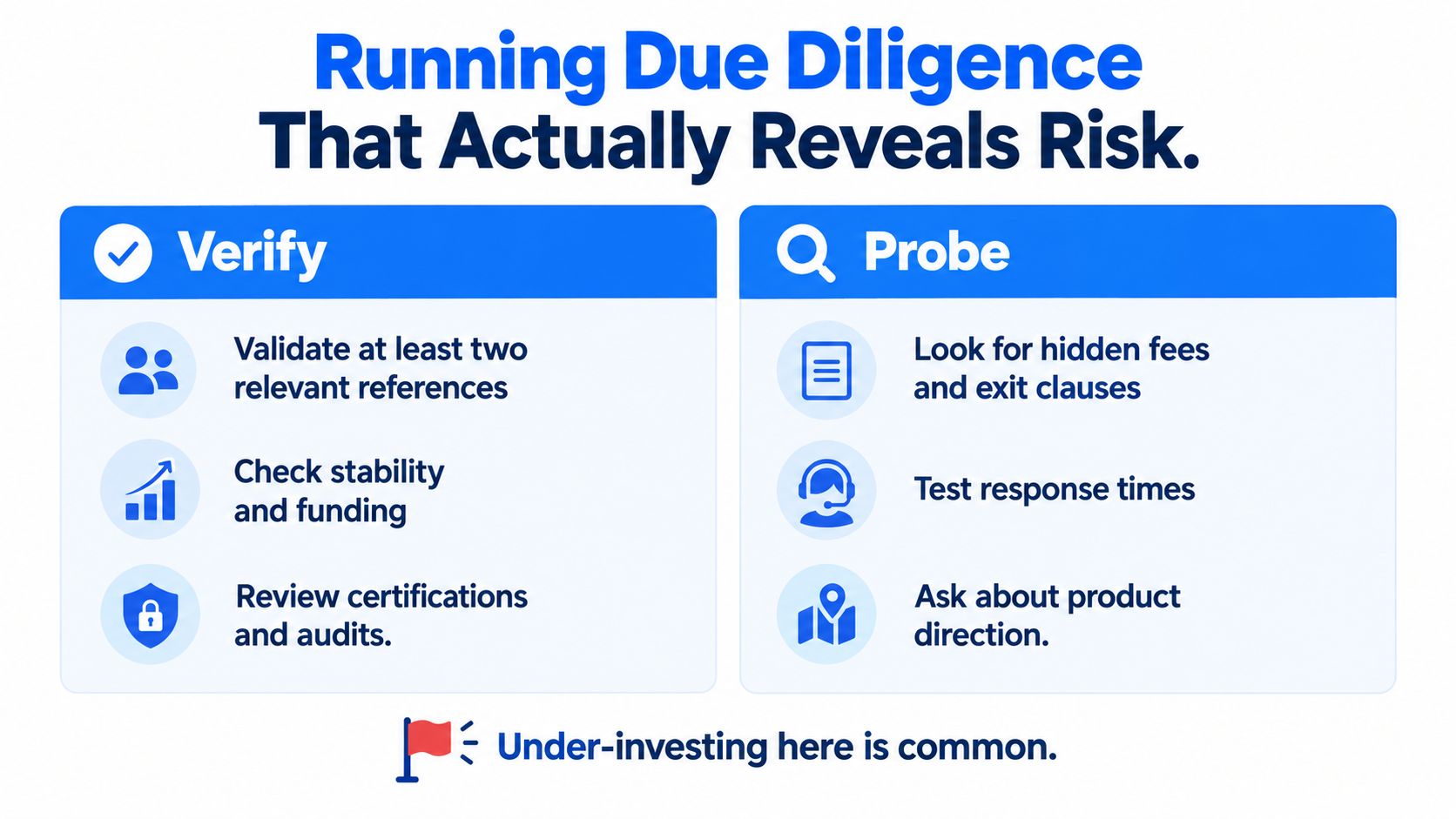
A proposal score tells you which vendor made the strongest case. Due diligence tests whether that case holds up. Buyers often under-invest here, then discover after award that references don't match the proposed delivery team, capacity claims were optimistic, or the provider relies on a fragile network of subcontractors and platforms.
Verify the claims behind the score
Validate at least two relevant customer references whose scope and complexity resemble the planned service. Ask what the vendor delivered, what required escalation, how the proposed team performed, and whether the client would use that team again. Confirm certifications directly with the issuing bodies. Review two years of financial information where available, and ask the provider to explain any risks that could affect service continuity (supplier-selection methodology).
Don't treat a polished presentation as proof of capacity. Test operational claims through demonstrations, security evidence, delivery-center visits where appropriate, and a controlled pilot. Use the pilot to observe real handoffs, reporting, escalation, and recovery behavior, not just to confirm that a vendor can run a rehearsed demo.
Look past the contracted provider
The vendor named on the contract may depend on subcontractors, cloud platforms, telecommunications, labor markets, and specific delivery regions. Ask for a dependency map showing which parties and locations support critical service components. Validate subcontractor disclosure and find out whether the provider can shift work if a key partner, facility, platform, or country becomes unavailable.
Concentration matters even when the provider passes compliance checks. A business can appear to have a capable vendor while depending on a narrow ecosystem that leaves little room to recover. Third-party-risk research reports that 56% of companies work with more than 100 vendors, with an average of 286 vendors per organization in 2025, compared with 237 in 2024. The same research reports that 74% of chief procurement officers identified active alternative sources as the most effective mitigation strategy (third-party risk research). For a buyer, the practical lesson is to test whether alternatives can take over, not merely whether they exist on paper.
A useful investigation checklist includes:
- References and team: Confirm comparable work and speak to clients familiar with the proposed delivery team.
- Security and compliance: Verify certifications and review the evidence relevant to the service.
- Financial and operational capacity: Assess financial information where available and test staffing, facilities, and technology assumptions.
- Fourth-party dependencies: Map subcontractors, platforms, locations, and other critical service dependencies.
- Continuity and exit: Require measurable recovery, transition, and service-continuity obligations.
If the service spans multiple markets or business functions, evaluate the provider in the context of the broader outsourcing business services landscape. Unclear subcontractor disclosure, a single critical location, or evasive answers about recovery should trigger deeper investigation, not a faster signature.
Negotiating Price, Scope, and Exit Without Losing the Deal
The lowest headline bid can become the most expensive contract. Buyers often compare recurring rates while leaving transition work, change orders, volume assumptions, service exclusions, and exit costs unresolved. Negotiate the full operating model, not just the number that looks good in a proposal.
Start by normalizing offers to a total cost of ownership view. Confirm what each price includes, what triggers additional charges, how volumes or scope changes affect the bill, and who pays for transition activities. A cheaper offer may depend on assumptions that don't match the buyer's actual operating needs. If those assumptions remain hidden until delivery, the buyer loses ground at the moment the cost matters most.
The commercial offer is only as strong as the service obligations and exit rights that sit beside it.
Put operating promises into the contract
Translate important vendor commitments into observable measures. Depending on the service, those may include service availability, response and resolution times, quality scores, forecast accuracy, staffing coverage, and corrective-action closure. Define how each measure is calculated, which evidence is used, how often it is reviewed, and what happens when performance falls short.
A buyer should also negotiate governance and escalation rights, data ownership and access, business continuity responsibilities, change control, and termination assistance. Don't accept a general promise to cooperate at exit. Specify what information and transition support the provider must supply, how the buyer can retrieve its data, and how service continuity will be maintained during a transfer.
Commercial structures should reinforce the outcome the buyer needs. Gain-share can reward agreed improvements when the provider can influence them. Risk-share can tie part of the commercial arrangement to delivery performance. Ramp pricing can reflect how a new operation may need time to reach steady-state delivery. None of these structures fixes vague measures; define the baseline and calculation method before signing.
Negotiation isn't about squeezing every provider until the relationship starts in conflict. It is about making obligations, assumptions, and remedies clear while both sides still have a choice. If a vendor resists a reasonable continuity obligation or won't explain a material cost condition, treat that response as evidence about fit.
Locking the Decision In With a Pre-Signature Checklist and Governance Loop
Before signing, confirm that the scope and service expectations are approved, the scorecard and decision rationale are documented, due diligence is complete, and the contract covers measurable KPIs, governance, continuity, data ownership, transition, and exit. Make sure the people who will own the relationship have reviewed the commitments they must manage.
After award, compare actual delivery with the original scorecard at 30, 90, and 180 days. Record gaps, corrective actions, and lessons in a reusable sourcing playbook. That feedback makes the next decision better informed, whether the team is selecting a new technology partner or comparing customer support centers.
This week, draft the requirements on one page, create a weighted scorecard, and prepare three reference-call questions. Treat provider selection with the care you'd give a senior hire: the decision will shape customer experience, risk exposure, and operating cost long after procurement closes the file.
AnyBPO offers AI-driven partner discovery, provider matching, and structured vetting for BPO and technology services. If you're weighing providers and want a curated shortlist matched to your scope, locations, and operating needs, visit AnyBPO.