
A BPO call center is an outside company that runs customer-contact operations for another business, and it's governed by service-level agreements rather than just hourly staffing. If you're hearing the term while trying to sort out customer support, the key question is how that outsourced operation handles a live customer moment, and what changes once you hand that work to a provider.
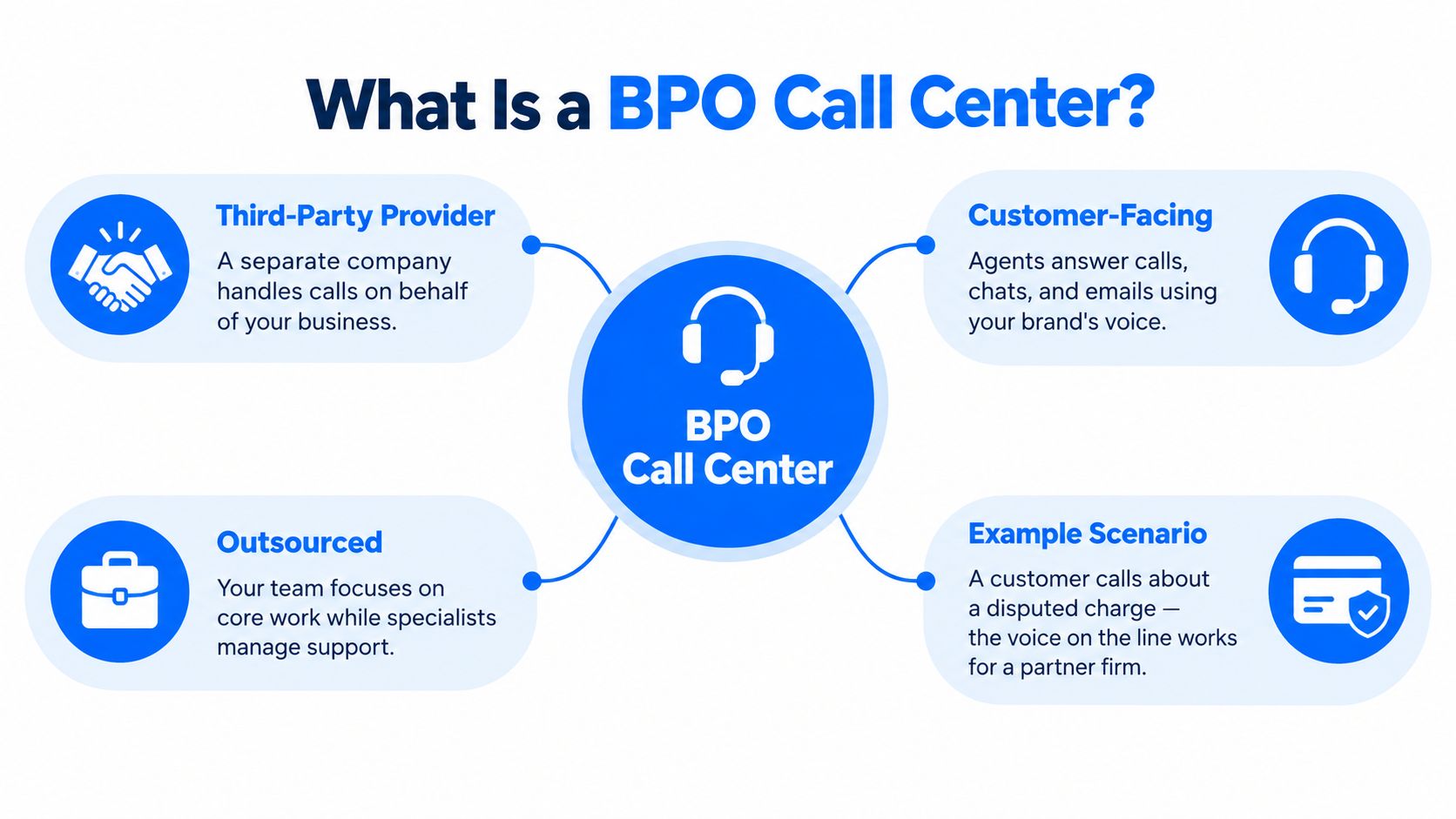
A customer calls a bank about a disputed charge. The voice on the line may sound like the bank, but the person answering could be working for a third-party provider, following the bank's scripts, systems, escalation rules, and reporting requirements. That's the simplest way to understand the model before looking at the mechanics, the economics, the AI shift, and the risks buyers need to control.
Table of Contents
- A Plain-English Definition of a BPO Call Center
- How Call Center Work Became an Outsourced Industry
- Core Service Models and Delivery Locations
- BPO Call Center vs In-House Contact Center
- The Operating Economics Behind Every BPO Call Center
- Where AI Changes What a BPO Call Center Actually Does
- Risk, Data, and Governance in Outsourced Call Centers
- A Short Buyer Checklist for Evaluating a BPO Call Center
A Plain-English Definition of a BPO Call Center
A customer has a problem, dials the number on the back of a card, and reaches an agent who seems to work for the brand they trust. Behind the scenes, that agent may be employed by a business process outsourcing provider that handles the interaction under contract, not by the client company itself. That is the core of what is a BPO call center, and it is more specific than "a call center that isn't in the building."
A BPO call center is an outside company that handles customer-contact work on behalf of another business under agreed service levels.
That definition matters because the client is buying an operating outcome, not just a person answering the phone. The provider supplies agents, telephony systems, quality controls, reporting, and the workforce management discipline needed to keep service levels on track. The client still owns the customer promise, the brand, and the business rulebook.
What the model includes
A BPO call center commonly handles inbound customer service, technical support, billing inquiries, reservations, sales, collections, and outbound notifications. The work may sit entirely with one provider, or the client and provider may share systems and management responsibilities. In either case, the point is the same, customer-facing work is executed by a specialist operating unit outside the client's walls.
That setup is different from temporary staffing. The provider is not just renting labor. It is taking responsibility for how the interaction is answered, measured, escalated, and reported.
For a plain example, a bank can keep the customer experience consistent while a provider manages the queue, trains the agents, and follows the bank's scripts and escalation rules. The caller hears one brand. The operating work sits somewhere else. The academic history of call centers shows how that split became normal as telephone work turned into a more structured service function.
How Call Center Work Became an Outsourced Industry
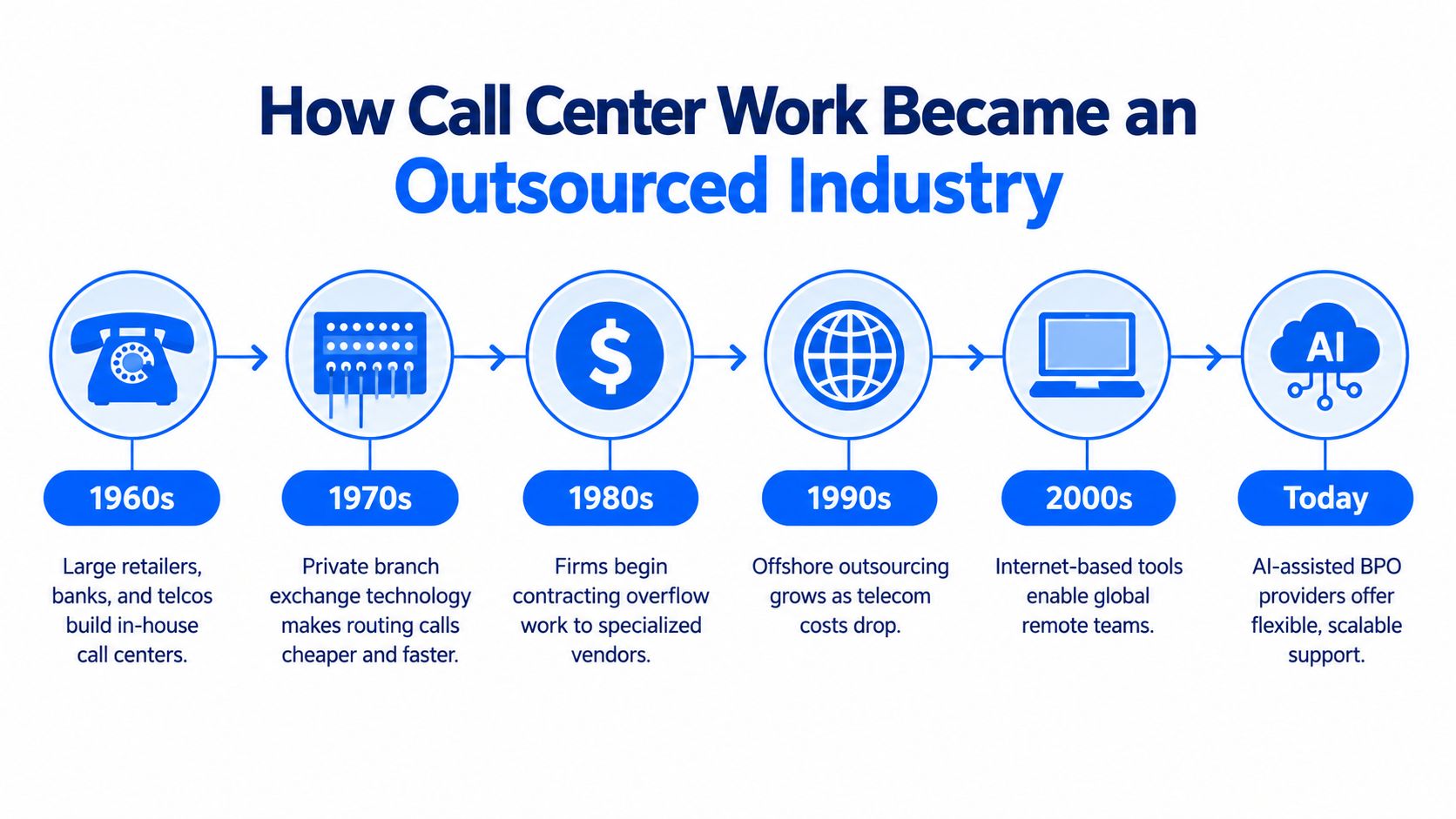
A customer calls for help, an agent answers, the issue gets logged, and a supervisor checks whether the interaction followed the right script and service standard. Once that pattern became repeatable, companies saw that customer-contact work could be treated as an operating function instead of an ad hoc support task. Large retailers, banks, polling organizations, data-management companies, and telecommunications firms built dedicated call units during the 1960s and 1970s, and those internal teams developed the scripts, quality checks, and staffing routines that later made outsourcing possible. a history of call-center labor in the late twentieth century
From internal department to specialist provider
The first version of the work stayed inside the company. A utility or bank staffed a telephone team, watched call volume, and refined the process through repetition. Over time, leaders learned that the key asset was not the room full of phones, but the know-how behind it. Once a team could manage queues, train agents, record calls, and report service quality, that operating knowledge could be separated from ownership of the customer-facing brand.
By the end of the twentieth century, call centers had become a routine channel for utilities, healthcare providers, transportation companies, social-service agencies, travel businesses, and sales organizations. The structure had matured enough that it could be packaged as a service. That is why a BPO call center is best understood as a managed operating model, not just a cheaper room full of headsets.
Why the outsourced version stuck
The outsourced model took hold because it gave clients access to specialized staffing, extended hours, multilingual coverage, and standardized service processes without building the whole operation in-house. Providers also learned to manage the work through formal agreements, reporting, and performance controls, which made the arrangement easier to buy and govern.
A useful way to frame it is through the broader outsourcing choices companies make across different business functions. AnyBPO's outsourcing business services page shows how customer-contact work sits inside a wider operating system, where the buyer decides what to keep close to the brand and what to hand to a specialist.
A BPO call center is a managed service designed to produce measurable customer and revenue outcomes.
Core Service Models and Delivery Locations
A BPO call center usually starts with the interaction type, then adds location as the second decision. The service lines are straightforward: inbound customer service, technical support, billing inquiries, reservations, sales, collections, and outbound notifications. The location model determines how much the work costs, how close the team is to the client, and how easy it is to manage language, time zones, and regulation.
Service lines buyers usually see
Inbound work is customer-led. Someone calls with a question, a complaint, or a problem that needs help. Outbound work is company-led. The provider places calls for sales follow-up, appointment reminders, collections, or account notifications. Many BPO contracts include both, but the operational design changes depending on whether the work is reactive or proactive.
Delivery locations and where each fits
Onshore means the provider operates in the client's own country. That usually fits regulated or culture-sensitive work where proximity and oversight matter. Nearshore usually means a nearby country with a similar time zone, which helps with live collaboration and language coverage. Offshore places the operation farther away, often to support cost-sensitive routine work and broad coverage windows. Captive means the client owns and runs the center directly, even if it may sit in another country.
| Model | Typical Strength | Common Trade-off |
|---|---|---|
| Onshore | Strong proximity, easier oversight, familiar regulatory context | Usually higher cost |
| Nearshore | Good time-zone alignment and collaboration | Smaller labor pool than offshore |
| Offshore | Broader coverage and stronger cost advantages for routine work | More coordination effort across distance |
| Captive | Maximum direct control over process and culture | Client carries the operating burden |
A practical way to read vendor proposals is to ask what mix of these models they're offering, and why. A support line for a regulated business may need onshore escalation handling. A routine after-hours queue may fit offshore delivery better. The right answer depends on the sensitivity of the work, the languages involved, and how much control the buyer wants to retain.
BPO Call Center vs In-House Contact Center
The comparison most buyers are really making is simple, should we own the contact center ourselves, or should we outsource it? The answer isn't universal. It depends on how much volatility the team has to absorb, how tightly the work must be controlled, and how specialized the interaction has become.
Cost, scalability, control, and expertise
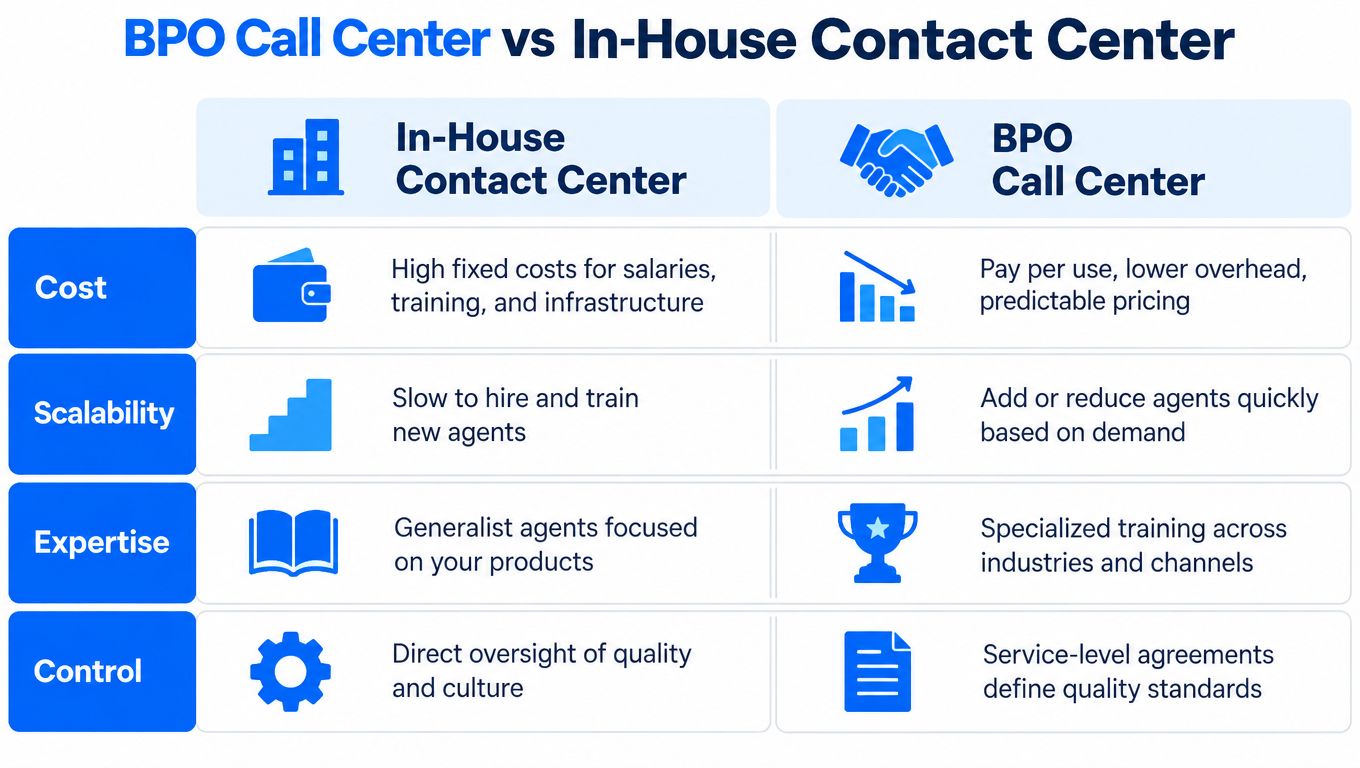
An in-house contact center gives you direct oversight of people, culture, and process. That can be important when the customer conversation is tied closely to product changes, brand risk, or complex internal knowledge. The trade-off is that the client carries the recruiting, training, workspace, systems, and management load.
A BPO call center shifts much of that operational burden to the provider. It can be more flexible when demand swings, when the company is entering a new market, or when the work needs multilingual coverage and specialized staffing. The trade-off is that governance becomes more important, because the client is no longer directing every person and every process minute by minute. For teams focused on customer support specifically, AnyBPO's customer support centers resource is a useful way to think about the category.
Which model tends to fit which situation
An in-house team often fits when the client wants very tight control over customer voice, product knowledge, or sensitive workflows. A BPO model often fits when speed, coverage, and scale matter more than ownership of every operational detail. Many mature companies use a hybrid approach, keeping the most delicate escalations close while outsourcing repetitive volume.
The better question isn't “Which model is cheaper?” It's “Which model gives us the most reliable customer outcome at the real volume we expect?”
The Operating Economics Behind Every BPO Call Center
A BPO call center runs on capacity planning and queue management. Calls do not arrive in a smooth line, they spike and dip, so staffing has to follow demand closely while the provider still holds service quality inside the contract terms. That is why the economics cannot be reduced to a simple labor rate.
The metrics that steer the operation
The main measures are service level, occupancy, average speed of answer, average handle time, abandonment, first-contact resolution, repeat contacts, quality scores, and customer satisfaction. Service level shows the share of calls answered within a target interval. Occupancy shows how much of agent time is spent on live interactions. The link between the two is straightforward, understaffing pushes up wait time, abandonment, and service-level misses, while overstaffing protects response time but raises idle labor cost (GAO findings on staffing and wait times).
Why one metric can mislead you
A lower per-minute price can look attractive, but it may be the more expensive choice if forecasting is weak or resolution quality slips. In that case, customers call back, agents transfer more often, and extra work shows up downstream. A contract should measure the whole system, not one line item.
Practical rule: a lower price only wins if the provider keeps resolution quality high enough that total cost to serve stays under control.
The same GAO analysis found that outsourced call-center contracts can produce very different service levels and average handle times depending on whether the commercial model is pay-per-time or pay-per-call. That matters because contract design shapes behavior. If you want better outcomes, the SLA has to line up staffing, quality checks, and escalation rules with the customer journeys in scope.
Where AI Changes What a BPO Call Center Actually Does
AI is changing BPO call centers, but not in the simplistic way many people assume. It doesn't just make the work cheaper. It changes which contacts stay routine and which ones land with human agents, and that often makes the remaining human work more complex.
Automation-led BPO is not the same as labor-arbitrage BPO
Recent global research found that 98% of surveyed contact centers had adopted AI in some form, yet 61% of leaders said customer conversations had become more difficult because AI is poorly suited to complex or emotionally charged interactions. The same study found that 64% of organizations did not provide emotional-intelligence or social-interaction training, while 59% lacked ongoing coaching for AI-enabled workflows (Calabrio research via Business Wire).
Those numbers point to a real operational shift. AI takes over routine volume, but the humans left behind are handling edge cases, escalations, and emotional interactions that need better judgment, not less. Buyers should therefore ask whether a provider can combine automation with coaching, not just a chatbot with a cheaper headcount.
What buyers should measure now
The most useful questions are different from the old ones. Ask about escalation quality, human takeover speed, agent judgment, coaching coverage, and customer outcomes. Those measures tell you whether the provider is managing handoffs well, or just pushing work around to make the dashboard look cleaner.
Inside an AI-enabled operation, quality assurance also has to evolve. AnyBPO's automated quality assurance page is relevant here because it reflects the larger point, quality programs now need to see both the human interaction and the automation layer that supports it.
Risk, Data, and Governance in Outsourced Call Centers
The least discussed part of a BPO call center is the risk surface it creates. Even when service levels are met, the client may still be exposing customer, payment, health, or employee data to a third-party workforce across jurisdictions. That makes governance a core buying criterion, not an afterthought.
What serious buyers need to control
The governance checklist should include least-privilege access, device and recording controls, background screening, subcontractor disclosure, data residency, breach notification, independent audits, business continuity, and exit or repatriation plans. Those controls matter because a provider can't just be good at answering calls, it also has to be able to prove how it protects information and how it handles exceptions.
A useful way to think about this is shared accountability. The provider operates the agents and the technology, but the client remains accountable for the customer outcome and for oversight of the vendor relationship. Offshore delivery is not automatically insecure, and onshore delivery is not automatically safe. Risk depends on controls, jurisdiction, process sensitivity, and evidence.
Why this matters in real life
Recent market reporting described a 2025 incident in which employees of a U.S. BPO firm allegedly accessed Coinbase customer data without authorization, and Coinbase estimated remediation costs of $180 million to $400 million. That figure came from industry reporting rather than a regulator, but it shows why buyers need to examine access design and fourth-party risk as carefully as staffing plans (SNS Insider market reporting).
If the work touches regulated data, ask for the documents, not the pitch deck. You want proof of process, not just confidence in the brand.
A Short Buyer Checklist for Evaluating a BPO Call Center
A useful evaluation starts with four decisions. First, define the exact customer journeys to outsource. Second, choose the right delivery model for those journeys. Third, lock down the KPIs and SLAs that will govern the work. Fourth, decide which controls will protect data, continuity, and accountability.
Questions to ask before you sign
- Scope clarity: Which interactions are in scope, and which ones stay inside the client team?
- Measurement design: How will the provider report service level, abandonment, first-contact resolution, quality, and customer satisfaction?
- Operational proof: Can the provider connect workforce forecasts, call-recording data, QA results, and SLA reporting in one auditable control system?
- Risk controls: How are access rights, recordings, subcontractors, and business continuity managed?
A good provider should be able to answer those questions without hiding behind jargon. If the answers stay vague, the operating model probably isn't ready for a serious contract.
The client still owns the customer experience, even when the provider runs the agents and the systems.
If you're comparing outsourcing partners, AnyBPO can help you define scope, evaluate provider fit, and structure the operating questions before you commit. Visit AnyBPO to explore partner discovery, advisory support, and vendor evaluation for customer-care outsourcing and related BPO programs.